
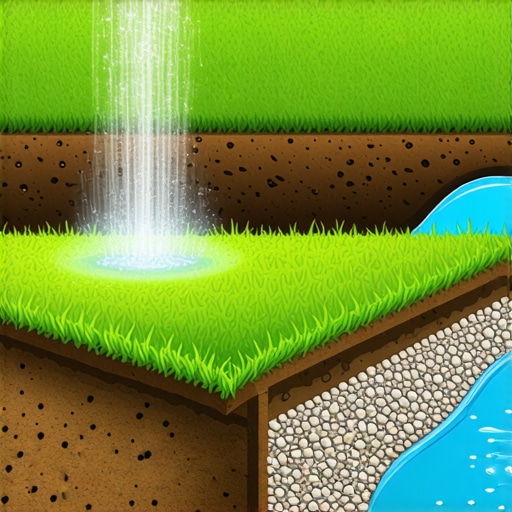
The Anatomy of a Backyard Swamp and Why Your Foundation Is at Risk
Backyard ponding near your foundation is caused by negative grading, soil compaction, or inadequate drainage systems that allow hydrostatic pressure to build against your footers. Fixing this requires establishing a 1/4-inch-per-foot pitch away from the house and installing mechanical diversion systems like French drains or catch basins to redirect subsurface and surface water flow.
I recently got called out to tear up a $30,000 patio that was sinking because the previous contractor ignored the most basic rule of civil engineering: water always wins. The homeowner had two inches of standing water against their foundation every time it rained. The ‘pro’ they hired just threw down some sand and pavers. Within two years, the subgrade had turned into a slurry, the patio was a hazard, and the basement had a vertical crack the size of a finger. It was a $30,000 autopsy on a project that failed because nobody bothered to look at the soil’s hydraulic conductivity. You don’t just ‘landscaping’ your way out of a drainage problem. You engineer your way out. If you see water sitting within five feet of your house for more than 24 hours after a storm, your home is literally being undermined. It will rot. It will settle. It will cost you six figures in structural repairs if you don’t act.
“A retaining wall doesn’t fail because of the stone; it fails because of the water trapped behind it.” – Hardscape Engineering Axiom
1. Implementing Subsurface French Drains with Rigid Pipe
French drains are the gold standard for managing groundwater, but most people install them incorrectly by using cheap, corrugated black tubing. For a foundation-critical install, you need Schedule 40 PVC with 1/2-inch perforations. The trench must be dug at a minimum depth of 18 inches, lined with non-woven geotextile fabric to prevent siltation. We use #57 washed stone—no fines allowed—to create the necessary pore space for water to migrate into the pipe. The physics is simple: water follows the path of least resistance. By creating a gravel-filled void, you relieve the hydrostatic pressure pressing against your concrete blocks. Check the pitch with a laser level. Don’t eyeball it. If you have zero-slope, you’re just building a long, expensive underground pond.
How much modified gravel do I need for a patio base or drainage trench?
Calculating aggregate needs is a matter of volume: multiply the length by the width by the depth (in feet), then divide by 27 to get cubic yards. For a standard 12-inch wide by 18-inch deep French drain, you’ll need approximately 1.5 tons of #57 stone per 100 linear feet. Do not use ‘crusher run’ or anything with stone dust, or your drainage system will clog within three seasons. Compaction is king, but the stone itself must remain open-graded to allow water flow.
| Material Type | Water Flow Rate (GPM) | Longevity (Years) | Structural Integrity |
|---|---|---|---|
| Corrugated Pipe | Low (due to ridges) | 5-10 | Flimsy; prone to crushing |
| Smooth-Wall PVC | High (low friction) | 50+ | High; handles soil weight |
| Open-Graded Stone | Excellent | Infinite | Non-compactible void space |
2. Surface Water Management: Catch Basins and Downspout Diversion
Surface ponding is often a result of ‘point source’ water—specifically, your roof. A single inch of rain on a 2,000-square-foot roof produces 1,250 gallons of water. If your downspouts are dumping next to the foundation, you are asking for a disaster. A proper irrigation and drainage strategy involves hard-piping those downspouts at least 10 to 15 feet away from the structure. We use 12-inch by 12-inch catch basins at low spots in the yard to collect surface runoff before it can saturate the soil. This is where a yard cleanup becomes technical; you must clear out organic debris that clogs these grates. If the grate is covered in mulched leaves, the water just bypasses the drain and heads for your basement.
3. Soil Grading and Professional Sod Install
Once the mechanical systems are in, the final defense is the soil itself. You need a positive grade—a 5% slope away from the house for the first ten feet. This often requires a sod install after significant earthmoving. When we do a sod install for drainage, we don’t just lay grass. We amend the soil with coarse sand and organic matter to break up heavy clay. Heavy clay is essentially waterproof; it has no infiltration rate. By tilling in amendments, we increase the soil’s ability to absorb water. Then, we lay high-quality turf that acts as a living filter. The root systems of the grass help stabilize the slope so your new grade doesn’t wash away in the first thunderstorm. Don’t skip the rolling phase. A heavy water-filled roller ensures the sod has 100% contact with the soil, preventing air pockets that lead to localized ‘spongy’ spots.
“Soil compaction reduces the pore space between soil particles, which significantly limits the infiltration of water and the movement of oxygen to plant roots.” – Penn State Extension, Agronomy Manual
How do I fix a yard that is already saturated?
You cannot effectively grade or install sod on mud. You must first perform a yard cleanup to remove dead biomass, then use core aeration to open up the soil profile. If the saturation is chronic, you may need a sump pump discharge line integrated into your exterior drainage. In heavy clay regions, we often install a ‘dry well’—a large underground plastic cistern wrapped in fabric—to hold excess water until it can slowly percolate back into the water table. This prevents the ‘ponding’ effect by giving the water a place to go immediately.
- Step 1: Locate all utility lines (Call 811) before digging.
- Step 2: Identify the ‘lowest exit point’ on your property for water discharge.
- Step 3: Excavate the trench at a minimum 2% grade.
- Step 4: Install rigid PVC and backfill with washed aggregate.
- Step 5: Replace topsoil and execute a professional sod install to stabilize the surface.
Landscaping is more than just aesthetics; it is the first line of defense for your most valuable asset. Stop buying bags of mulch and start looking at your elevations. If you ignore the water, the water will eventually find its way into your living room. Do it right the first time, or pay someone like me to tear it all out and fix it later. The choice is yours, but the physics of water won’t wait for you to decide.