
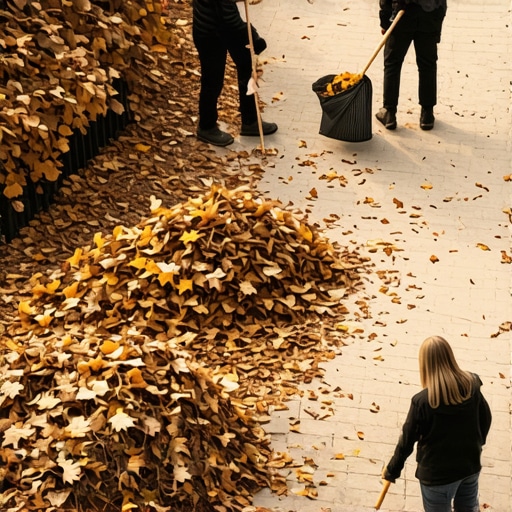
Why You Should Never Bag Your Leaves This Fall
Most homeowners view fallen leaves as a nuisance, a layer of debris that needs to be suffocated in plastic bags and hauled to a landfill. This is a fundamental misunderstanding of soil biology. You are literally throwing away the high-octane fuel your turf needs to survive the winter. As a landscaper who has spent two decades rehabilitating dead soil, I see this every year. People pay me thousands for yard cleanup services only to request that I remove the very nutrients they would otherwise buy in a bag of synthetic fertilizer. It is an engineering failure at the residential level.
The Nutrient Theft: Why Bagging Leaves Is a Bio-Chemical Mistake
Bagging leaves removes critical organic matter, nitrogen, and phosphorus from your ecosystem, forcing you to rely on synthetic inputs that degrade soil structure over time. Instead of acting as a waste product, mulched leaves serve as a biological buffer that regulates soil temperature and provides a slow-release carbon source for beneficial microbes and earthworms. This process is essential for long-term turf health.
I remember a homeowner in late October who called me in a panic after they completely torched their front lawn by applying a heavy dose of high-nitrogen weed-and-feed on top of a lawn they had meticulously raked clean. They thought they were being proactive. In reality, they had stripped the soil of its natural carbon buffer and then applied a chemical salt that dehydrated the root zones of their fescue. The lawn looked like it had been hit with a blowtorch. If they had simply mulched their oak leaves into the turf, the organic carbon would have buffered those salts and provided a natural, slow-release nitrogen source that wouldn’t have burned the grass. It was a $5,000 mistake that required a full sod install the following spring. Don’t be that guy.
“Leaf litter represents a massive reservoir of nutrients; as much as 50 to 80 percent of the nutrients trees take up during the year are found in the foliage.” – Michigan State University Extension
The Forensic Autopsy of Soil Sterility
When you bag leaves, you interrupt the nitrogen cycle. Soil is not just dirt; it is a living matrix of fungal hyphae, bacteria, and endogeic earthworms. When these organisms are deprived of the cellulose and lignin found in leaf tissue, they go dormant or die. This leads to soil compaction. Compacted soil has poor hydraulic conductivity, meaning your irrigation system has to work twice as hard to get water to the roots. You end up with localized dry spots and hydrophobic soil conditions that no amount of “wetting agent” can fix. You have to feed the biology to maintain the physics of the soil.
How much nitrogen do mulched leaves actually provide?
Mulched leaves provide approximately 0.5 to 1.0 percent nitrogen by weight. While this sounds small, when you calculate the sheer mass of a mature maple or oak tree’s canopy, you are looking at several pounds of free, organic nitrogen per 1,000 square feet. This organic nitrogen is superior to synthetic urea because it does not leach into the groundwater during heavy autumn rains.
| Material Type | Carbon-to-Nitrogen (C:N) Ratio | Decomposition Speed | Benefit to Turf |
|---|---|---|---|
| Fresh Grass Clippings | 15:1 | Very Fast | Immediate Nitrogen Boost |
| Mixed Deciduous Leaves | 60:1 | Moderate | Soil Structure & Microbes |
| Pine Needles | 80:1 | Slow | Acidic Buffer/Mulch |
| Synthetic Fertilizer | N/A | Instant | High Risk of Root Burn |
Will leaf mulch cause thatch buildup in my lawn?
No. Thatch is a layer of undecomposed stems and roots, primarily caused by over-fertilizing with synthetics and over-watering. Leaf mulch, when properly shredded by a mulching mower, actually stimulates the microbes that eat thatch. It accelerates the decomposition of the organic layer, keeping your turf’s “breathing room” open. If you are planning a sod install, tilling mulched leaves into the top four inches of soil is one of the best ways to ensure the new roots take hold.
The Physics of the Mulching Blade
You can’t just leave whole leaves on the grass. That will kill it. Whole leaves create a biological seal that prevents gas exchange and blocks sunlight, leading to snow mold and crown rot. You need a high-lift mulching blade. The tip speed of a professional mower blade can exceed 18,000 feet per minute. This creates a vacuum that pulls the leaf up, shreds it into pieces smaller than a dime, and blows it down into the landscaping canopy where it can reach the soil surface. You should see about 20% of the soil surface through the leaf bits after a pass. If you can’t, go over it again. Do not skip this step. If the debris is too thick, it will rot and suffocate the turf. Precision is everything.
“A retaining wall doesn’t fail because of the stone; it fails because of the water trapped behind it.” – Hardscape Engineering Axiom
The same logic applies to your lawn. A lawn doesn’t fail because of the leaves; it fails because the homeowner doesn’t manage the transition of those leaves into the soil. We often see this when people ignore their yard cleanup responsibilities until December. By then, the leaves are wet, matted, and anaerobic. You have to mulch while they are dry. If you wait until they are a sodden mess, you are just making compost tea that will drown your grass roots.
The Fall Maintenance Checklist
- Inspect irrigation heads to ensure they aren’t buried by leaf debris; clear the spray path.
- Sharpen mower blades to a razor edge; dull blades tear the grass, making it susceptible to disease.
- Check soil pH; deciduous leaves can slightly acidify the surface, which may require a lime application.
- Call 811 before any deep aeration to mark utility lines and irrigation pipes.
- Adjust mower height to 2.5 or 3 inches to allow leaves to be trapped and shredded effectively.
The Bottom Line on Soil Health
Stop treating your property like a living room carpet. It is a biological engine. Every bag of leaves you put on the curb is a withdrawal from your soil’s bank account. Over time, that account goes into the red, and you end up with thin, yellowing turf that requires constant chemical life support. Mulch the leaves. Feed the worms. Build the soil. Your landscaping will reflect the effort. It won’t be easy, and it won’t be as fast as raking, but it will be better for the ecosystem you are supposedly trying to maintain. Real pros know that the best fertilizer is the one that’s already on the ground.
Comments are closed.