
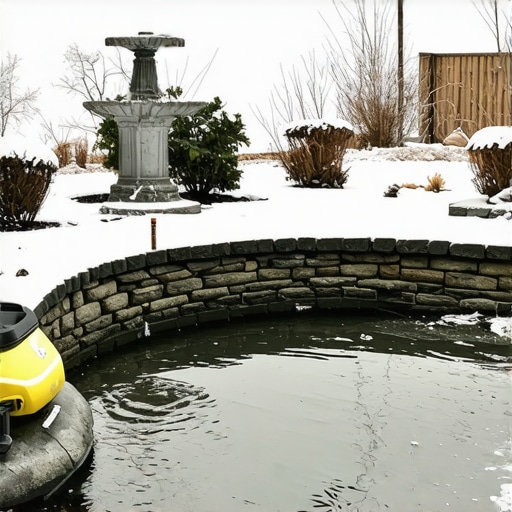
Why Frozen Water Features Fail Structurally and Biologically
Winterizing a 2026 water feature requires a de-icer or aerator to maintain a gas exchange hole in the ice, preventing toxic gas buildup and structural expansion damage. Without this opening, hydrogen sulfide and methane produced by decomposing organic matter cannot escape, leading to the rapid death of aquatic life and potential liner failure under localized pressure.
I recently got called out to tear up a $30,000 patio that was sinking because the previous contractor failed to account for hydrostatic pressure and the expansion of a neighboring water feature. The pond had frozen solid, and the expansion of the ice pushed against the retaining wall of the patio, displacing the modified gravel base and causing a total structural collapse. This was not a failure of the stone: it was a failure of physics. When water freezes, it expands by approximately 9 percent. In a confined space like a pond or a pipe, that expansion generates thousands of pounds of pressure per square inch. If you are managing an aquatic ecosystem, ignoring the freeze-thaw cycle is a recipe for an expensive autopsy. You are not just dealing with ice; you are dealing with a biological reactor that needs to breathe.
De-Icers vs. Aerators: Choosing the Right Survival Gear
Choosing between a de-icer and an aerator depends on your local climate zone, pond depth, and the biological load of your aquatic system. A de-icer is a heating element that floats on the surface, while an aerator uses a compressor to pump air to a diffuser, creating bubbles that physically break the surface tension to prevent freezing.
Many homeowners mistake a de-icer for a pond heater. They are not the same. A pond heater attempts to raise the temperature of the entire water column, which is an exercise in futility and high electric bills. A de-icer simply keeps a small hole open in the ice. This hole is your pond’s exhaust pipe. If the pond is deeper than 36 inches, the water at the bottom stays around 39 degrees Fahrenheit due to the specific gravity of water being highest at that temperature. This is where your fish enter a state of torpor. Disturbing this thermal layer with a poorly placed pump can actually super-cool the water and kill the inhabitants. This is why professional landscaping firms prioritize the science of the water column over simple aesthetics. You must avoid placing aerator stones directly on the bottom in deep zones; instead, suspend them 12 inches below the surface to maintain the thermal stratification.
“A pond doesn’t fail because of the cold; it fails because of the anaerobic gases trapped beneath the ice layer.” – Aquatic Ecosystem Management Handbook
How many watts does a pond de-icer need?
The wattage required for a pond de-icer depends on your USDA hardiness zone and the surface area of the pond. In most temperate climates, a 100 to 300-watt unit is sufficient to keep a hole open. For extreme northern climates where temperatures stay below zero for weeks, a 1500-watt unit may be necessary to overcome the thermal loss. Always use a thermostatically controlled unit to ensure it only activates when temperatures drop below 35 degrees.
Will a waterfall keep a pond from freezing?
No, a waterfall will not reliably keep a pond from freezing and can actually lead to ice dams. Ice dams can divert water out of the pond and onto the surrounding ground, leading to a dry pump and a burnt-out motor. Additionally, the constant exposure of falling water to sub-zero air causes rapid evaporative cooling, which can drop the pond’s internal temperature much faster than a still pond would. This is why we recommend shutting down waterfalls and irrigation lines well before the first hard freeze.
The Critical Role of Yard Cleanup in Winterization
Proper yard cleanup before the first freeze is the most effective way to reduce the biological load that produces toxic gases under the ice. Removing fallen leaves, decaying lily pads, and excess sludge from the pond floor significantly reduces the amount of methane and ammonia generated during the winter months.
If you skip the yard cleanup, you are essentially leaving a ticking time bomb in your pond. Organic debris decomposes via aerobic bacteria as long as oxygen is present. Once the ice seals the surface, the oxygen is quickly depleted, and anaerobic bacteria take over. These bacteria produce hydrogen sulfide as a byproduct, which is lethal to fish in very low concentrations. This is why we often see fish kills in the spring after the ice melts: it wasn’t the cold that killed them, but the gas. This same principle applies to your lawn. Leaving heavy leaf mats on top of a new sod install will smother the grass and create a breeding ground for snow mold. Precision in maintenance is non-negotiable.
| Feature | Purpose | Energy Use | Best For |
|---|---|---|---|
| Floating De-Icer | Gas Exchange Hole | High (100-1500W) | Heavy Ice Areas |
| Pond Aerator | Oxygenation/Movement | Low (15-50W) | Deeper Ponds |
| Submersible Pump | Water Circulation | Medium | Mild Climates |
| Pond Netting | Debris Prevention | Zero | All Ponds |
Hardscape Engineering and Hydrostatic Pressure
Hardscape engineering must account for the expansion of water in both liquid and solid states to prevent heaving and cracking. Proper drainage behind retaining walls and under pavers is the only way to mitigate the damage caused by the freeze-thaw cycle in 2026 and beyond.
“Hydrostatic pressure is the primary cause of retaining wall failure, especially in clay-heavy soils where water retention is high.” – Hardscape Engineering Axiom
When we design a water feature near a patio or walkway, we install a minimum of 6 to 12 inches of compacted modified gravel (2A or 3/4-inch clean stone) to allow water to drain away from the structure. If the soil is heavy clay, we also install a French drain system to carry excess water to a lower point on the property. Without this, the water stays trapped, freezes, and heaves the stone. It will rot the integrity of your investment. Do not skip the drainage. I have seen countless DIY jobs fail because the homeowner thought they could save money on the base. They ended up paying me double to fix it two years later. Engineering is about managing the movement of energy and matter; water is the most aggressive form of both in the landscape.
- Inspect the pond liner for any small leaks that could lead to ice heaving behind the structure.
- Clean out all skimmer baskets and pump intakes to ensure zero blockage.
- Drain all irrigation systems and blow out the lines with an air compressor to prevent pipe bursts.
- Apply a late-season fertilizer to your sod install to encourage root growth before dormancy.
- Test the thermostat on your de-icer by placing it in a bucket of ice water before deployment.
The Technical Setup for 2026 Water Features
The technical setup for winterizing involves a combination of mechanical filtration, thermal management, and chemical balancing. Use a cold-water bacterial additive to help break down organic matter when the water temperature drops below 50 degrees Fahrenheit, as standard pond bacteria become dormant at these temperatures.
When you install your de-icer, do not just toss it in. Secure it with a tether so it stays near the edge where you can monitor it. If you are using an aerator, place the diffuser on a shelf rather than the deepest part of the pond. This prevents the cold air from being pumped into the warmest part of the water. This is basic thermal dynamics. The density of water changes at 39.2 degrees. Below that, it becomes lighter and stays at the surface as ice. Above that, it is heavier and sinks. By keeping the bottom of the pond undisturbed, you create a safe zone for your aquatic life. This is the difference between a professional installation and a backyard hack job. We don’t guess: we measure. We don’t hope: we engineer. Your 2026 winterization protocol is the only thing standing between a beautiful aquatic ecosystem and a stinking pit of dead fish and cracked stone in the spring. Plan accordingly.