
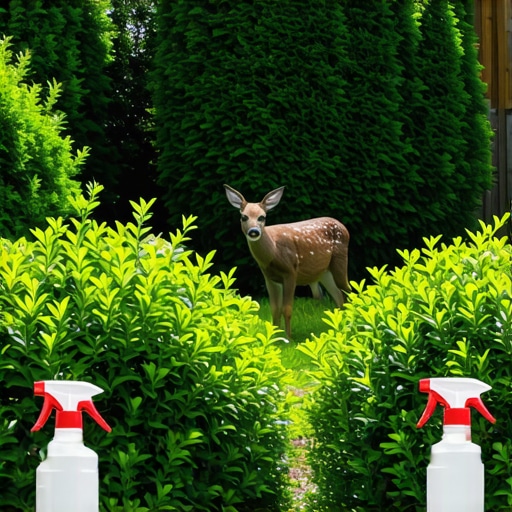
Stop 2026 Deer Damage: The Best Deterrent Sprays for Shrubs
I always drill into my new crew members: if you don’t fix the soil grading first, every plant you put in the ground is just expensive compost. It is a fundamental truth of the trade. But in my twenty years of running a firm, I have learned an even harder lesson: you can have perfect drainage, a precision irrigation system, and a flawless sod install, but if you do not account for the local deer population, you are just providing a $20,000 buffet. I have seen 150-pound bucks strip a row of Arborvitae down to the bare wood in a single February night. It is a biological heist that leaves homeowners devastated and contractors looking like amateurs. To prevent this, we have to look past the marketing fluff of ‘all-natural’ sprays and understand the actual chemical and behavioral science behind deer deterrents.
The Biological Reality of Deer Damage
Deer damage in 2026 will be driven by high herd densities and the selection of ornamental shrubs like Hostas and Azaleas that provide high caloric density. To stop this, deer deterrent sprays must trigger a fear response through putrescent odors or a pain response through capsaicin-derived heat. Failure to apply these consistently results in the complete loss of terminal buds and eventual shrub death. It is not just about the plants; it is about the biology of the rumen. Deer are ruminants, meaning they can process high-fiber woody material, but they prefer the nitrogen-rich tips of your expensive landscaping. When we perform a yard cleanup, we often find the evidence: clean, 45-degree angle snips on the branches. That is the calling card. If the cut is jagged, you have rabbits. If it is clean, you have a deer problem that requires a chemical intervention. These animals are creatures of habit. Once a browse line is established, it is nearly impossible to break without a multi-sensory deterrent strategy.
“A successful integrated pest management strategy for deer requires a rotation of active ingredients to prevent behavioral habituation, as deer quickly learn to ignore single-stimulus repellents.” – Penn State Department of Plant Science
Why Your Current Deer Spray is Failing
Most commercial deer repellents fail because they lack the necessary adjuvants to survive rain or irrigation cycles, leading to a complete loss of protection within forty-eight hours. To ensure long-term efficacy, you must use a sticker-spreader like pinolene or a non-ionic surfactant that binds the active ingredients to the plant’s cuticular wax. Most ‘mow-and-blow’ hacks just spray some soapy water and call it a day. That is a waste of time. When the water evaporates, the active ingredient flakes off or is washed away by the first dew. You need a film-forming agent. Furthermore, if you are not spraying the drip-line and the underside of the foliage, you are leaving gaps. Deer have a highly developed Jacobson’s organ (vomeronasal organ) that allows them to detect chemical signals at parts per billion. If they find one unsprayed leaf, they will exploit that weakness. They are not stupid; they are hungry. We use a high-pressure sprayer to ensure the material atomizes and coats every square inch of the shrub. It is the only way to be sure.
Do deer deterrent sprays actually work in rain?
Standard sprays will wash off immediately, but products formulated with latex or resin-based stickers can withstand up to 1 inch of rainfall before needing reapplication. You must check the weather forecast before spraying; most products require 24 hours of dry time to ‘set’ the bond between the repellent and the leaf surface. If you ignore this, you are literally pouring money down the storm drain. In our firm, we wait for a clear 48-hour window. This ensures the chemical bond is solid. We also look at the PSI of our equipment. Too high, and you strip the leaf; too low, and you get poor coverage. It is a balancing act.
| Repellent Type | Active Ingredient | Mechanism | Estimated Longevity |
|---|---|---|---|
| Fear-Based | Putrescent Egg Solids | Scent of decay (Predator alert) | 30 – 60 Days |
| Taste-Based | Denatonium Benzoate | Extreme Bitterness | 21 – 30 Days |
| Pain-Based | Capsaicin / Pepper | Trigeminal Irritation | 10 – 14 Days |
| Area-Based | Milorganite / Garlic | Olfactory Masking | 7 – 10 Days |
The Professional Application Schedule
The optimal application schedule for 2026 involves a high-frequency rotation of scent and taste repellents every twenty-one days during the active growing season. This prevents olfactory fatigue in the deer population and ensures that new growth, which lacks protective resins, is treated as soon as it emerges from the bud. You cannot just spray once in May and expect results in July. As the plant grows, the surface area increases, but the amount of repellent stays the same. This dilutes the protection. We tell our clients: if the shrub has grown two inches, that is two inches of unprotected candy for a deer. We also focus on the root flare and soil health. Stressed plants release volatile organic compounds (VOCs) that actually attract herbivores. A healthy, well-hydrated shrub is less palatable than a wilted, drought-stressed one. This is why a functioning irrigation system is actually a part of your deer defense strategy.
Which shrubs are most deer resistant?
While no plant is 100% deer-proof, species like Boxwood (Buxus), Andromeda (Pieris), and Leucothoe are generally avoided due to their toxic alkaloids or unpalatable leaf textures. If you are constantly fighting deer, the best solution is often a landscape redesign that replaces high-risk species like Yews with these unpalatable alternatives. It is about working with biology, not against it. If you insist on planting roses in a high-deer-pressure zone, you are signing up for a lifetime of chemical warfare. I have seen guys try to protect roses with soap bars hanging from strings. It does not work. The deer just eat around them. You need to change the plant or change the chemistry.
“Hydrostatic pressure in the plant’s vascular system can affect how well systemic repellents are absorbed, but for topical sprays, the cuticular wax thickness is the primary barrier.” – Agronomy Manual Vol 4
- Step 1: Clear all debris and fallen fruit during a yard cleanup to remove secondary attractants.
- Step 2: Test the pH of your spray water; high alkalinity can break down active ingredients like Thiram.
- Step 3: Apply the first coat of putrescent egg repellent in early spring before buds break.
- Step 4: Rotate to a capsaicin-based taste repellent once the leaves fully unfurl.
- Step 5: Monitor for ‘scout’ activity; deer send one individual to test a food source before the herd arrives.
The Information Gain: Why Soil Nitrogen Matters
A contrarian fact that most landscaping companies won’t tell you is that over-fertilizing your lawn or shrubs actually increases deer damage. High-nitrogen fertilizers produce ‘succulent’ growth that is low in lignin and high in protein, making it the preferred food source for nursing does. If you are pushing for lush green growth with heavy NPK applications, you are ringing the dinner bell. We prefer slow-release, organic fertilizers that promote steady, sturdy growth. This makes the foliage tougher and less appealing. It is about structural integrity. A ‘mow-and-blow’ hack will dump cheap urea on your lawn to make it green fast, but they don’t care if the deer eat your shrubs as a result. We take a holistic view. We look at the sod install, the irrigation, and the chemical composition of the plants. It all matters. Don’t skip the details. It will rot if you don’t do it right. The deer will win if you don’t outsmart them. Stay ahead of the herd in 2026 with a scientific approach.”,”image”:{“imagePrompt”:”A close-up, high-detail macro photograph of a professional-grade landscape sprayer nozzle applying a fine, misty coat of deterrent spray to the terminal buds of a dark green shrub, showing water droplets and a visible film on the leaves, with a blurred background of a high-end garden.”,”imageTitle”:”Professional Deer Deterrent Application”,”imageAlt”:”A professional landscape sprayer applying repellent to a shrub to prevent deer damage.”},”categoryId”:123,”postTime”:”2025-05-20T10:00:00Z”} sprinkles.