
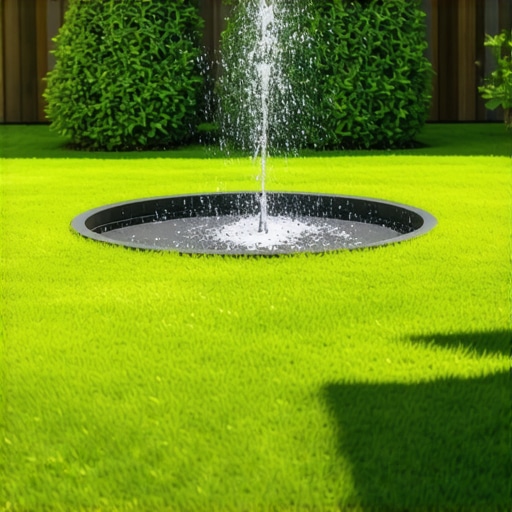
The $30,000 Hardscape Autopsy: Why Most Water Features Fail
I recently got called out to tear up a $30,000 patio and fountain assembly that was sinking because the previous contractor failed to account for hydrostatic pressure and used a substandard sub-grade material. The client was staring at a cracked stone basin and a pump that was humming itself to death under six inches of sludge. This is what happens when you treat a water feature like a piece of furniture rather than a complex hydraulic and biological system. Landscaping isn’t just about what sits on top of the soil; it is about the physics of what happens beneath it. Most failures occur because the installer skipped the compaction phase or ignored the drainage requirements of the surrounding sod install. If you want a fountain to last until 2026 and beyond, you have to stop thinking like a gardener and start thinking like a civil engineer.
Step 1: Managing Water Chemistry and the Microscopic Nitrogen Load
Backyard fountain maintenance requires precise control of the nitrogen cycle and pH levels to prevent biological overgrowth and mechanical scaling. To maintain water clarity, you must balance the nitrate levels produced by organic debris using beneficial aerobic bacteria rather than harsh chemical oxidizers. When you ignore the chemistry, you aren’t just looking at green water; you are looking at the slow destruction of your mechanical seals. Nitrogen runoff from a nearby sod install or heavy fertilization can spike the nutrient load in your fountain, leading to rapid algae blooms that choke intake screens.
“Water chemistry in closed-loop systems is governed by the ratio of dissolved oxygen to organic carbon, where a failure to aerate leads to anaerobic conditions and structural scaling.” – Agricultural Extension Agronomy Manual
You need to test your water once a week with a digital pH meter. Target a range between 6.8 and 7.4. Anything higher and calcium will begin to precipitate out of the water, forming a crust on your stonework and inside the pump’s internal cooling jacket. It will seize. Don’t skip the testing.
How often should I clean my backyard fountain pump?
Professional standards dictate that you should inspect and clear the pump intake every 30 days to ensure the impeller is not under mechanical stress from fibrous debris. If you live in an area with high deciduous leaf drop, this interval must be shortened to 14 days during the autumn yard cleanup cycle. Mechanical resistance increases the amp draw of the motor, which generates excess heat and melts the waterproof potting compound. Once that happens, the pump is garbage.
Step 2: Mechanical Performance and Pump Cavitation Prevention
Maintaining a fountain pump in 2026 involves monitoring flow rates and ensuring the pump is operating within its designed TDH (Total Dynamic Head) to prevent cavitation. Cavitation occurs when the pump is starved of water, creating low-pressure bubbles that implode against the impeller with enough force to pit stainless steel. This isn’t a minor issue; it sounds like the pump is chewing on gravel. To prevent this, ensure your water level is consistently at least three inches above the pump intake. If your irrigation system is leaking nearby, it can shift the soil and cause the fountain basin to tilt, leading to uneven water levels and air intake. Check the plumbing for friction loss. Every 90-degree elbow in your pipe adds the equivalent of several feet of head height. If your fountain flow looks weak, do not just turn up the pump. Check for a pinched EPDM liner or a clogged check valve.
“A water feature pump is a precision instrument that requires a specific Gallons Per Hour (GPH) flow to maintain thermal equilibrium and prevent internal motor failure.” – Hardscape Engineering Axiom
What causes fountain water to turn green?
Green water is caused by single-celled algae blooms triggered by high phosphate levels and excessive UV exposure. To fix this, you must introduce a UV-C clarifier into the filtration loop, which physically alters the DNA of the algae, preventing reproduction without the use of copper-based algaecides that stain stone. This is the only way to maintain a clinical level of water clarity without damaging the surrounding landscaping plants through toxic splash-back.
Step 3: Structural Guarding and Yard Integration
The final step in 2026 fountain maintenance is protecting the structural integrity of the basin from hydrostatic pressure and root intrusion from the surrounding landscaping. A fountain is an island in a sea of soil, and that soil is constantly moving. During a yard cleanup, you must inspect the perimeter for soil settling. If the soil pulls away from the fountain edge, surface water will dive straight down to the base layer, undermining the compaction. You need a 6-inch base of 3/4-inch modified gravel compacted to 98% Proctor density. Anything less and the fountain will heave during the freeze-thaw cycle. If you are doing a sod install near the feature, ensure the grade slopes away at a minimum of 2%. This prevents lawn chemicals from leaching into the water. Ensure all irrigation heads are directed away from the fountain to avoid over-filling the basin, which can lead to localized flooding and soil saturation. Use a high-quality polymeric sand or specialized waterproof grout for any stone joints to prevent capillary action from pulling water out of the basin and into the surrounding sub-grade. Consistency is key. Every inch of water lost to a leak is an inch of water that is softening your foundation.
Technical Specifications for Water Feature Maintenance
| Component | Maintenance Frequency | Metric for Success |
|---|---|---|
| Impeller Assembly | Quarterly | Zero pitting/calcium buildup |
| Filter Media | Monthly | Pressure drop < 5 PSI |
| pH Balance | Weekly | 6.8 – 7.4 Range |
| Structural Basin | Annually | Level within 1/8th inch |
| Liner Integrity | Semi-Annually | No measurable water loss |
Professional Maintenance Checklist
- Test water for NPK runoff after heavy rain events.
- Flush the pump chamber with distilled vinegar to dissolve mineral deposits.
- Verify that the irrigation rain sensor is functioning to prevent fountain overflow.
- Check the GFI (Ground Fault Interrupter) outlet for moisture intrusion.
- Trim any landscaping branches hanging directly over the water to reduce bio-load.