
The Engineering Reality of 2026 Runoff Management
A 2026 dry creek bed is a functional drainage system engineered to manage stormwater runoff, reduce soil erosion, and mitigate hydrostatic pressure by redirecting water through a calculated path of least resistance. If you are seeing standing water or your yard feels like a sponge three days after a storm, your current drainage has failed. Most homeowners think they can just throw some river rock in a trench and call it a day. That is how you end up with a mosquito-breeding swamp that undermines your foundation. True landscaping is about civil engineering. We are talking about soil compaction, infiltration rates, and hydraulic conductivity. Every inch of your yard has a saturation point. When you hit that point, gravity takes over, and if you have not planned for it, gravity will destroy your sod install and your wallet.
The Hardscape Autopsy: Lessons from a $30,000 Failure
I recently got called out to tear up a $30,000 patio that was sinking because the previous contractor ignored the sub-grade drainage. The homeowner thought they were getting a deal, but the ‘pro’ they hired just dumped modified gravel on top of raw clay without any thought for where the water would go. After two seasons of freeze-thaw cycles, the hydrostatic pressure behind the retaining wall pushed the stones four inches out of alignment. I had to bring in a mini-excavator to gut the entire project. We found that the water was literally pooling under the pavers because there was no exit strategy. This is why I preach the gospel of the dry creek bed. It is not an ornament; it is a pressure-relief valve for your entire property. If you skip the yard cleanup and site prep, you are just building a very expensive grave for your hardscape.
“Surface drainage should be designed to move water away from the structure at a minimum slope of 2 percent.” – Penn State Agricultural Extension
Phase 1: Site Analysis and Soil Mechanics
Before you touch a shovel, you need to understand the topography of your lot. You are looking for the natural ‘thalweg’ – the lowest point of the valley where water naturally wants to flow. In 2026, we are seeing more frequent, high-intensity rain events. You cannot design for the average rain; you must design for the 100-year storm. This involves calculating the catchment area of your roof and hard surfaces. If your downspouts are dumping 500 gallons of water every fifteen minutes during a heavy downpour, a shallow trench will not cut it. You need to assess your soil pH and structure. Heavy clay soil has low porosity, meaning it holds water like a bathtub. Sandy loam drains faster but erodes more easily. Your dry creek bed needs to account for these variables to remain stable.
How much modified gravel do I need for a patio base?
Calculating modified gravel requirements depends on the PSI load and the plasticity index of the underlying soil. Generally, a standard pedestrian patio requires a 6-inch compacted base of 2A or CR-6 gravel, which translates to approximately 1 ton of gravel per 40 square feet at that depth. For heavy clay soils, you should increase this to 8 or 10 inches to ensure stability and prevent heaving during temperature fluctuations.
Phase 2: Excavation and the Non-Woven Rule
Excavation is the most physically demanding part of the yard cleanup and build process, and it is where 90 percent of DIYers fail. You need a trench that is at least twice as wide as it is deep, with a parabolic cross-section. This shape slows the water at the edges while keeping it moving in the center. Here is the golden rule: never, ever use woven ‘weed barrier’ fabric in a drainage project. It will clog with silt in six months and turn your creek bed into a slide. You must use 4-ounce or 6-ounce non-woven geotextile fabric. This material allows water to pass through into the sub-soil while keeping the rocks from sinking into the mud. It acts as a filtration layer that maintains the integrity of your drainage channel for decades.
| Material Component | Function | Critical Specification |
|---|---|---|
| Non-woven Geotextile | Separation & Filtration | 4oz Minimum Weight |
| #57 Clean Stone | Sub-surface Drainage | Angular, not rounded |
| River Rip-Rap | Energy Dissipation | 4-12 inch diameter |
| Polymeric Sand | Joint Stabilization | ASTM C-144 Graded |
Phase 3: Rock Graduation and Hydraulic Flow
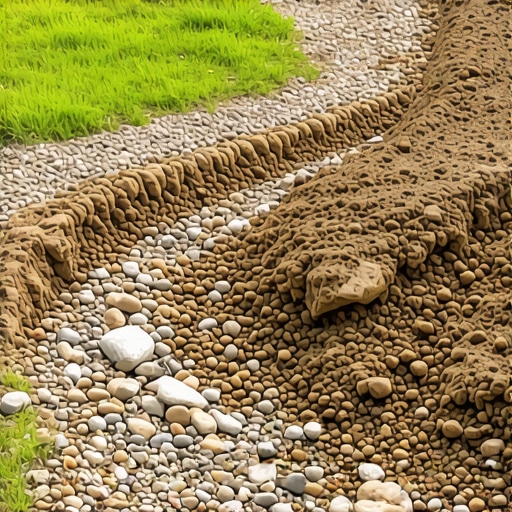
A natural-looking dry creek bed uses rock graduation to mimic a real stream. In the center of the channel, you place your largest boulders. These are not just for looks; they act as energy dissipators that break up the flow of water and prevent it from gaining enough velocity to wash away your landscaping. Around these boulders, you layer in medium-sized river rock (3-5 inches), and then finish the edges with smaller pea gravel or cobbles. This creates a friction coefficient that manages water speed. If the water moves too fast, it will jump the banks and ruin your sod install. If it moves too slow, it will silt up. It is a delicate balance of hydraulics and aesthetics. Use angular stones for the base layers as they lock together better than rounded ones.
How deep should a dry creek bed be for heavy rain?
For high-volume stormwater management, a dry creek bed should have a finished depth of 12 to 18 inches at its lowest point. This depth allows for a 4-inch base of clean drainage stone, the geotextile liner, and several layers of river rock while still leaving enough freeboard to contain a significant surge of water without overtopping the banks.
“The stability of any gravity-retaining structure or drainage channel depends entirely on the management of hydrostatic pressure through proper backfill and filtration.” – Hardscape Engineering Axiom
Phase 4: Integrating Sod and Irrigation for Erosion Control
Once the ‘hard’ part of the creek bed is in, you have to secure the ‘soft’ edges. This is where your sod install becomes critical. You cannot leave bare dirt next to a new creek bed. The first rain will wash that dirt right into your rocks. I recommend using a turfgrass with a deep root system, such as a turf-type tall fescue or a hybrid Bermuda, depending on your USDA zone. You should ‘tuck’ the sod over the edge of the geotextile fabric to create a seamless, stable transition. Additionally, check your irrigation lines. Often, during excavation, we find old PVC pipes that were buried too shallow. This is the time to reroute them. Ensure your sprinkler heads are not spraying directly into the creek bed, as this is a waste of water and can lead to localized soil saturation issues.
- Call 811 before digging to mark all utility lines.
- Always maintain a minimum 2 percent slope away from your house.
- Use ‘boulder clusters’ at bends to prevent bank erosion.
- Check the 10-year storm data for your specific zip code.
- Install a ‘pop-up emitter’ at the end of the creek bed for clean discharge.
The 2026 Maintenance Protocol: Beyond the Cleanup
Maintenance is not just about pulling a few weeds. It is about sediment management. Every year, you should do a thorough yard cleanup that includes checking the ‘mouth’ of your creek bed for debris. If leaves and silt build up, they will eventually create a dam. This causes the water to back up, potentially flooding your irrigation valves or crawlspace. Use a high-powered leaf blower to clear the stones, and every three to five years, you may need to add a fresh layer of 1-inch river pebble to replace what has settled. A well-built creek bed should last 25 years, but only if you respect the physics of water. Don’t be the homeowner who ignores a small clog until it becomes a structural nightmare. Fix it fast. Fix it right. Build it to last through 2026 and beyond.
{“@context”:”https://schema.org”,”@type”:”HowTo”,”name”:”Building a 2026 Dry Creek Bed”,”step”:[{“@type”:”HowToStep”,”text”:”Analyze site topography and mark the thalweg.”},{“@type”:”HowToStep”,”text”:”Excavate a parabolic trench at least 12 inches deep.”},{“@type”:”HowToStep”,”text”:”Install 4oz non-woven geotextile fabric.”},{“@type”:”HowToStep”,”text”:”Layer #57 clean stone followed by graduated river rock.”},{“@type”:”HowToStep”,”text”:”Secure edges with sod and adjust irrigation heads.”}],”totalTime”:”P2D”}{“@context”:”https://schema.org”,”@type”:”FAQPage”,”mainEntity”:[{“@type”:”Question”,”name”:”How much modified gravel do I need for a patio base?”,”acceptedAnswer”:{“@type”:”Answer”,”text”:”A standard patio requires about 1 ton of gravel per 40 square feet for a 6-inch compacted base.”}},{“@type”:”Question”,”name”:”How deep should a dry creek bed be for heavy rain?”,”acceptedAnswer”:{“@type”:”Answer”,”text”:”A depth of 12 to 18 inches is recommended to handle high-volume stormwater surges effectively.”}}]}