
The Forensic Autopsy of a $40,000 Failed Water Feature
I recently got called out to tear up a massive naturalistic pond and the adjacent $30,000 patio that was sinking because the previous contractor failed to account for the fundamental physics of water movement and rock placement. The homeowner was complaining about a thick, carpet-like layer of algae that returned 48 hours after every cleaning. When we pulled the first boulder, the smell of hydrogen sulfide (rotten eggs) was overwhelming. The rocks were literally suffocating in an anaerobic sludge trap created by poor drainage and ‘mow-and-blow’ yard cleanup crews blowing lawn debris directly into the water. The engineering failure was simple: no hydrostatic relief and zero consideration for nutrient loading. We had to excavate the entire base, replace the contaminated substrate, and rethink the irrigation runoff that was leaching fertilizers directly into the pond. This isn’t just about aesthetics; it is about biological engineering. If your rocks are green, your system is failing.
Why Algae Smothers Your Pond Rocks
To clean algae off pond rocks fast, apply 3 percent hydrogen peroxide directly to exposed surfaces or use a sodium percarbonate treatment to oxidize organic matter. Scrubbing with a stiff nylon brush and performing a targeted water exchange prevents immediate regrowth and stabilizes the aquatic nitrogen cycle and oxygen levels.
Algae is not the enemy; it is the symptom. Specifically, it is the biological response to an imbalance of nitrates, phosphates, and sunlight. In my twenty years of hardscaping, I have seen homeowners dump hundreds of dollars of big-box ‘clarifiers’ into their ponds, only to kill their expensive koi. Those chemicals are often just copper-based algaecides that stay in the sediment forever. Real pond maintenance requires understanding the microscopic reality. When you see string algae (Spirogyra), you are looking at a plant that has evolved to outcompete your ornamental lilies for every scrap of nitrogen. It thrives in high-flow areas like waterfalls because it can cling to the porous surface of the rock. If your yard cleanup routine involves leaving grass clippings near the pond edge, you are basically spoon-feeding the algae. High-phosphorus runoff from a poorly planned sod install or over-fertilized lawn is the primary driver of these blooms. You cannot fix with a scrub brush what you broke with a spreader. It is about the load. Stop the input of nutrients, and the algae loses its fuel.
“Excessive nutrient loading, specifically phosphorus and nitrogen, acts as the primary catalyst for filamentous algae blooms in closed hydraulic systems.” – Penn State Extension Water Quality Manual
How much pressure can pond rocks handle during cleaning?
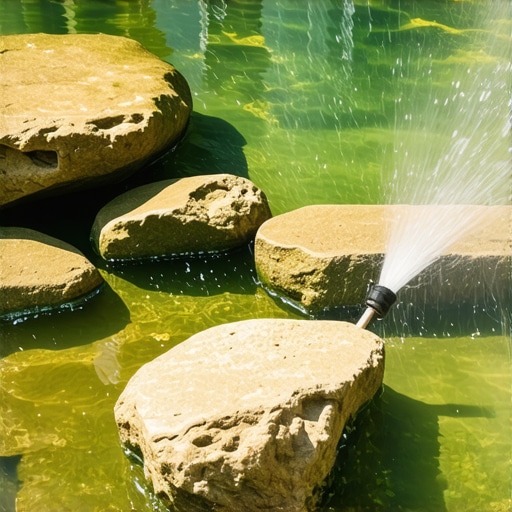
When using a pressure washer on pond rocks, you must limit the output to 1,500 PSI and use a wide-angle tip. High-pressure streams can de-laminate softer sedimentary rocks like sandstone or limestone, creating more surface area for algae to colonize. Furthermore, never blast the rocks if they are in direct contact with an EPDM liner, as the pressure can easily pierce the membrane, leading to a catastrophic leak that requires a full teardown. Focus the spray on the rock face and immediately vacuum the dislodged debris to prevent it from resettling and rotting in the pond floor.
The Chemistry of Clean: Peroxide vs. Manual Labor
The fastest way to clear the green is oxidation. Sodium percarbonate, often sold as ‘Ecological Pond Cleaner,’ is a dry powder that releases hydrogen peroxide upon contact with water. It works by lysing the cell walls of the algae. You turn off the pumps, sprinkle it on the rocks, and watch the algae bubble to the surface. It is satisfying. But it is also dangerous if you don’t know the volume of your water. Overdosing will swing the pH and potentially kill your bio-filter. I tell my apprentices: treat the pond like a patient, not a pool. After the oxidation process, you must manually remove the dead mass. If you leave the dead algae in the pond, it will decompose, release all that nitrogen back into the water, and trigger a second, even larger bloom. It is a cycle of decay. You need a heavy-duty pond vacuum. Do not skip the physical removal. It is the hardest part and the most critical.
| Treatment Method | Application Speed | Environmental Impact | Long-term Effectiveness |
|---|---|---|---|
| Manual Scrubbing | Slow | Zero | Low (Spores remain) |
| Hydrogen Peroxide (3%) | Fast | Low (Turns to water/oxygen) | Medium |
| Sodium Percarbonate | Very Fast | Moderate (pH shifts) | High (When combined with vacuuming) |
| UV Clarification | None (Passive) | Zero | High (Planktonic algae only) |
Will vinegar damage my pond liner while cleaning rocks?
Vinegar is an acetic acid that can drastically lower the pH of your pond, potentially killing fish and beneficial nitrifying bacteria. While it is effective at dissolving calcium deposits and killing algae on contact, it should only be used on rocks that have been removed from the pond. If used in-situ, the acid can also react with limestone rocks, causing them to degrade prematurely. For rocks staying in the water, stick to peroxide-based solutions which break down into harmless oxygen and water, maintaining the delicate chemical balance of the ecosystem.
Engineering a Permanent Solution
If you are tired of cleaning rocks, you need to change the engineering of the pond. Most ponds suffer from ‘dead zones’ where water becomes stagnant. This is usually due to poor pump sizing or incorrect irrigation integration. Your pump should turn over the entire volume of the pond at least once per hour. If you have 2,000 gallons of water, you need a 2,000 GPH pump, accounting for head pressure. We also look at the ‘fines’—the tiny organic particles that settle between rocks. During a proper yard cleanup, ensure that no mulch or soil is allowed to wash into the pond. I recommend a 4-inch layer of 1-3 inch river stone over the liner, but only if you have a bottom drain or a powerful skimmer system. Without filtration, that stone just becomes a dumpster for muck. If you are doing a new sod install nearby, grade the land away from the pond. Use a French drain to intercept runoff. This is civil engineering 101. Stop the water from carrying silt and chemicals into your aquatic feature.
“The structural integrity of a pond’s edge is compromised when organic sludge builds up between the rock layers, creating hydrostatic pockets that shift stones.” – Hardscape Engineering Axiom
[image_placeholder]
Professional Remediation Checklist
- Turn off all circulation pumps and waterfalls to keep the treatment localized.
- Apply sodium percarbonate to the wet rocks and let it sit for 20 minutes.
- Use a stiff nylon brush (never wire) to agitate the dead algae.
- Vacuum the sludge immediately using a professional-grade pond vacuum.
- Perform a 15% water change to dilute any released phosphates.
- Add a concentrated dose of beneficial bacteria to outcompete any remaining spores.
- Check the irrigation system for leaks that might be introducing treated city water or fertilizers.
The goal is a balanced ecosystem, not a sterile one. You want a thin, dark green patina on your rocks—this is a healthy biofilm of nitrifying bacteria. What you don’t want is the long, flowing hair of string algae. That stuff is a sign of failure. Maintenance is about consistency. Check your skimmer every week. If you see leaves, pull them out. If you see a light dusting of algae, hit it with a small dose of bacteria. Don’t wait for a crisis. Landscaping is a marathon, not a sprint. If you treat your pond like a piece of furniture, it will fail. Treat it like a living organism, and it will thrive for decades.