
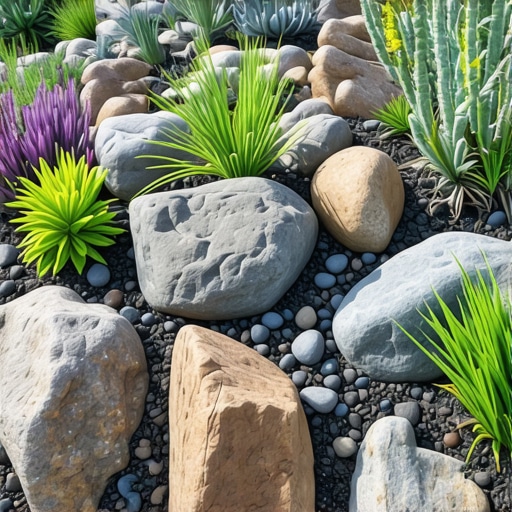
The Engineering Reality of Sloped Rock Gardens
Establishing a rock garden on a steep slope requires managing gravitational shear and hydrostatic pressure through the use of angular rip-rap, geotextile fabrics, and tiered stabilization to prevent soil migration and ensure long-term structural integrity without constant maintenance. You cannot just throw some stones on a hill and hope for the best. Gravity is a constant adversary. If the angle of repose is not respected, your investment will end up at the bottom of the hill after the first heavy rain. Most homeowners make the mistake of thinking this is a cosmetic upgrade. It is not. It is a civil engineering project that happens to use plants as a secondary reinforcement layer.
The Hardscape Autopsy: Why Slopes Fail
I recently got called out to tear up a $30,000 patio that was sinking because the previous contractor failed to account for the sub-surface water movement on a 35-degree incline. The entire structure had shifted four inches downslope because they used rounded river rock as a base instead of crushed, angular #57 stone. Rounded rocks act like ball bearings under pressure. This is the hallmark of a hack job. We had to excavate the entire site, install a proper 12-inch base of compacted modified gravel, and re-engineer the drainage with a series of French drains. Don’t let this be your story. When you are dealing with steep grades, the physics of water is the only thing that matters. If you don’t control the water, the water will control your yard. It will rot your footings and wash away your topsoil. Don’t skip the site prep.
“A retaining wall doesn’t fail because of the stone; it fails because of the water trapped behind it.” – Hardscape Engineering Axiom
Hydrology and Soil Mechanics on the Grade
To build a rock garden that lasts until 2026 and beyond, you must understand the soil you are working with. Heavy clay soils, common in many regions, expand when wet and contract when dry. This creates a rhythmic pushing force that can dislodge boulders. In contrast, sandy loam drains quickly but lacks the internal friction to hold a slope without mechanical intervention. We use a 4-ounce non-woven geotextile fabric as a separator. This isn’t the cheap plastic you buy at a big-box store. This is industrial-grade material that allows water to pass through while keeping the fines (small soil particles) from clogging your drainage stone. If your soil can’t breathe, it will liquefy under the pressure of a storm. That is when landslides happen. Professional landscaping is about managing these invisible forces before the first plant is ever placed.
| Material Type | Friction Coefficient | Best Use Case | Durability Rating |
|---|---|---|---|
| Angular Rip-Rap | High | Slopes >30 degrees | Extreme |
| Rounded River Rock | Low | Dry Creek Beds (Flat) | Moderate |
| Crushed Limestone | Medium | Pathways/Base Layers | High |
| Fieldstone Boulders | Variable | Structural Anchors | Extreme |
How much modified gravel do I need for a patio base?
Calculating the modified gravel for a slope-adjacent patio requires a volume formula of (Length x Width x Depth in feet) / 27 to find the cubic yardage, typically requiring a minimum 6-inch base for stability. For a slope, I always recommend over-ordering by 10 percent to account for compaction. We use a vibratory plate compactor in 2-inch lifts. If you throw 6 inches of stone down and hit it once, the middle remains loose. It will settle. The tamper should literally bounce off the compacted base when it is ready. If it still feels soft, keep going. There are no shortcuts in earthwork. You either do it right or you do it twice.
Vegetation as Biological Rebar
Plants in a rock garden are more than just aesthetics; they are biological rebar. On a steep slope, you want species with deep, fibrous root systems that can knit the soil together. Avoid turf grass. A sod install on a steep incline is a maintenance nightmare and a safety hazard for whoever has to mow it. Instead, look at creeping junipers, micro-clover, or native bunchgrasses. These plants require zero yard cleanup once established and can survive the harsh micro-climate of a sun-baked rock face. We target the USDA hardiness zones with precision. A plant that is marginally hardy will die during a polar vortex, leaving a hole in your erosion control strategy. One dead plant on a slope can start a gully that destroys the whole garden. It is that simple.
Irrigation Strategies for Zero Runoff
Traditional spray irrigation is useless on a slope. Gravity pulls the water down the hill before it can soak into the root zone, leading to waste and potential erosion. We utilize pressure-compensating drip emitters. These deliver water at a slow, measured rate directly to the base of each plant. This forces the roots to grow deep into the cool, moist sub-soil rather than staying near the hot surface. Deep roots mean drought resistance. If you see water running off into the street, you have failed the engineering test. Turn it off. Adjust your timers. We use smart controllers that monitor local weather stations. If there is rain in the forecast, the system stays off. Efficiency is not an option; it is a requirement in 2026.
“Effective erosion control is achieved through the integration of mechanical stabilizers and vegetative cover to reduce the kinetic energy of rainfall.” – USDA Soil Conservation Manual
Steep Slope Installation Checklist
- Survey the slope to determine the exact degree of incline.
- Call 811 to mark all underground utilities before digging.
- Excavate benches or terraces to create flat planting pockets.
- Install 4oz non-woven geotextile fabric across the entire area.
- Place large anchor boulders at the base of the slope first.
- Backfill with #57 crushed stone for drainage, not dirt.
- Integrate drip-line irrigation under the mulch or rock layer.
- Select native plants based on solar exposure and wind patterns.
Maintaining the Structural Integrity
Once the install is complete, the first year is the most critical. You need to watch for any signs of piping—where water creates small tunnels under your rocks. If you see a hole, fill it immediately with crushed stone. This isn’t a “set it and forget it” situation until the plants have fully established their root networks. After year two, the maintenance drops to almost zero. You might have to pull a stray weed or blow out some leaves, but the days of mowing that dangerous hill are over. This is how we build gardens that last. We respect the physics, we select the right biology, and we never compromise on the base material. Quality costs more upfront, but failure is much more expensive. Do it once. Do it right.