
The Anatomy of a Failing Landscape: Why Leaf Debris is a Silent Killer
Proper yard cleanup is not a cosmetic choice; it is a mechanical necessity for the survival of your woody ornamentals. I always drill into my new crew members: if you don’t fix the soil grading and clear the debris first, every plant you put in the ground is just expensive compost. I remember an apprentice who thought he could skip the interior of a dense Barberry hedge because the thorns were too thick. Three months later, the client called because the entire hedge line was showing signs of Phytophthora root rot. The trapped leaves had created a wet, anaerobic mat that literally suffocated the root flares. If you leave organic matter to rot against the stem of a thorny shrub, you are inviting pathogens into your yard.
“A retaining wall doesn’t fail because of the stone; it fails because of the water trapped behind it. Similarly, a shrub doesn’t die from the cold; it dies from the moisture trapped at its base.” – Hardscape Engineering Axiom
How do you clean leaves out of rose bushes without getting scratched?
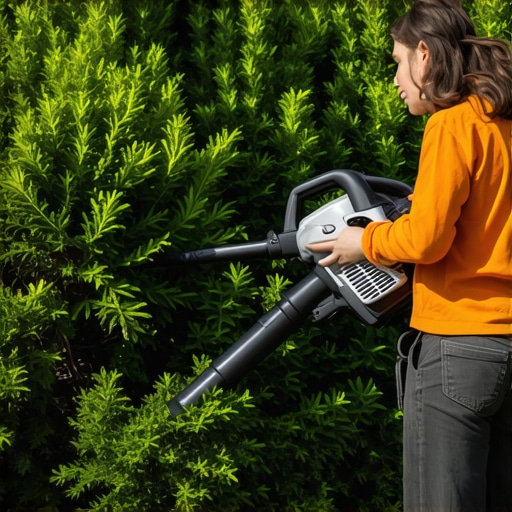
To clean leaves out of thorny bushes without injury, you must use a high-CFM leaf blower combined with a long-reach air nozzle and heavy-duty goatskin gloves. The goal is to use the physics of airflow to dislodge debris so that you never have to reach your hands into the ‘death zone’ of the plant thorns. We rely on air volume rather than just air speed. High speed can strip bark, but high volume moves the mass.
The Physics of Airflow: CFM vs MPH in Professional Landscaping
Most homeowners focus on MPH (Miles Per Hour) when buying a blower, which is the equivalent of focusing on the top speed of a car while trying to tow a boat. In a professional landscaping context, CFM (Cubic Feet per Minute) is the only metric that matters for clearing thorny shrubs. You need mass to move mass. When leaves are wedged between thorns, they create mechanical friction. A high MPH blower with low CFM is like a needle; it just pokes a hole in the pile. A high CFM blower is like a sledgehammer; it moves the entire air column, forcing the leaves out through the gaps in the branches.
| Blower Type | Average CFM | Best Use Case | Thorn Effectiveness |
|---|---|---|---|
| Electric Handheld | 350-450 | Small patios and dry leaves | Poor |
| Gas Backpack | 600-900 | Heavy leaf loads and wet debris | Excellent |
| Walk-Behind | 1200+ | Large turf areas and sod install prep | Overkill |
| Professional Handheld | 450-600 | Detailing around delicate irrigation | Moderate |
What is the best leaf blower for thorny bushes?
The best leaf blower for thorny bushes is a backpack unit that delivers at least 600 CFM at the nozzle. This provides the necessary force to overcome the static friction of matted leaves without requiring the operator to get dangerously close to the thorns. Brands like Stihl or Echo dominate this space for a reason: their engines are tuned for consistent torque. This is critical when you are working on a yard cleanup that involves dense Barberry or Holly hedges where airflow is restricted.
Surgical Blowout Techniques: The Professional Approach
We do not just aim and spray. That is for amateurs. Professional yard cleanup requires a tactical approach to airflow. First, you must identify the wind direction. Even a 5 MPH breeze will fight your blower. Second, use the ‘Pulse Method.’ Instead of a steady stream of air, use short, high-throttle bursts. This creates a vibration in the branches that helps shake the leaves loose from the thorns. Third, always blow from the inside of the bush outward. If you blow from the outside in, you are just compacting the debris further into the center of the plant. This is the same principle we use in irrigation maintenance: clear from the source to the exit.
“Proper sanitation, including the removal of fallen leaves, is a primary cultural practice for managing rose black spot and other fungal pathogens.” – Texas A&M AgriLife Extension
Integrating Cleanup with Irrigation and Sod Install
Your leaf cleanup directly impacts your irrigation system and any future sod install. If leaves are left to rot, they break down into a fine silt that can clog your pop-up sprinkler heads and lateral lines. During a spring yard cleanup, we always check the irrigation zones after the blowout. When it comes to a sod install, the soil must be perfectly clear. Any leftover organic debris under new sod will create air pockets and nitrogen draw-down. As the leaves decompose, they consume the nitrogen that your new grass needs to establish a root system. This results in yellowing turf and poor knit-down. You cannot shortcut the prep work.
- Inspect the Root Flare: Ensure the blower has cleared all debris away from the base of the trunk.
- Check Irrigation Heads: Blowout any dust or small leaf particles that settled in the sprinkler housings.
- Calibrate Airflow: Reduce throttle when working near fresh sod to avoid lifting the edges.
- Personal Protective Equipment: Wear wrap-around eye protection. Thorny bushes tend to kick back debris directly at your face.
The Impact of Soil pH and Nutrient Cycling
Leaves from certain trees, like Oaks, are highly acidic. If they are allowed to sit in your thorny bushes and decompose, they can significantly alter the soil pH. Most ornamental shrubs prefer a pH between 6.0 and 7.0. A massive influx of decomposing oak leaves can drop that pH, locking out essential nutrients like Phosphorus and Magnesium. This is why a thorough yard cleanup is a chemical intervention. We aren’t just making it look pretty; we are stabilizing the soil chemistry for the next growing season. If you skip the blowout, you might find yourself needing a heavy lime application in the spring just to fix the damage caused by the winter rot.
The Final Maintenance Schedule
A professional landscape requires a rhythm. Fall is for the heavy lift: the deep blowout and the final irrigation shut-off. Winter is for dormant pruning of those thorny shrubs once the leaves are gone. Spring is for the sod install and the restart of the nutrient cycle. If you manage the debris correctly in the fall, your workload in the spring is cut in half. Don’t be the guy who leaves the mess for ‘later.’ In landscaping, later usually means expensive. Clean the base. Clear the thorns. Protect the soil. It is a simple formula that separates the pros from the hacks. Professionalism is found in the details of the dirt. Stop treating your yard like a hobby and start treating it like the biological machine it is. Clear the leaves or watch the rot take hold. The choice is yours. [{“@context”:”https://schema.org”,”@type”:”HowTo”,”name”:”How to Blow Out Leaves from Thorny Bushes”,”step”:[{“@type”:”HowToStep”,”text”:”Equip yourself with a high-CFM backpack blower and heavy duty protective gear.”},{“@type”:”HowToStep”,”text”:”Position the blower nozzle at the base of the shrub, aiming from the interior outward.”},{“@type”:”HowToStep”,”text”:”Use short, high-throttle pulses to vibrate the branches and dislodge matted leaves.”},{“@type”:”HowToStep”,”text”:”Clear the debris away from the root flare to prevent crown rot.”},{“@type”:”HowToStep”,”text”:”Check nearby irrigation heads for debris clogs following the blowout.”}],”totalTime”:”PT30M”},{“@context”:”https://schema.org”,”@type”:”FAQPage”,”mainEntity”:[{“@type”:”Question”,”name”:”What is the best leaf blower for thorny bushes?”,”acceptedAnswer”:{“@type”:”Answer”,”text”:”A backpack blower with at least 600 CFM is recommended to provide enough air volume to move leaves through dense, thorny branches.”}},{“@type”:”Question”,”name”:”Why should I remove leaves from the base of shrubs?”,”acceptedAnswer”:{“@type”:”Answer”,”text”:”Trapped leaves trap moisture against the plant, leading to fungal diseases, crown rot, and pest infestations.”}}]}]