
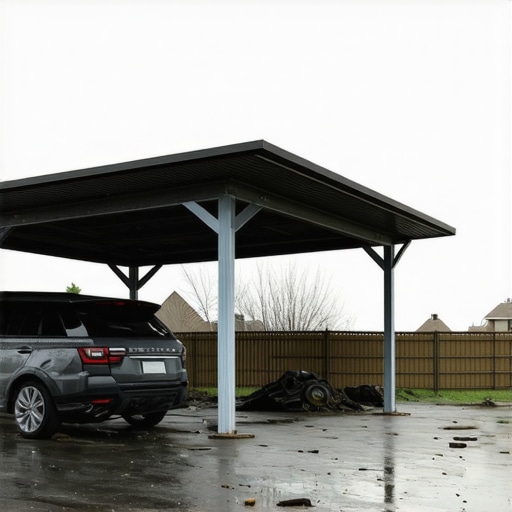
Why Steel Carport Installations Outlast Wooden Alternatives in Storm-Prone Areas
Every year, as the sky darkens and the first gusts of a seasonal storm begin to rattle windowpanes, homeowners across the country hold their breath. For those with vehicles parked outdoors, the anxiety is twofold: will the structure protecting my car hold up, or will it become the very source of damage? As a Professional Engineer (P.E.) with over two decades of experience in structural inspections and load-bearing calculations, I have stood on many driveways in the aftermath of hurricane-force winds. I have seen the splintered remains of decorative wooden pergolas and the twisted, buckled frames of under-engineered shelters.
The visual appeal of wood is undeniable; it offers a rustic, organic warmth that many feel complements residential architecture. However, when we move from the realm of aesthetics into the hard science of structural integrity, wood often fails to meet the rigorous demands of storm-prone environments. In my professional capacity, I have performed countless forensic analyses on failed structures, and the data is consistent: when wind speeds exceed 60 to 70 MPH, the inherent vulnerabilities of organic materials become critical points of failure. This is why Steel Carport Installations are not merely a preference for the modern homeowner – they are a structural necessity for asset protection. Steel is the only material that offers engineered peace of mind, providing a predictable, high-strength response to the unpredictable forces of nature.
The Engineering Reality: Tensile Strength vs. Organic Decay
To understand why steel is superior, we must look at the fundamental material properties. Wood is an anisotropic material, meaning its strength and physical properties vary depending on the direction of the grain. While this makes it excellent for certain craft applications, it introduces significant unpredictability in high-wind scenarios. Over time, even the highest quality pressure-treated timber is subject to organic decay. Moisture infiltration leads to warping, cracking, and splitting, which compromises the structural joints where the most stress is concentrated during a storm.
In contrast, galvanized steel is isotropic; its strength is uniform in all directions. When I calculate the load-bearing requirements for a structure, steel allows for a level of precision that wood simply cannot match. Steel does not rot, it does not warp under the relentless summer sun, and it does not become brittle when the temperature drops. Most importantly, steel distributes wind forces across the entire structure through rigid connections. While a wooden beam might snap at a knot or a weak grain line, a steel member will flex and return to its original shape, absorbing the energy of the wind rather than succumbing to it.
Furthermore, the long-term integrity of wood is constantly under siege by pests. In storm-prone areas where humidity is often high, the risk of infestation is magnified. A structure weakened by insects is a disaster waiting to happen when the next gale hits. This is one reason Why Professional Termite Treatment Saves Your Foundation Long-Term, but for an outdoor structure like a carport, the best defense is using a material that pests cannot consume. Steel provides a permanent barrier against the biological degradation that eventually turns wooden carports into safety hazards.
Wind Ratings and Structural Certification
In the world of structural engineering, we live and die by “Wind Ratings.” A wind rating is not a guess; it is a calculated certification that a structure can withstand a specific velocity of wind without catastrophic failure. Properly engineered Steel Carport Installations can be specified to handle wind ratings of 150 to 170 MPH. This is the threshold of Category 5 hurricanes. Achieving this with wood is not only prohibitively expensive but often physically impossible due to the bulk and weight required to reach those same strength metrics.
When discussing Single Carport Installations, the surface area might seem small, but the “uplift” force – the wind getting underneath the roof – can be immense. For Double Carport Installations, the surface area doubles, and the wind loads increase exponentially. Steel allows us to use thinner, more aerodynamic profiles that reduce the “parachute effect” while maintaining a higher yield strength. When I review the blueprints for a steel installation, I am looking at the gauge of the steel and the quality of the galvanization. These factors ensure that the structure remains standing when wooden alternatives have been reduced to kindling.
Comparing Design Profiles: Cantilever vs. Wall Mount
The geometry of a carport significantly influences how it manages the dynamic loads of a storm. Two of the most common profiles in high-end residential projects are the cantilever and the wall mount. Each has its own set of engineering challenges and advantages.
Cantilever Carport Installations are highly sought after for their “floating” aesthetic. Because they are supported by posts on only one side, they offer unobstructed movement for vehicles. However, from an engineering perspective, a cantilever is a giant lever. During a storm, the wind hitting the underside of the roof creates a massive amount of torque at the base. This requires massive concrete footings – sometimes several feet deep – to counteract the leverage. If the steel isn’t of a high enough grade, the arm of the cantilever can buckle under the strain of upward gusting winds.
On the other hand, Wall Mount Carport Installations leverage the existing structural strength of the home. By anchoring one side of the carport directly into the house’s framing or masonry, we create a much more rigid and stable system. This design is particularly effective in high-wind zones because it halves the number of independent ground anchors required and uses the mass of the house as a stabilizer. For many of my clients, I recommend this approach not just for stability, but for spatial efficiency. You can read more on Why Wall Mount Carports Are the Smarter Move for Narrow Driveways and discover Why Wall Mount Carports Save More Space Than Cantilever Designs to see how these engineering choices impact your daily use.
The Vulnerability of Soft Coverings: Shadeports and Shadenet
Not every carport uses a solid steel roof. In many regions, Shadenet Carport Installations and Shadeport Carport Installations are preferred for their ability to block UV rays while allowing for better airflow. These are often referred to as Shadesail Installations when they utilize more architectural, high-tension fabrics.
One might assume that a fabric cover is a liability in a storm, but there is a specific engineering logic at play here. In a steel-framed shadeport, the fabric acts as a “sacrificial” or highly flexible element. Unlike a wooden roof that might tear away and take part of the structure with it, a high-quality shadecloth is designed to breathe. The porosity of the material allows some wind to pass through, significantly reducing the total wind load on the steel frame. In extreme conditions, the sail can be removed or is designed to tear at specific “fuse” points, preserving the expensive steel skeleton. This is a strategic design choice that balances daily utility with emergency resilience. For those considering this lighter, more modern look, it’s helpful to research What Homeowners in Pretoria Actually Pay for Shadeport Carports to understand the value proposition of these systems.
Anchoring Systems: The Secret to Storm Survival
If there is one thing I emphasize in every structural inspection, it is that a structure is only as strong as its connection to the earth. You could have the strongest steel beams in the world, but if they are poorly anchored, the entire carport will become a projectile. This is where many DIY or “budget” installations fail.
In Multi Carport Installations, where the roof surface can be hundreds of square feet, the uplift forces are staggering. As an engineer, I calculate the “dead load” (the weight of the structure) versus the “live load” (the force of wind and rain). In many cases, the wind force is five to ten times greater than the weight of the carport itself. To counter this, we use:
- Deep Concrete Piers: Extending below the frost line and designed with a flared base to resist being pulled upward.
- Heavy-Duty Wedge Anchors: Expansion bolts that bite into the concrete, providing hundreds of pounds of pull-out resistance per bolt.
- Epoxy Anchoring: In cases where we anchor to existing slabs, high-strength chemical adhesives ensure the steel post becomes one with the concrete.
A “cheap” installation often cuts corners here, using shorter bolts or shallower holes. In my experience, the anchor point is almost always where the failure begins. Once one post lifts, the geometry of the structure is compromised, and the wind does the rest.
Long-Term ROI: Maintenance and Replacement Cycles
When homeowners choose wood, they are often looking at the upfront cost. However, a true engineering assessment includes a Life Cycle Cost Analysis (LCCA). A wooden carport requires a rigorous maintenance schedule: sanding, staining, and sealing every 24 to 36 months to prevent the decay we discussed earlier. Even with perfect maintenance, the lifespan of an outdoor wooden structure in a harsh environment is rarely more than 10 to 15 years before structural members need replacement.
Galvanized steel, particularly when powder-coated, has a functional lifespan of 30 years or more with minimal intervention. There is no need for termite treatments, no risk of rot, and no warping. When you factor in the cost of labor and materials for maintaining wood, the steel option becomes significantly cheaper within the first seven years. For those budgeting for larger projects, looking into What Homeowners in Midrand Actually Pay for a Cantilever Carport Installation can provide a realistic baseline for the investment required for a high-durability steel structure.
The Physics of the “Parachute Effect”
One of the most dangerous aspects of storm damage is the “parachute effect.” This occurs when wind enters an open-sided structure and has nowhere to go, creating a massive pressure buildup under the roof. Wooden carports, which often feature thick, heavy rafters and decorative trim, provide many “catch points” for the wind. These catch points increase the drag coefficient of the structure.
Steel designs are inherently more streamlined. Because steel is so much stronger than wood, we can use smaller cross-sections for the beams and purlins. This “open-air” engineering allows the wind to flow more freely around and through the structure. By reducing the surface area of the structural members themselves, we decrease the total force the wind can exert on the carport. This is a fundamental principle of aerodynamic design that is easily achieved with steel but nearly impossible with the bulkiness of timber.
Conclusion & Final Verdict
In my years as a Professional Engineer, I have learned that nature is the ultimate stress test. While wood has its place in interior design and protected architectural features, it is fundamentally ill-suited for the raw exposure of a storm-prone driveway. The combination of organic decay, unpredictable grain strength, and high maintenance requirements makes it a risky choice for protecting your vehicles.
Steel Carport Installations represent the pinnacle of residential exterior engineering. From the isotropic strength of the material to the precision-engineered wind ratings of 170 MPH, steel provides a level of durability that wood simply cannot match. Whether you are opting for a Single Carport Installation or a massive Multi Carport Installation, the structural advantages are clear: steel handles the tension, resists the uplift, and survives the storm.
Before you commit to your next installation, I strongly encourage you to consult with a structural professional. Ensure that your chosen design is compliant with local wind-load requirements and that your anchoring system is up to the task. When the next storm clouds gather on the horizon, you shouldn’t have to wonder if your carport will still be there in the morning. With steel, you can be certain it will.