
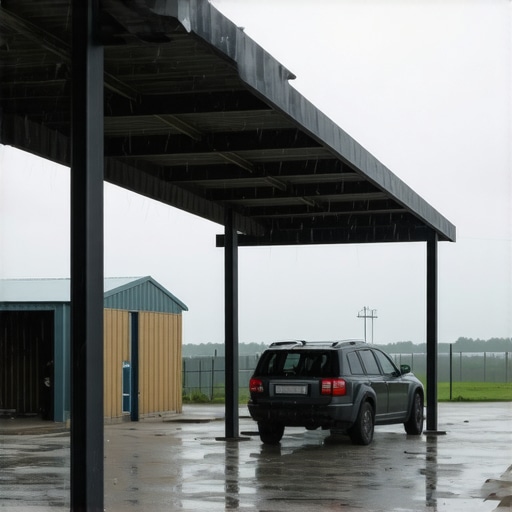
Why Steel Carport Installations Outlast Wooden Alternatives in Storm-Prone Areas
As a structural engineer with years of experience designing and analyzing load-bearing structures across the United Kingdom and India, I have witnessed firsthand the devastating impact that extreme weather can have on residential infrastructure. When a storm hits, the anxiety a homeowner feels isn’t just about the noise outside; it is a very real concern for the safety of their vehicles and the integrity of their property. In regions prone to high winds, heavy rainfall, and seasonal gales, the choice of material for your carport isn’t merely an aesthetic decision – it is a critical engineering choice.
My name is Rebin K Reji, and my background in structural design and construction engineering has taught me that “good enough” is never sufficient when nature is at its worst. While wood has been a traditional favorite for its rustic charm and initial lower cost, modern Steel Carport Installations have become the gold standard for durability. In this deep dive, we will explore the structural engineering principles that make steel the only logical choice for homeowners living in the eye of the storm.
The Physics of Failure: Why Wood Struggles in High Winds
To understand why wood often fails during severe weather, we must look at its cellular structure. Wood is an anisotropic, porous material. This means its strength varies depending on the direction of the grain, and it is susceptible to environmental changes. In Single Carport Installations made of timber, several “failure points” are inherent to the material itself.
1. Wind Uplift and Fastener Withdrawal
One of the most dangerous forces during a storm is wind uplift. As wind hits a structure, it creates a pressure differential. Wood relies heavily on mechanical fasteners like screws and nails. Over time, as wood expands and contracts due to moisture, the “grip” of the wood fibers on these fasteners weakens. During a high-wind event, the force can literally pull these fasteners out of the grain, leading to a catastrophic collapse of the roof structure.
2. The Rot Factor at the Base
Structural integrity begins at the foundation. Wooden posts, even when pressure-treated, are vulnerable to ground moisture. In storm-prone areas where heavy rain is common, the base of a wooden post can develop “toe rot.” This hidden decay weakens the most critical part of the structure – the point where it meets the ground – making it unable to resist the lateral (sideways) forces of a storm.
3. Tensile Strength Limitations
From an engineering perspective, wood has a much lower tensile strength-to-weight ratio than steel. When a storm applies lateral loads, a wooden frame may “rack” or tilt. Once the frame moves out of its vertical alignment, gravity takes over, and the weight of the roof can cause the entire structure to fold.
Steel’s Secret Weapon: Galvanization and Wind Distribution
In contrast to wood, steel is an isotropic material – it provides consistent strength in all directions. When we specify Double Carport Installations or Multi Carport Installations, we utilize galvanized steel for its superior chemical and mechanical properties.
The Power of Galvanization
Galvanized steel is coated with a protective layer of zinc. This isn’t just a surface paint; it is a metallurgical bond. In storm-prone coastal regions, salt-heavy air can corrode untreated metal in months. Galvanized steel resists this corrosion, ensuring that the structural thickness of the beams remains constant for decades. Unlike wood, which warps and cracks, steel maintains its shape, ensuring that every bolt and weld remains exactly where it was designed to be.
Engineered Wind Resistance
High-quality steel carports are not just “put together”; they are engineered. Many professional steel systems are certified to withstand wind speeds of up to 170 MPH. This is achieved through:
- Cohesive Framing: A steel frame acts as a single, rigid unit. When wind hits one side, the force is distributed throughout the entire frame and transferred directly into the concrete foundations.
- Vertical Roof Designs: By utilizing vertical panels, steel carports allow wind and debris to slide off more efficiently, reducing the surface area that “catches” the wind.
- High Tensile Strength: Steel can withstand immense pulling forces without deforming, which is essential for resisting the “suction” effect of high-velocity winds passing over the roof.
Comparing Installation Types: Cantilever vs. Wall Mount
Choosing the right material is only half the battle; the design of the installation determines how it will interact with your existing property during a storm. Two of the most popular modern designs are Cantilever and Wall Mount systems.
Wall Mount Carport Installations
A wall-mounted system uses your existing home as a primary structural anchor. This is an incredibly robust design because the house acts as a massive “ballast” against wind forces. For those with limited space, Why Wall Mount Carports Are the Smarter Move for Narrow Driveways explains how these structures provide maximum protection with a minimal footprint. By bolting the carport directly into the structural studs or masonry of the home, you create a combined structural system that is significantly harder for a storm to dislodge.
Cantilever Carport Installations
Cantilever Carport Installations are marvels of engineering, supported by posts on only one side. This allows for unobstructed vehicle movement. However, because they lack support on one side, the engineering requirements for the steel and the foundations are much higher. If you are considering this sleek design, it is important to understand the investment involved. For a real-world perspective, you can read about What Homeowners in Midrand Actually Pay for a Cantilever Carport Installation to see how professional engineering impacts the final cost.
Specialized Solutions: Shadenet and Shadeports
In some storm-prone areas, a solid roof might not be the best solution. This is where Shadenet Carport Installations and Shadeport Carport Installations come into play. These structures utilize a heavy-duty steel frame paired with High-Density Polyethylene (HDPE) fabric.
The “Breathe” Factor
One of the biggest issues with solid roofs during a storm is the “sail effect.” If wind gets underneath a solid roof, it acts like a parachute, trying to lift the entire structure out of the ground. Shadesail Installations and shadeports use permeable fabric. This allows a portion of the wind to pass through the material, significantly reducing the uplift pressure on the steel frame.
From a structural engineering standpoint, this reduces the “moment load” on the columns. While a solid roof must be built to resist the full force of the wind, a shadeport “sheds” some of that energy, often allowing the structure to survive gusts that might peel the panels off a traditional wooden or poorly constructed metal carport.
The Importance of Professional Anchoring
A carport – no matter how strong the steel – is only as good as its connection to the earth. In my experience, most storm-related carport failures are not failures of the beams themselves, but failures of the anchors. Steel allows for much more precise and varied anchoring methods than wood.
1. Deep Concrete Piers
For most Steel Carport Installations, we recommend digging piers that reach below the frost line and provide enough “dead weight” to counteract wind uplift. Steel posts are either cast directly into the concrete or bolted to the surface using heavy-duty wedge anchors.
2. Wedge and Chemical Anchors
When installing on an existing concrete slab, we use industrial-grade wedge anchors. These expand inside the concrete to create a friction fit that can withstand thousands of pounds of shear force. For even greater security, chemical anchors (epoxy resins) can be used to bond the steel bolts to the concrete at a molecular level.
3. Shear Force Resistance
During a storm, the wind doesn’t just push up; it pushes sideways. This is known as “shear force.” Steel’s rigidity allows it to resist these forces without the “wobble” that eventually causes wooden joints to loosen and fail.
Maintenance and Long-Term ROI
When choosing between wood and steel, homeowners must look beyond the initial installation day. Wood is a high-maintenance material. To keep it from rotting and weakening in a storm-prone climate, it requires annual staining, sealing, and frequent inspection for termite damage or fungal growth. If you neglect a wooden carport for even two years, its structural integrity in a storm can drop by 30-40%.
Steel is virtually maintenance-free. Aside from an occasional wash to remove debris, a galvanized steel frame will maintain its full structural capacity for 20 to 30 years. Furthermore, in regions that experience both storms and winter weather, steel’s ability to handle “live loads” like snow is vastly superior. For those in colder climates, knowing The Best Way to Handle Heavy Snow Removal on Steep Lampe Driveways is essential, as the weight of wet snow combined with high winds is the ultimate test for any carport.
Conclusion: Making the Structural Choice
From an engineering perspective, the debate between wood and steel is easily settled when safety and longevity are the primary concerns. Wood is a beautiful material for furniture and interior aesthetics, but when it comes to standing up against 100+ MPH winds, torrential rains, and the test of time, it simply cannot compete with the structural properties of steel.
Steel Carport Installations offer a level of predictability and reliability that wood cannot match. Whether you choose a Single Carport Installation for a small sedan or a Multi Carport Installation for a fleet of vehicles, the peace of mind that comes with a wind-rated, galvanized steel structure is invaluable.
If you live in a storm-prone area, don’t wait for the next weather warning to wonder if your carport will hold up. Invest in a structure designed by engineering standards, not just carpentry traditions. Consult with a professional to discuss how a steel installation can provide a permanent, safe, and maintenance-free upgrade to your property.