
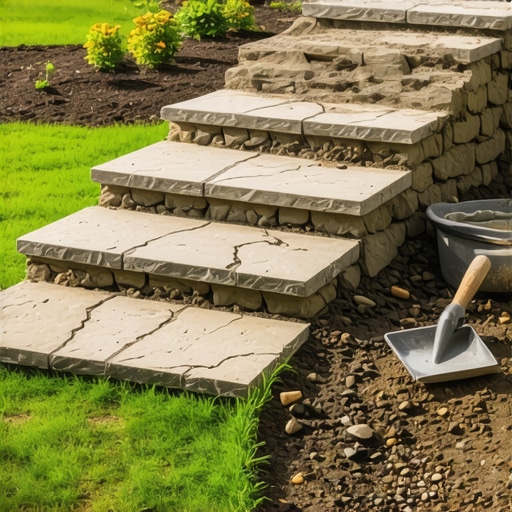
Understanding the Structural Failure of Sinking Stone Steps
A sinking stone staircase is a symptom of a failed foundation, usually caused by improper base compaction, hydrostatic pressure, or the presence of organic material beneath the structural stone. To fix a sinking staircase, you must excavate the entire structure, replace the soil with a 6-inch compacted modified gravel base, and install proper drainage systems to prevent future hydraulic shifting or frost heave.
The Hardscape Autopsy: Why This Happened
I recently got called out to tear up a $30,000 patio and staircase system that was sinking because the previous contractor thought he could save money by using dirt instead of modified gravel. When I dug it up, I found a anaerobic mess of rotting roots and saturated clay. The staircase didn’t just ‘settle’; it was being pushed out by the weight of the hill because there was no drainage. This is what happens when you hire a ‘mow-and-blow’ crew to do an engineer’s job. Landscaping is about managing water and gravity. If you ignore the physics, the stones will move every single time. It is a mathematical certainty. You cannot simply ‘tuckpoint’ a sinking step. You have to go deep.
“A retaining wall or stone staircase doesn’t fail because of the stone; it fails because of the water trapped behind it.” – Hardscape Engineering Axiom
The Physics of Stone Settlement
When we talk about yard cleanup, people think about raking leaves. To a foreman, it means clearing out the organic debris that traps moisture against your hardscape. If you have a staircase sinking, the first culprit is the base material. Most DIYers and low-bid contractors use ‘pea gravel’ or sand. Pea gravel acts like ball bearings; it never stays put. You need 21A or CR6 modified stone—a mix of various sizes that lock together under 3,000 PSI of compaction. Without this mechanical lock, the weight of the stone treads (which can exceed 200 pounds each) will simply compress the air pockets in the soil. This is exacerbated by your irrigation system if it is leaking or over-spraying. Over-saturation turns your soil into a slurry. You need to ensure your irrigation lines are at least three feet away from any structural hardscape base.
Material Comparison for Staircase Foundations
| Material Type | Compaction Rating | Drainage Capability | Recommended Use |
|---|---|---|---|
| Modified Gravel (21A/CR6) | High (98% Proctor) | Moderate | Primary Load-Bearing Base |
| #57 Clean Stone | Low (Self-compacting) | Excellent | Drainage Behind Walls |
| Concrete Sand | Medium | Low | Setting Bed Only (1 inch) |
| Topsoil/Fill Dirt | None | None | Never use for Hardscape |
The Step-by-Step Remediation Process
First, we strip the area. This isn’t a delicate process. We use a pry bar and a sled to remove the stone treads. Check each stone for cracks. If the stone is compromised, it is garbage. Next, excavate. You need to get down past the organic ‘A’ horizon of the soil. If I see a single root, I keep digging. Once you hit sub-grade clay or till, you lay down a non-woven geotextile fabric. This fabric is the ‘skin’ that keeps your expensive gravel from disappearing into the mud.
“Proper base preparation requires the removal of all organic matter and the compaction of sub-grade soils to 95% of the standard proctor density to prevent differential settlement.” – Penn State Department of Plant Science
Fill the hole with 2-inch lifts of modified gravel. If you dump 6 inches in at once and run a tamper over it, the bottom 4 inches will stay loose. You do it in lifts. Each lift gets hit with a plate compactor until the machine literally bounces off the surface. That is the sound of success. It should feel like a highway. If you are doing a sod install after the repair, keep the sod at least two inches away from the stone base to prevent water from wicking into the foundation.
Hardscape Repair Checklist
- Excavation: Minimum 6-12 inches below the first step.
- Geotextile: Non-woven fabric to separate soil from stone.
- Base Material: 21A Modified or 3/4″ minus crushed rock.
- Compaction: Plate compactor (not a hand tamper) for every 2-inch layer.
- Leveling: Use a transit level, not a 2-foot bubble level.
- Adhesive: High-temp polyurethane hardscape glue for the treads.
How much modified gravel do I need for a patio base?
To calculate your base material, multiply the square footage by the depth (in feet), then multiply by 1.35 to account for compaction shrinkage. For a standard 10×10 area with a 6-inch base, you need roughly 3.5 tons of gravel. Don’t guess. If you under-order, you’ll be tempted to use ‘fill,’ and that is how you end up back at square one.
Can I fix a sinking step without taking it apart?
No. You cannot. Anyone who tells you they can ‘mud-jack’ or ‘inject foam’ under a dry-laid stone staircase is selling you a temporary fix. The underlying soil is the problem. If you don’t remove the soil and replace it with a structural base, the stone will continue to follow the path of gravity. It will rot the aesthetic of your entire landscaping project. Do it once. Do it right.
Long-Term Maintenance and Drainage
Once the steps are reset, look at your irrigation. Many sinking staircases are caused by a broken lateral line or a head that is misting the base of the stairs. Water is the enemy of stone. Ensure your yard cleanup includes clearing the French drains or weep holes at the base of the staircase. If water pools at the bottom step, it will eventually undermine the entire project. Direct your downspouts away. Control the water, or the water will control your yard. It’s that simple.