
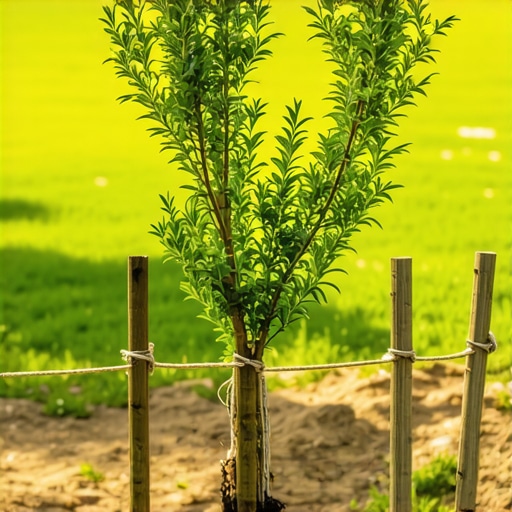
Why Most Tree Staking Fails Before the First Storm
Staking a newly planted tree for wind involves using two or three wooden stakes driven into solid ground outside the root ball, connected with flexible flat webbing to allow the trunk to sway slightly. This movement stimulates trunk taper and root growth while preventing the root ball from shifting in its soil pocket. Most homeowners treat a tree like a structural beam or a fence post, but a tree is a biological hydraulic system that requires movement to gain strength. If you strap a tree down too tight, you create a weak point at the tie-off. When the ties eventually fail, or the tree grows too large for the rigid support, it snaps. My firm has been called out to hundreds of sites where a $500 specimen was killed not by the wind, but by the very wires meant to protect it.
The Narrative Reality: The Apprentice Lesson
I always drill into my new crew members: if you don’t fix the soil grading first, every plant you put in the ground is just expensive compost. I remember a job back in 2008 where we were tasked with planting a row of 15-foot October Glory Maples. The site was a mess of heavy clay that had been compacted by heavy machinery. One of the junior guys wanted to just dig the holes and drive the stakes. I stopped him and made him check the percolation. The water sat for four hours. If we had staked those trees in that soup, the stakes would have acted like levers, prying the root balls out of the ground the moment a 20-mile-per-hour gust hit. We spent two days correcting the grade and installing a French drain system before a single tree touched the dirt. That is the difference between a landscaper and a guy with a truck and a shovel. You have to understand the engineering of the ground before you worry about the biology of the leaves.
The Physics of Wind Load and Trunk Taper
To understand staking, you must understand thigmomorphogenesis. This is the biological response of a tree to mechanical sensation. When a tree sways, it produces more lignin and increases its radial growth, particularly near the base. This creates what we call trunk taper. A tree that is staked too high or too rigidly will grow like a telephone pole: tall, thin, and structurally incompetent.
“Staking and guying can have several negative effects on trees, including reduced trunk taper, increased stress at the point of attachment, and bark abrasion.” – ISA Arboriculture Standard
We want the tree to move. The stakes are only there to keep the root ball from rocking. If the root ball rocks, the fine hair-like feeder roots that are trying to penetrate the native soil will snap. It is like trying to heal a broken leg while someone keeps kicking it. You need the roots to be static, but the canopy to be dynamic.
Comparative Staking Materials and Methods
| Material Type | Pros | Cons | Best Use Case |
|---|---|---|---|
| Galvanized Wire in Hose | Very strong, cheap | Girdles bark, causes rot | Never recommended |
| Polypropylene Webbing | Wide surface area, flexible | Can degrade in UV after 2 years | Standard residential planting |
| Elastic Tree Ties | Maximum movement | Less support for heavy canopies | Small saplings in high wind |
| 2×2 Cedar Stakes | Rot resistant, rigid | Can snap in extreme soil shear | Standard 2-inch caliper trees |
The Step-by-Step Installation Protocol
First, identify the prevailing wind direction. You want your stakes to be perpendicular to the wind. If the wind comes from the West, your stakes should be on the North and South sides of the tree. This allows the tree to sway into and away from the wind without hitting the stakes. Drive your 2×2 cedar stakes at least 18 inches into the undisturbed soil outside the planting hole. If you drive them into the backfilled soil, they will pull out. The stakes should be about 2 to 3 feet tall after they are driven. [image placeholder] Use a broad, flat webbing like Arbor-tie. Attach it about 18 inches to 2 feet above the ground. You do not need to go high. The lower the tie, the more the trunk can move. Use a figure-eight loop around the tree to prevent the webbing from sliding up or down the trunk. Ensure there is about 1 to 2 inches of slack. The tree should be able to move, but the root ball should stay dead still.
How deep do tree stakes need to be?
Stakes must penetrate the native, undisturbed soil by at least 18 to 24 inches. If you are working in sandy loam, you may need to go deeper or use three stakes instead of two. In heavy clay, 18 inches is usually sufficient because the soil density provides higher friction against the stake surface. Never rely on the loose backfill of the planting hole to hold a stake. It will fail during the first heavy rain when the soil reaches its saturation point and loses its structural integrity. This is often when hydrostatic pressure is at its highest, and the wind loads are most aggressive.
When should I remove tree stakes?
Stakes are a temporary prosthetic, not a permanent fixture. Most trees should have their stakes removed after one full growing season. If you plant in the spring, remove them the following spring. By then, the roots should have grown 12 to 18 inches into the native soil, providing enough natural anchorage.
“The main objective in staking a tree is to anchor the root ball in the soil until the roots grow into the surrounding soil.” – University Extension Manual
If you leave stakes on for two or three years, the tree becomes dependent on them. This is how you end up with a tree that falls over the first time you take the stakes off three years later. Inspect the ties every three months to ensure they aren’t rubbing the bark raw or becoming tight as the trunk expands.
Pre-Staking Checklist for Success
- Verify 811 utility markings before driving any stakes. A cedar stake can easily puncture a shallow irrigation line or a low-voltage lighting cable.
- Ensure the root flare (the point where the roots widen at the base of the trunk) is visible and at or slightly above the soil grade.
- Remove all nursery hardware, including wire baskets and burlap, from the top third of the root ball.
- Mulch properly. A 2-inch layer of organic mulch helps retain moisture, but keep it 3 inches away from the trunk. No mulch volcanoes.
- Deep soak the tree immediately after planting. This settles the soil and removes air pockets that can cause root desiccation.
Should I stake my tree on the windward side?
Actually, the two-stake method perpendicular to the wind is superior for most residential applications. If you use a single stake on the windward side, the tree is constantly pulled against the tie, which can cause severe bark abrasion and restricted growth on the windward side. By using two stakes positioned on the sides, the tree has the freedom to move within a controlled range. In extremely high-wind corridors, a three-stake triangular configuration is used. This involves three stakes spaced 120 degrees apart. This is common in coastal landscaping or open prairie environments where gusts exceed 50 miles per hour regularly.
Irrigation and Post-Planting Maintenance
Staking is only half the battle. A tree stressed by drought will not grow the roots necessary to eventually stand on its own. For a standard 2-inch caliper tree, you need approximately 15 to 20 gallons of water per week, delivered slowly. This is why professional irrigation systems with dedicated bubblers or drip emitters are vital. During the first year, the tree is in a recovery phase. Avoid heavy nitrogen fertilizers that promote rapid top growth. You want the tree to focus on root development, not putting out 3 feet of weak, floppy branches that act like a sail in the wind. Stick to a root stimulator or a low-NPK organic blend. Yard cleanup during the fall should involve checking the stakes to ensure they haven’t been loosened by frost heave. If the ground freezes and thaws, it can push the stakes up, rendering them useless. Always re-tamp the soil around the base of the stakes if this occurs.