
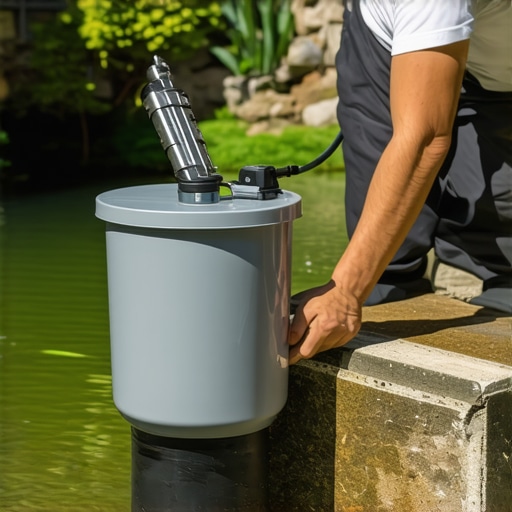
The Forensic Autopsy of a Dying Ecosystem
Cleaning a pond filter without draining the tank involves isolating the filtration unit and using dechlorinated pond water to rinse mechanical media while preserving the beneficial nitrifying bacteria colonies. This prevents a catastrophic crash of the pond’s nitrogen cycle and protects your fish from ammonia spikes. When you see that thick, pea-soup green water or notice your koi gasping at the surface, your instinct is to grab the pump and drain the whole thing. Don’t. You are looking at a system failure, but the solution isn’t a total reset. It is a surgical strike on the filtration media itself. I have walked onto properties where homeowners spent $10,000 on a custom water feature only to turn it into a sterile, chlorine-filled dead zone because they thought ‘clean’ meant ‘scrubbed with a brush.’ Real pond health is found in the muck, or more specifically, in the bacteria that live within it.
The Apprentice Lesson: Why Biology Trumps Aesthetics
I always drill into my new crew members: if you don’t fix the soil grading first, every plant you put in the ground is just expensive compost. The same logic applies to pond filtration. I remember a job three years ago where a new hire decided to ‘help’ by pressure washing the biological filter mats with city water. He thought he was being thorough. Within 48 hours, every fish in that 2,000-gallon pond was dead. Why? Because he didn’t just wash away the dirt; he nuked the entire nitrifying bacteria population. Those bacteria are the only thing standing between your fish and an ammonia-induced death. They convert toxic fish waste into nitrites, and then into relatively harmless nitrates. When you drain the tank or kill the filter bacteria, you reset that cycle to zero. You aren’t cleaning; you’re sabotaging. High-end landscaping requires understanding these microscopic cycles before you ever touch a tool.
“The biological filter is a living organism; treating it with chlorinated tap water is equivalent to sterilizing a fertile field with bleach.” – Aquatic Ecosystems Management Guide
The Physics of Filtration: Mechanical vs. Biological
Your filter has two distinct jobs that require two different cleaning approaches. The mechanical stage catches the ‘fines’ and large debris: the grass clippings from your yard cleanup, the decaying oak leaves, and the fish waste. This is the stuff that physically clogs the pump and reduces your Gallons Per Hour (GPH) flow. The biological stage is a habitat for bacteria. These bacteria need oxygenated water flowing over them at all times. If the mechanical stage gets too clogged, the flow rate drops, oxygen levels plummet, and your ‘good’ aerobic bacteria die off, replaced by ‘bad’ anaerobic bacteria that produce hydrogen sulfide. That rotten-egg smell you get when you stir up pond muck? That is the smell of a dying filter. You need to clear the path for water without killing the residents.
How often should I clean my pond filter?
Filter maintenance frequency depends entirely on your irrigation runoff, fish load, and the amount of debris entering the water. In a balanced system with 1 inch of fish per 10 gallons of water, you should be rinsing mechanical pads every 2 to 4 weeks during the peak growing season. If you just finished a major sod install nearby, you might need to clean it every few days until the site stabilizes. Runoff from new sod often carries high levels of phosphorus and nitrogen which can cause an algae bloom that will choke a filter in 48 hours. Watch the pressure gauge on your filter canister; a 5 PSI increase over the baseline is your signal to act.
| Media Type | Function | Cleaning Frequency | Cleaning Agent |
|---|---|---|---|
| Filter Mats (Coarse) | Mechanical | Every 2-4 Weeks | Pond Water Bucket |
| Bio-Balls / K1 Media | Biological | Twice a Year | Pond Water Bucket |
| UV Clarifier Quartz | Algae Control | Monthly Wipe | Vinegar / Soft Cloth |
| Polishing Pads (Fine) | Mechanical | Weekly | Replace / Rinse |
The Step-by-Step Isolation Method
First, turn off the pump. This sounds obvious, but you would be surprised how many people try to open a pressurized bead filter while it is running. Once the power is killed, close the valves leading to the pond to prevent backflow. You are now working on a closed loop. If you have a bottom drain, make sure it is shut so you don’t lose prime in your pump. Next, prepare three 5-gallon buckets. Fill them with water directly from the pond. This is the most critical step. This water contains the same pH, temperature, and mineral content as the filter’s current environment. It lacks the chlorine and chloramines found in your garden hose that would otherwise wipe out your bacterial colonies. It is a simple step that separates the pros from the hacks.
Can I use a garden hose to clean my pond filter pads?
No, you cannot use a garden hose directly on biological media because the chlorine will kill the nitrifying bacteria instantly. You can only use a hose if you are cleaning the exterior housing of the filter or if you are cleaning mechanical-only pads that will be treated with a dechlorinator afterward. However, the safest and most effective method is always to use buckets of pond water. If the pads are so clogged that pond water won’t clean them, they are likely past their functional lifespan and need to be replaced. Most high-quality filter mats should last 2 to 3 seasons if handled with care.
“Ammonia levels exceeding 0.05 mg/L can induce respiratory stress in koi, leading to secondary bacterial infections.” – Penn State Extension
- Inspect the O-Rings: Every time you open a canister filter, check the rubber gaskets for cracking. Use a silicone-based lubricant.
- Check the UV Bulb: If your system has a UV clarifier, check the ‘glow plug.’ Bulbs lose their effectiveness after 9,000 hours of use.
- Prune the Drip Line: Ensure no landscaping plants have grown roots into the filter’s discharge pipe.
- Monitor the Pump Intake: Clear any debris from the pump basket to prevent cavitation.
The Hidden Impact of Yard Cleanup and Runoff
When you are performing a yard cleanup, the debris doesn’t just vanish; much of it ends up as dissolved organic compounds in your water. If you are using a leaf blower near the pond, you are forcing fine dust and organic matter into the water column. This increases the ‘biological load’ on your filter. Furthermore, if you just had a sod install, the grading of the surrounding soil is paramount. If the soil slopes toward the pond, every rainstorm will wash fertilizer and silt into your filter. This is why I tell my clients that a pond is only as healthy as the yard around it. You must maintain a 2-inch buffer zone of river rock or a specialized swale to divert runoff away from the water feature’s edge.
The Restoration Phase
After the media is rinsed in the buckets and reinstalled, do not just flip the switch and walk away. This is when the system is most vulnerable. Add a concentrated dose of liquid beneficial bacteria directly into the filter chamber. This ‘boosts’ the population you just disturbed. Reconnect your plumbing, open the valves, and turn the pump back on. Check for leaks around the head unit immediately. For the next 24 hours, do not feed your fish. Feeding them increases ammonia production at exactly the moment your filter’s bacterial colony is recovering from the cleaning process. It is a small sacrifice for long-term stability.
The Long-Term Management Plan
Stop looking for a ‘set it and forget it’ solution. A pond is a living, breathing entity. If you treat it like a swimming pool, you will fail. If you treat it like a biological laboratory, you will succeed. Ensure your irrigation heads are not spraying directly into the pond, as this introduces untreated tap water and can cause temperature shocks. Keep your landscaping well-trimmed to prevent excessive leaf drop. If you follow this bucket-rinse method, you will maintain a crystal-clear environment without ever having to drain the tank and destroy the delicate balance you have worked so hard to build. It takes more effort than a garden hose, but the results are visible in the health of your fish and the clarity of your water. No shortcuts. No hacks. Just science. “