
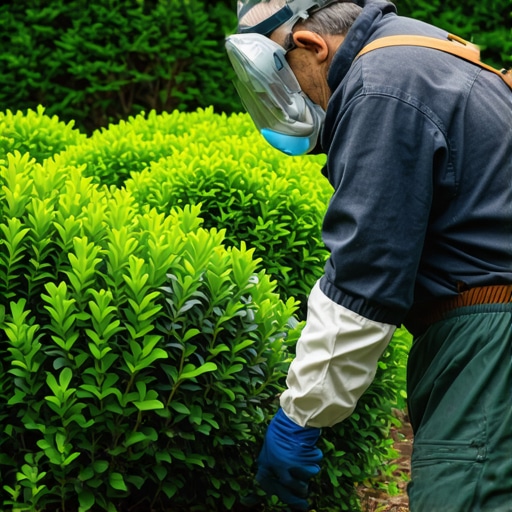
Stop 2026 Boxwood Blight: 3 Cleanup Tactics That Work
I always drill into my new crew members: if you do not fix the soil grading and environmental conditions first, every plant you put in the ground is just expensive compost. Last season, we spent three weeks on a site where the client had lost forty linear feet of English Boxwood. The cause was not just the fungus itself, but a complete failure in landscape hygiene and irrigation logic. The crew before us had been using the same unsterilized shears on every property in the neighborhood. They were essentially biological couriers for Calonectria pseudonaviculata. When I stepped onto that turf, I could smell the rot. The soil was a saturated, anaerobic mess because the irrigation heads were hitting the foliage directly for twenty minutes every night. That is a death sentence. To stop boxwood blight in 2026, you must stop thinking like a gardener and start thinking like a bio-hazard technician. This is not about aesthetics anymore. It is about containment and soil chemistry.
What is Boxwood Blight and Why Does it Kill So Fast?
Boxwood blight is a devastating fungal disease caused by Calonectria pseudonaviculata that manifests as dark brown leaf spots, black stem cankers, and rapid, total defoliation. It thrives in high humidity and temperatures between 60 and 80 degrees Fahrenheit, often killing mature hedges within a single season if left unchecked.
“Sanitation is the most critical component of a boxwood blight management program because the spores are heavy and sticky, clinging to tools, clothing, and animal fur.” – Virginia Cooperative Extension
How do I know if my boxwoods have blight or just winter burn?
Winter burn usually affects the outer tips of the plant and appears as a uniform tan or bleached color. Boxwood blight is different. You will see circular brown spots with a dark border on the leaves. Flip the leaf over. If you see white, fuzzy spore masses during humid weather, it is blight. The most defining characteristic is the black, diamond-shaped cankers on the green stems. If the stems are black, the tissue is necrotic. It will rot. There is no coming back from stem necrosis. Do not wait for the whole plant to turn brown. One infected branch can produce millions of spores that will splash onto the rest of your landscape during the next rain event.
Tactic 1: The Bio-Security Strip and Sanitation Protocol
The first step in any forensic cleanup is the creation of a bio-security perimeter. Boxwood blight spores are not wind-blown; they are moved by water splash and physical contact. If you walk from an infected area to a clean area, you are the vector. We implement a strict three-step sanitation process for every tool that touches the soil or the wood. Every saw, shear, and rake must be submerged in a solution of 70 percent isopropyl alcohol or a 10 percent bleach solution between every single plant. This sounds tedious. It is. But skipping it is how you lose a thirty-thousand-dollar hedge. You must also remove every single fallen leaf from the base of the plant. These leaves harbor the oospores which can survive in the soil for five years or more. We do not rake these. We vacuum them or hand-pick them. Bag them in heavy plastic. Seal the bag. Do not compost this material. If it goes in the compost pile, you are just incubating the pathogen for next year. Burning is the only way to ensure the spores are neutralized, provided your local municipal codes allow it.
What is the best fungicide for boxwood blight 2026?
Fungicides are a preventative, not a cure. You cannot spray your way out of an active infection that has already hit the stems. However, for surrounding healthy plants, a rotation of Chlorothalonil and Fludioxonil is the current industry standard. You must rotate the active ingredients to prevent fungal resistance. Apply every seven to fourteen days when the weather is warm and wet. Always follow the label rates exactly. Over-application leads to phytotoxicity, which further stresses the plant’s immune system.
Tactic 2: Soil Capping and Moisture Management
Irrigation is the primary driver of fungal proliferation in the modern yard. Most homeowners are over-watering. They have their zones set to run for fifteen minutes every day. This keeps the leaf surface wet for hours, providing the perfect film for spores to germinate. We switch all boxwood zones to drip irrigation or Netafim tech-line. The water must go directly into the soil, never on the leaves. If you see your rotors hitting the boxwoods, move them. We also implement “soil capping.” After removing all leaf litter, we apply a 2-inch layer of clean hardwood mulch. Do not use pine straw. Pine straw creates too many air pockets that allow spores to splash back up from the soil. A dense hardwood mulch acts as a physical barrier. It traps the spores on the soil surface and prevents them from reaching the lower interior branches. It also helps regulate soil temperature, which reduces the physiological stress on the root system.
| Boxwood Variety | Blight Resistance Level | Recommended Use |
|---|---|---|
| Buxus sempervirens (English) | Very Low | Avoid in humid climates |
| Buxus microphylla (Littleleaf) | Moderate | Good for low hedges |
| NewGen Independence | High | Primary replacement choice |
| NewGen Freedom | High | Fast growth, high resistance |
Tactic 3: Radical Airflow Engineering
Fungi hate moving air. Most boxwood hedges are grown too close together, creating a stagnant micro-climate where humidity stays at 90 percent all day. We use a technique called “thinning cuts.” Instead of just shearing the outside of the boxwood into a smooth ball, which creates a thick shell of foliage, we reach inside and remove 10 to 15 percent of the interior branches. This allows light to penetrate the center and allows wind to dry out the inner stems. If the interior of the plant stays dry, the spores cannot germinate. You should be able to see bits of light through the plant when you are done. This is not about making it look pretty today; it is about making sure it is alive next year. We also look at the surrounding canopy. If a large oak tree is shading the boxwoods and preventing the morning sun from drying the dew, we prune the oak. Sun is a natural disinfectant.
“A landscape design that ignores hydrostatic pressure and air movement is a landscape designed for failure.” – Hardscape Engineering Axiom
The 2026 Boxwood Health Checklist
- Sterilize all pruning tools with 70 percent alcohol between each plant.
- Remove 100 percent of fallen leaf litter and bag it for disposal.
- Convert all overhead spray irrigation to low-volume drip emitters.
- Apply a 2-inch hardwood mulch cap to suppress soil-borne spores.
- Perform thinning cuts to ensure interior airflow and light penetration.
- Monitor soil pH; boxwoods prefer a range of 6.5 to 7.2 for optimal nutrient uptake.
Landscape maintenance is not a set-it-and-forget-it endeavor. It is an ongoing battle against biology. If you are dealing with a heavy clay soil, like the red clay common in many suburban developments, your drainage issues are magnified. Water sits in the root zone, creates stress, and invites the blight. In these cases, we often have to install French drains or regrade the entire bed to ensure water moves away from the root flares at a rate of at least 1 inch per hour. If the ground is soggy, the boxwood is a goner. Check your soil compaction. If you cannot push a screwdriver six inches into the ground with one hand, your roots are suffocating. Aerate the area manually if you have to. Every bit of oxygen you get to the roots helps the plant fight off the infection. This is about building a resilient system. Don’t skip the details. It will rot if you do.