
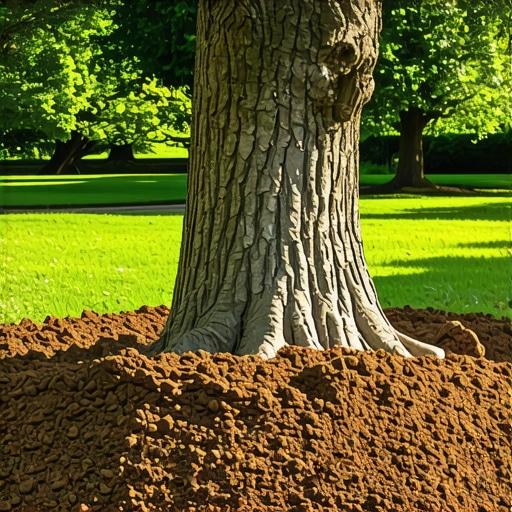
The Hard Truth About Tree Health and Mulch Application
I always drill into my new crew members: if you do not fix the soil grading and respect the root flare, every plant you put in the ground is just expensive compost waiting to happen. Mulch volcanoes—the practice of piling mulch high against a tree trunk—are an arboricultural crime that causes trunk decay, root girdling, and eventual tree death by suffocating the cork cambium and trapping moisture where it should not be. It is a visual signal of a contractor who prioritizes aesthetics over biology. During a routine yard cleanup last season, I had to explain to a client why their twenty-year-old maple was dying; the previous ‘mow-and-blow’ crew had built a two-foot mound of hardwood mulch around the base for five years straight. The bark was literally sloughing off in my hands.
“Mulch applied in a ‘volcano’ fashion traps moisture against the trunk, leading to phloem necrosis and providing a harbor for pathogens and wood-boring insects.” – International Society of Arboriculture (ISA) Best Management Practices
Why Are Mulch Volcanoes Bad for Trees?
Mulch volcanoes kill trees by trapping excessive moisture against the bark, leading to secondary root growth that eventually strangles the main trunk, known as girdling roots. This improper technique prevents gas exchange between the soil and the atmosphere, effectively suffocating the root system while creating a dark, damp environment perfect for fungal pathogens like Phytophthora. Bark is the tree’s skin; it is meant to be dry. Roots are meant to be moist. When you flip that logic by burying the bark in wet mulch, the tree’s structural integrity is compromised. The tissue begins to rot, and the tree loses its ability to transport nutrients from the roots to the canopy.
How Much Mulch Is Actually Needed?
For most residential landscaping applications, a layer of 2 to 4 inches is the professional standard. Anything deeper than 4 inches begins to inhibit oxygen levels in the soil, which is critical for root respiration. You must maintain the ‘donut’ shape, not the ‘volcano.’ This means the mulch should start 3 to 6 inches away from the actual trunk, exposing the root flare—the area where the trunk widens as it meets the roots. If you cannot see the flare, the tree is planted too deep or mulched too high. Stop doing it. It will rot.
| Mulch Type | Recommended Depth | Decomposition Rate | Best Use Case |
|---|---|---|---|
| Triple-Shredded Hardwood | 2-3 Inches | High | Standard garden beds, slopes |
| Pine Bark Nuggets | 3-4 Inches | Low | Large established trees |
| Arborist Wood Chips | 3-5 Inches | Medium | Naturalized areas, soil biology boost |
| Cedar Mulch | 2-3 Inches | Very Low | Insect deterrence, paths |
Does Improper Mulching Affect My Irrigation System?
Excessive mulch depth acts as a hydrophobic barrier or a giant sponge that prevents water from reaching the root zone. In many irrigation audits I perform, I find that even with a functional zone, the water never penetrates the 6-inch mulch mound, leaving the actual soil bone dry. This leads to hydrostatic imbalance. If you have recently performed a sod install, you might be tempted to mulch heavily to match the new grass height. Don’t. The sod and the tree have different hydrological needs. Turf needs frequent shallow watering; trees need deep, infrequent saturation.
How Do I Fix a Mulch Volcano?
The remediation process is a manual labor task that requires a light touch. You must carefully rake back the excess material until the root flare is visible. If you find small, fibrous roots growing upward into the mulch, these are adventitious roots. They need to be pruned carefully if they are starting to circle the trunk. Once the flare is exposed, ensure the soil grade slopes away from the tree to prevent water pooling. This is a critical step in any professional yard cleanup. Don’t use a power spade near the trunk; use your hands or a small hand trowel to avoid scarring the bark. Use a 3-3-3 rule: 3 inches of mulch, in a 3-foot radius, kept 3 inches away from the trunk.
“A tree’s root system extends far beyond the drip line, and the most critical area for gas exchange is the upper 6 to 12 inches of soil profile.” – ANSI A300 (Part 2) Soil Management Standards
What Is the Best Material for Healthy Trees?
I prefer aged arborist wood chips over the dyed, bagged stuff you find at big-box stores. Dyed mulch often contains recycled pallet wood which can harbor chemical residues and has a high carbon-to-nitrogen ratio that can actually pull nitrogen out of your soil as it breaks down. Natural wood chips mimic the forest floor. They encourage mycorrhizal fungi which form a symbiotic relationship with tree roots, increasing their ability to take up phosphorus and water. If you are doing a sod install nearby, keep a clear buffer zone between the grass and the mulch bed to prevent the mower from throwing chips or the grass from creeping into the tree’s root zone.
How Much Modified Gravel Do I Need for a Patio Base?
While not directly related to mulching, if you are building a hardscape near trees, you need 6 inches of compacted 21A or 57 stone, but you must never compact soil within the drip line of a tree. Soil compaction is the silent killer of urban trees. If your landscaping plan includes a patio, keep the excavation at least 10 to 15 feet away from the trunk of a mature specimen. The weight of the gravel and the vibration of the plate compactor will crush the fine feeder roots, leading to canopy dieback in three to five years.
- Identify the root flare before applying any material.
- Remove old mulch layers before adding new ones; never exceed 4 inches total depth.
- Use natural, undyed organic matter to support soil microbiology.
- Ensure irrigation emitters are not buried under mounds of mulch.
- Check for girdling roots during every seasonal yard cleanup.