
The Anatomy of a Sinking Pond Liner
Pond liners sink because of subgrade soil compaction failure, poorly executed shelf-cutting, or inadequate anchoring of the perimeter coping stones. When the soil beneath the EPDM membrane isn’t stabilized with crushed stone or geotextile underlayment, hydrostatic pressure and water weight force the liner into voids, causing catastrophic structural displacement. It is rarely a leak; it is almost always a failure of the civil engineering beneath the water.
The Hardscape Autopsy: Why This Specific Job Failed
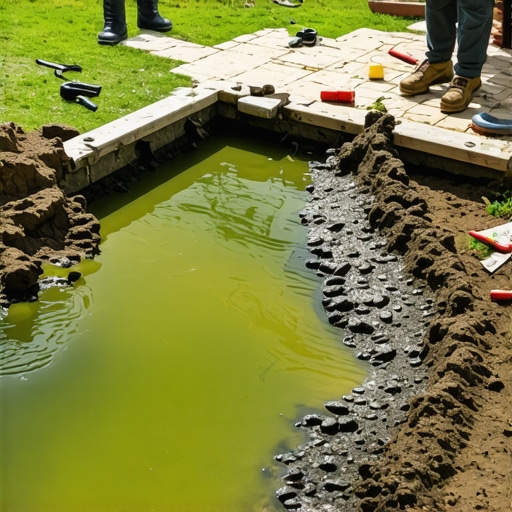
I recently got called out to tear up a $30,000 pond and patio installation that was sinking because the previous contractor thought he could skip the underlayment on a slope. The client was losing three inches of water a day. He thought it was a puncture. I spent six hours excavating the perimeter and found that the entire shelf had liquified. The contractor had used loose fill dirt to level the site instead of structural fill. As the water weight pressed down—roughly 8.3 pounds per gallon—the loose dirt turned into mud, and the liner simply followed the path of least resistance down into the earth. We had to crane out three-ton boulders just to reach the failure point. This is what happens when you treat a pond like a bathtub rather than a hydraulic structure. If the base isn’t solid, the feature is just expensive compost in the making.
“A retaining wall doesn’t fail because of the stone; it fails because of the water trapped behind it.” – Hardscape Engineering Axiom
The Physics of Soil Subsidence and Hydrostatic Pressure
When you dig a pond, you are disturbing the natural compaction of the earth. Soil has a specific shear strength. Once you introduce water weight, you are testing that strength. If your yard cleanup involved heavy machinery that wasn’t followed by proper grading, you likely have pockets of air in your soil. In regions with heavy clay, the soil expands and contracts. In sandy loam, it washes away. A sinking liner is often the result of the ‘capillary effect,’ where water wicks over the edge of the liner and saturates the soil behind it, causing the entire bank to slump. You must ensure your irrigation lines are at least five feet away from the pond’s edge to prevent external saturation of the shelf. One leak in a nearby irrigation head can liquefy your pond’s foundation in forty-eight hours. It is a slow-motion disaster.
How much modified gravel do I need for a pond base?
For a standard pond base, you need a minimum of 4 to 6 inches of compacted #57 crushed stone or modified gravel to ensure the subgrade does not shift under the weight of the water. This layer acts as a structural bridge, distributing the weight of the 45-mil EPDM liner and the decorative boulders across a wider surface area to prevent localized sinking.
| Material Substrate | Compaction Rating (PSI) | Subsidence Risk Level |
|---|---|---|
| Loose Topsoil | < 800 | Critical |
| Compact Clay | 1,500 – 2,000 | Moderate |
| Crushed Stone (#57) | 3,500+ | Negligible |
| Engineered Structural Fill | 4,500+ | Low |
The Forensic Step-by-Step Remediation Process
If your liner is already sinking, you cannot fix it from the top. You have to go deep. Stop adding water; you are only making the mud softer. First, remove the coping stones. These are the heavy rocks around the edge. Most ‘mow-and-blow’ contractors just sit them on the liner. That is a mistake. They need to be set on a concrete collar. Second, pull back the liner and inspect the shelf. If the soil is mushy, you must excavate it and replace it with crushed stone. Don’t use sand; sand migrates. Use stone that locks together. Third, install a non-woven geotextile underlayment. This fabric prevents the liner from being punctured by the stone while allowing the soil to breathe without washing away. Secure the liner into an anchor trench—a 12-inch deep ditch dug 6 inches back from the water’s edge. Fold the liner into it and backfill with heavy gravel. It won’t move again.
- Step 1: Drain the pond to below the lowest sinking point to relieve pressure.
- Step 2: Remove all stone media and organic sludge from the affected area.
- Step 3: Re-grade the shelf to a slight 5-degree inward slope to prevent outward sliding.
- Step 4: Install a concrete collar if the perimeter boulders exceed 200 lbs.
- Step 5: Apply polymeric sand or stone dust to lock the final coping layer.
How do I know if my pond liner is leaking or just sinking?
To distinguish between a leak and subsidence, perform a ‘leak down’ test by turning off all pumps and marking the water level. If the water level stays the same but the rocks are shifting, your soil is failing. If the water drops and the liner remains taut, you have a puncture in the EPDM membrane that requires a chemical patch kit.
The Intersection of Sod Installation and Pond Integrity
Many homeowners make the mistake of doing a fresh sod install right up to the edge of the pond liner. This is a recipe for disaster. Sod requires heavy initial watering. That water runs straight under the liner if the edge isn’t sealed. When we do a yard cleanup, we ensure the grade slopes away from the pond. You want a 2% grade minimum moving water away from the feature. If your irrigation system is hitting the pond, you are also introducing phosphates and nitrates into the water, which will bloom algae faster than you can scoop it out. Keep the lawn and the pond separate. Use a dry creek bed or a gravel buffer. It looks better and it saves your foundation. Don’t skip the compaction. Use a plate tamper. It should literally bounce off the ground when you are done. If it sinks, you aren’t finished.
“Soil pH and moisture content dictate the longevity of any buried membrane; ignore the chemistry, and the physics will punish you.” – Journal of Agronomy and Hardscape Standards
The Maintenance Schedule for Year One
After you secure the liner, the first twelve months are the settling period. Check the perimeter after every major rain event. Look for ‘soft spots’ in the grass near the edge. If you see a dip, fill it immediately with 1/4-inch minus gravel. Do not use mulch; mulch holds water and promotes rot at the liner’s edge. Watch your pond’s water level. A stable liner means a stable ecosystem. If you do the work right the first time, you won’t be calling me to crane out your mistakes later. It is about the dirt. It is always about the dirt.