
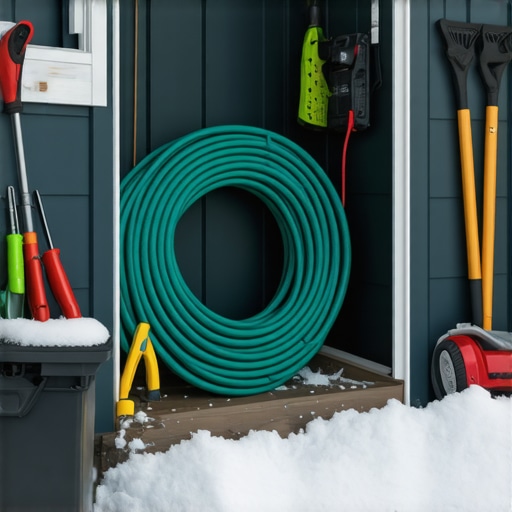
Why Winter Kills Your Landscape Equipment
I recently got called out to tear up a $30,000 patio that was sinking because the previous contractor failed to account for the hydrostatic pressure and poor drainage around an outdoor spigot that had slow-leaked all winter. A frozen hose attached to a frost-proof bib isn’t just a hose problem; it is a structural threat to your hardscaping and your home’s foundation. When water freezes, it expands by approximately 9 percent. This expansion exerts thousands of pounds of pressure per square inch. If that water is trapped inside a reinforced PVC or rubber hose, it will find the weakest point. It will split the casing. It will strip the brass threads. Worse, it will back up into the copper piping inside your wall and cause a pinhole leak that you won’t find until your drywall starts growing black mold in April. This is the reality of professional maintenance. It is not about neatness. It is about engineering. Use this guide to prevent material failure during the freeze-thaw cycle.
The Best Way to Store Your Garden Hose for Winter
To store your garden hose for winter, you must disconnect it from the spigot, drain every drop of residual water by gravity or compressed air, and coil it in a 3-foot diameter loop before storing it in a temperature-controlled environment like a basement or heated garage to prevent polymer fatigue.
“Frozen water in a hose or irrigation line can create an ice plug that prevents expansion, leading to a build-up of pressure that can rupture even heavy-duty materials.” – Penn State Extension Horticultural Manual
The Science of Material Degradation in Sub-Zero Temperatures
Most homeowners buy cheap vinyl hoses from big-box stores. These are essentially disposable. Vinyl becomes brittle at 32 degrees Fahrenheit. If you leave a vinyl hose on a reel outside, the internal lattice of the plastic micro-cracks. When you pressurized it in the spring, it will leak from a thousand pores. Professional-grade hoses are often made of EPDM rubber or polyurethane. While these materials handle cold better, they are not immune to the damage of ice crystals. The brass fittings on the end of your hose are also at risk. Brass is an alloy that can contract and expand at different rates than the hose material. This creates gaps in the crimp. Once that seal is broken, the hose is garbage. You cannot fix a crimp leak reliably. You throw the hose away. That is a waste of money and resources. Proper yard cleanup involves more than just raking leaves. it involves protecting your infrastructure. If you just finished a sod install, you have likely spent thousands on irrigation and hoses. Don’t let $100 worth of rubber ruin your investment.
| Hose Material | Cold Resistance | Durability | Winter Storage Requirement |
|---|---|---|---|
| Vinyl (PVC) | Poor | Low | Must be moved to heated indoor space |
| Rubber (EPDM) | Excellent | High | Drain and store in unheated garage |
| Polyurethane | Good | High | Drain and store in shed |
| Expandable (Fabric) | Terrible | Very Low | Must be drained and kept above 40°F |
How much water is left in a drained hose?
Even if you think you have drained a hose by dragging it across the lawn, a 50-foot hose can hold up to a quart of water in its low spots. This is enough to cause an ice plug. You must use gravity. Drape the hose over a fence or a ladder to ensure every drop exits the nozzle end. If you have an air compressor, blow it out at low PSI (under 30). This is the only way to be 100 percent sure. This is the same principle we use when winterizing a professional irrigation system. We don’t guess. We verify. If you are doing a final yard cleanup, this should be the very last thing you do after the final mow and the final watering of your new sod install. Established sod needs less water in the winter, but it still needs the ground to be clear of heavy, water-filled hoses that can smother the dormant grass and create fungal pockets.
Can I leave my hose on the reel outside?
No. Most hose reels are made of plastic or thin-walled metal. They hold water in the internal plumbing of the reel itself. If that water freezes, the reel will crack. If you must store it outside, you are gambling with the lifespan of the equipment. UV rays in the winter are also surprisingly harsh. Combined with the cold, the sun will bleach and weaken the outer jacket of the hose. Move it inside. A basement or a heated crawlspace is ideal. If those aren’t options, a sturdy plastic bin in the garage will suffice. This keeps the rodents from chewing on the rubber, which is a common issue in rural areas. Mice love the salt and minerals that accumulate on the outside of a garden hose.
The Professional Winterization Checklist
Follow this list to ensure your irrigation tools survive until the spring thaw. Do not skip steps. Precision is the difference between a pro and a hack.
- Disconnect all hoses from outdoor faucets to allow the backflow preventer to drain.
- Drain the hose using the gravity method (over a shoulder or fence).
- Inspect brass couplings for cross-threading or mineral buildup.
- Apply a thin layer of silicone lubricant to the O-rings or gaskets.
- Coil the hose in large, loose loops (never tight kinks).
- Connect the male and female ends together to keep spiders and dirt out.
- Store in a dark, dry, climate-controlled area.
- Shut off the interior water valve leading to the outdoor spigot.
- Open the outdoor spigot to release any trapped pressure.
“The primary cause of outdoor faucet failure is the failure to disconnect a garden hose before the first hard freeze.” – International Association of Certified Home Inspectors (InterNACHI)
The Link Between Hose Care and Landscape Health
A failed hose often leads to a failed sod install or a dead garden bed. If you go to water your transplants in the spring and your hose is leaking, you will likely under-water. Or, you will leave a leaking spigot running, which saturates the soil and leads to root rot. Landscaping is a system. Every tool in that system must be maintained. When we do a yard cleanup for a client, we don’t just blow leaves. We check the irrigation. We check the drainage. We ensure the hoses are stored properly because we know that a soggy foundation in January leads to a cracked patio in June. Do the work now. Save the money later. It is that simple. Don’t be the homeowner who has to call me to replace a burst pipe because they were too lazy to walk a hose to the garage. It is an expensive mistake. Treat your equipment with the same respect you treat your plants. Soil health, irrigation efficiency, and tool maintenance are the three pillars of a high-end landscape. Neglect one, and the others will suffer. Make this winter the year you actually take care of your gear. Your wallet will thank you when April rolls around.