
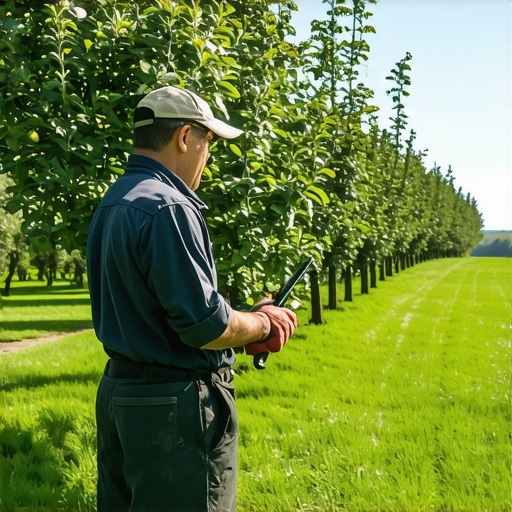
Why the Open-Center Method is Mandatory for Apple Yields
The open-center pruning method, often called vase-shaped pruning, involves removing the central leader to allow sunlight penetration and airflow into the canopy. This technique minimizes fungal pathogens and maximizes fruit spurs on scaffold branches, essential for high-density apple production in the 2026 season. I always drill into my new crew members: if you don’t fix the soil grading first, every plant you put in the ground is just expensive compost. You can’t expect an apple tree to thrive in a swamp. We see it every day during a standard yard cleanup—homeowners plant a Malus domestica in a low spot with zero drainage, then wonder why the roots are suffocating. Last month, I had to explain to an apprentice that pruning is secondary to the root flare. If the tree is planted 3 inches too deep, your pruning won’t save it from collar rot. We are building a structural skeleton, not just clipping twigs.
“The objective of pruning young trees is to develop a strong framework that will support heavy crops and allow for efficient pest management.” – Penn State Agricultural Extension
How do I prune a young apple tree for the first time?
Initial pruning requires a heading cut at 24 to 30 inches above the ground to stimulate lateral branch development. Ensure you are using bypass pruners, not anvil style, to avoid crushing the vascular cambium. This first cut dictates the height of your primary scaffold limbs. You aren’t just cutting wood; you are redirecting auxins. When you remove the apical bud, you break the hormone-driven suppression of lower buds. This forces the tree to push energy into the sides, creating that vase shape we need for the 2026 harvest. Stop thinking about aesthetics. Think about photosynthetically active radiation (PAR). Every leaf that doesn’t see the sun is a parasitic drain on the tree’s resources.
The 2026 Timeline: Year-by-Year Structural Development
Success in 2026 requires a 36-month vision that balances vegetative growth with reproductive potential. Most amateurs wait until the tree is overgrown to prune, which results in massive, water-sprout-inducing wounds that invite fire blight. In year one, we select 3 to 5 primary scaffolds. These should be spaced 4 to 6 inches apart vertically and distributed evenly around the trunk. If you have two branches growing from the same point, one has to go. It is binary. Use a branch spreader to keep crotch angles between 45 and 60 degrees. Anything tighter than 30 degrees will develop included bark, which is a structural failure waiting to happen under the weight of a full fruit load. We don’t want the tree to snap when the 2026 crop hits its peak weight in late August.
| Cut Type | Physiological Result | Best Used For… |
|---|---|---|
| Heading Cut | Stimulates lateral growth below the cut | Establishing scaffold height |
| Thinning Cut | Removes entire branch to the collar | Increasing light and airflow |
| Bench Cut | Redirects a vertical limb to an outward lateral | Lowering the canopy height |
What is the best month to prune apple trees in 2026?
Late winter, specifically February or March, is the optimal window because the tree is dormant but the healing response is about to accelerate with the spring sap flow. Avoid pruning in late autumn. Pruning is a stimulus. If you prune in October, you might trigger a late-season flush of growth that will be annihilated by the first hard freeze. I’ve seen entire landscaping projects ruined because a crew went through in November and ‘tidied up’ the orchard. That’s not maintenance; it’s botanical malpractice. You wait for the tree to be fully dormant. The cold helps prevent the spread of bacterial cankers. If the temperature is above 40 degrees and raining, stay out of the orchard. You’ll just spread spores.
Integrating Landscape Systems: Irrigation and Sod Management
Modern orcharding requires a holistic view of the yard, where irrigation and sod install protocols directly impact the tree’s nitrogen uptake. You cannot run a standard lawn sprinkler and expect a healthy apple tree. Overhead watering is a death sentence for pome fruits; it creates the perfect microclimate for apple scab and powdery mildew. We install drip irrigation systems that deliver water directly to the root zone. Furthermore, do not let your sod install reach the trunk. I see ‘mow-and-blow’ hacks run Kentucky Bluegrass right up to the bark. That grass is a nutrient thief. It will out-compete the tree for surface nitrogen every time. Maintain a 3-foot mulch ring (no mulch volcanoes!) to suppress competition and retain moisture during the July heat. It’s simple: grass at the trunk leads to trunk rot and stunted growth.
“A retaining wall doesn’t fail because of the stone; it fails because of the water trapped behind it, much like a tree fails because of the pathogens trapped in its canopy.” – Hardscape Engineering Axiom (Adapted)
- Sterilize tools with 70% isopropyl alcohol between every tree to prevent fire blight spread.
- Remove mummies (dried fruit) during your yard cleanup to break the life cycle of pests.
- Check soil pH; apple trees prefer a slightly acidic 6.0 to 6.5 range for optimal nutrient solubility.
- Inspect for borers at the base of the trunk before the spring growth flush.
Pathogen Prevention and Final Structural Checks
As we approach the 2026 season, the focus shifts from building wood to managing fruiting spurs. A tree that is too dense will hold humidity, and humidity is the carrier for every disease that ruins a harvest. During your final dormant prune, look for the ‘three Ds’: dead, damaged, or diseased wood. Cut them out first. Then, look for crossing branches. If two limbs touch, they will rub, create a wound, and invite infection. Your goal is to be able to throw a bird through the center of the tree without it hitting a wing. That is the old-timer’s rule, and it still holds 100% true today. Hard pruning in the dormant season will result in vigorous growth, so be prepared to do some light summer thinning to keep the scions in check. If you skip the maintenance, the 2026 crop will be small, scabby, and worthless. Do the work now. The tree doesn’t care about your schedule; it only cares about the biology of the cut.