
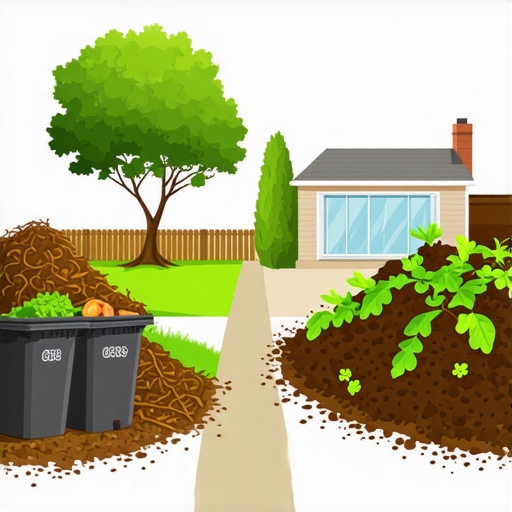
The Engineering of Yard Waste Management
When choosing between curbside disposal and on-site composting for 2026 yard waste, homeowners must evaluate nutrient cycling, municipal compliance, and carbon-to-nitrogen ratios. Effective yard cleanup involves the strategic separation of lignocellulosic woody debris from nitrogen-rich grass clippings to maximize soil health or minimize disposal fees. I always drill into my new crew members: if you don’t fix the soil grading first, every plant you put in the ground is just expensive compost. That technical wisdom extends to how we handle what we cut out. Most contractors treat debris as a nuisance to be hauled away to a landfill. I see it as a raw material. If you are doing a sod install, you are moving tons of biomass. Managing that weight requires an understanding of logistics and biology. Waste is just misplaced resources. I have seen guys lose their entire profit margin on a landscaping job because they didn’t account for the weight of wet irrigation-soaked sod. We are talking about 30 pounds per square yard. Do the math. It adds up to tons of material that needs a home.
“The biological decomposition of organic matter in a compost pile is an aerobic process that requires specific moisture levels and oxygen concentrations to prevent anaerobic putrefaction.” – Agricultural Extension Agronomy Manual
How much yard waste fits in a standard 96-gallon bin?
A standard 96-gallon municipal bin can hold approximately 4 to 5 cubic feet of compressed yard cleanup debris, which typically equates to about 50-75 pounds of dry material or 150 pounds of wet grass. Overfilling these bins leads to hydraulic failure in the collection trucks and potential fines for the homeowner. In 2026, many municipalities are moving toward strict weight limits enforced by automated sensors on the lifting arms. If your irrigation system is running the night before your pickup, your grass clippings will be 40% heavier. This is a common point of failure for DIY homeowners. They think they are being efficient, but they are actually triggering overweight surcharges. We treat waste like we treat a sod install: we measure the moisture content before we move a single shovel of dirt. It is the difference between one trip to the dump and three. It is about the PSI on your tires and the structural integrity of your trailer. Don’t be the guy who snaps an axle because he thought wet oak leaves were light.
The Municipal Curbside Protocol: Efficiency vs. Cost
Municipal curbside yard waste programs utilize industrial-scale aerobic digesters and tub grinders to process organic matter into low-grade mulch or bio-fuel. While convenient, this yard cleanup method removes essential micronutrients like manganese and zinc from your local ecosystem, requiring more chemical inputs later. In 2026, the cost of these services is projected to rise due to fuel surcharges and labor shortages. When we perform a sod install, the old turf often goes to these facilities. Why? Because the volume is too great for a home compost bin. You are looking at a 10:1 reduction in volume once material is ground up. If you have a half-acre lot, a full landscaping renovation can generate 20 cubic yards of debris. You cannot compost that in a plastic bin behind the garage. You need a fleet. The curbside option provides a pressure valve for these high-volume events. However, you pay for that pressure valve through your property taxes and monthly utility fees. It is a convenience tax on your property’s potential fertility.
| Metric | Curbside Pickup | On-Site Composting |
|---|---|---|
| Processing Speed | Immediate Removal | 6-12 Months |
| Nutrient Retention | 0% (Exported) | 100% (Recycled) |
| Labor Level | Low | High (Aeration required) |
| Volume Capacity | High (Unlimited bins) | Low (Space constrained) |
| Cost Factor | Monthly Utility Fee | Initial Setup Cost |
How long does it take for sod install waste to decompose?
Unprocessed sod install waste typically takes 18 to 24 months to fully decompose due to the high soil-to-root ratio, but this can be reduced to 6 months through mechanical shredding and maintaining a thermophilic temperature of 140 degrees Fahrenheit. The dirt attached to the roots is the problem. It smothers the oxygen. Without oxygen, you get anaerobic bacteria. That produces methane. It smells like rotten eggs. My crew knows that if a pile starts smelling, they didn’t turn it enough. We use irrigation sensors to monitor the moisture inside our large-scale compost windrows. Too dry and the microbes die. Too wet and they drown. It is a biological engine. You have to tune it like a carburetor. Most people just throw stuff in a pile and wonder why it is still there three years later. It is because they didn’t manage the carbon-to-nitrogen balance. You need brown material (carbon) to balance the green (nitrogen). It is a 30:1 ratio. Hit that, and the pile will literally steam in the winter.
The Science of On-Site Composting for 2026
On-site composting in 2026 focuses on microbial inoculation and static aerated piles to turn yard cleanup debris into high-value humus. This process restores soil structure, improves water retention in irrigation zones, and provides a slow-release source of macronutrients (N-P-K) for future landscaping projects. You are building a living battery. Every leaf is a solar panel that captured energy. When you compost, you are reclaiming that energy. I tell my clients that a good compost system is better than any fertilizer they can buy at a big-box store. Those synthetic fertilizers are just salts. They kill the mycorrhizal fungi in the soil. Compost feeds the fungi. We are talking about rhizosphere health. If you want your sod install to actually take root, you need that fungal network. It is the internet of the soil. Without it, your plants are just sitting in a sterile medium, waiting to die of thirst because their roots can’t find water. Composting is the engineering solution to soil sterility.
“A retaining wall doesn’t fail because of the stone; it fails because of the water trapped behind it, much like a compost pile fails not from the waste, but from the lack of drainage and airflow.” – Hardscape Engineering Axiom
- Sort by Material: Separate woody stems (>1/4 inch) from soft green tissue.
- Hydration Check: Compost should feel like a wrung-out sponge, approx 40-50% moisture.
- Size Reduction: Use a 5HP chipper for any landscaping debris larger than a pencil.
- Aeration Schedule: Turn the pile every 14 days to reintroduce oxygen to the core.
- Temperature Monitoring: Use a long-stem thermometer to ensure the core reaches 130°F to kill weed seeds.
Integrating Waste Management into Landscaping Design
Professional landscaping designs in 2026 must incorporate discrete waste processing zones to handle the inevitable output of irrigation-driven growth and seasonal yard cleanup. A well-designed property includes a three-bin system hidden by evergreen screening or hardscape walls. This isn’t just about aesthetics; it is about functional flow. If your compost area is too far from your lawn, you won’t use it. You’ll end up dragging bags to the curb like a hack. I see it all the time. People spend $50,000 on a sod install and irrigation but forget that they have to mow it. They forget the grass has to go somewhere. We build the infrastructure for the waste before we plant the first tree. That is the difference between a contractor and a foreman. I look at the 10-year lifecycle of the property. I look at the biomass production. A single silver maple can drop 200 pounds of leaves in a weekend. Where is that going? If you don’t have a plan, you have a mess. And a mess is just an invitation for pests and drainage issues. Proper waste management is part of the engineering of the home.
What is the most efficient way to dispose of 2026 landscape debris?
The most efficient method is a hybrid approach: use on-site composting for soft green waste and leaves to improve soil tilth, while utilizing curbside pickup for heavy woody perennials and sod install soil-clogged roots that are difficult to process manually. This balances nutrient recycling with labor efficiency. You don’t want to spend your entire weekend chipping oak branches. It’s a waste of time. Use the city for the heavy lifting and keep the nutrient-rich leaves for yourself. This is how I run my own property. I don’t give the city my gold (leaves), but I’ll give them my trash (invasive vines and diseased wood). You have to be tactical. Yard cleanup is a chess match against the seasons. If you lose, your yard looks like a jungle by June. If you win, you have the best soil in the neighborhood. It is all about the process. Don’t skip the sorting phase. Don’t toss plastic trash in your compost. It won’t rot. It will just be there in twenty years when your grandkids are trying to plant a garden. Do it right the first time. Period.