
The Engineering of a 2026 Gravel Walkway: Why Heavy Fabric is Your Only Insurance Policy
Installing a 2026 gravel walkway requires more than just pouring stones over dirt; it demands a heavy-duty non-woven geotextile fabric to ensure structural separation and soil stabilization. By using industrial-grade fabric, you prevent the migration of sub-grade fines into your aggregate layer, which is the primary cause of sinking and rutting in landscaping projects. High-quality fabric acts as a tensile reinforcement layer that distributes weight and manages hydrostatic pressure.
I recently got called out to tear up a $30,000 hardscape project that was sinking faster than a lead weight in a pond because the previous contractor thought they could save four hundred bucks by skipping the fabric. The sub-base was a mess. They had dumped three inches of crushed limestone directly onto silt-heavy clay. Within two seasons, the clay had pumped up through the stone, turning a high-end path into a muddy slurry. This isn’t just a cosmetic failure; it’s a civil engineering failure. When the fines migrate, the void spaces in your gravel disappear. Once those voids are gone, the stone loses its angular friction and starts to shift. It’s a total loss. I had to excavate the whole mess, haul it to the landfill, and start from the sub-grade up. It’s a lesson I drill into my crew every Monday morning: if the soil grading and fabric separation aren’t perfect, you aren’t building a walkway; you’re building a future headache.
“A retaining wall doesn’t fail because of the stone; it fails because of the water trapped behind it.” – Hardscape Engineering Axiom
The Physics of Soil Separation and Drainage
The primary function of heavy-duty landscape fabric in a gravel walkway is separation, not just weed suppression, which is a common DIY misconception. In 2026 standards, we use non-woven needle-punched geotextiles with at least a 4oz to 8oz weight to maintain the integrity of the aggregate base while allowing optimal water infiltration. This prevents capillary action from pulling moisture into the upper stone layers, which can lead to frost heave in colder climates. If you are also managing irrigation lines nearby, the fabric protects your trenching from soil erosion during heavy rain events.
How much modified gravel do I need for a patio base?
To calculate modified gravel needs, multiply the square footage by the depth in feet (usually 0.33 for 4 inches) and divide by 27 to find cubic yards. For a stable walkway, you must factor in a 20% compaction rate when ordering materials like CR-6 or ¾-inch minus stone. Never estimate low.
| Fabric Type | Weight (oz) | Permeability (GPM/sq ft) | Best Use Case |
|---|---|---|---|
| Light Non-Woven | 2.0 – 3.0 | 100+ | Temporary yard cleanup or annual beds |
| Medium Non-Woven | 4.0 – 6.0 | 80 – 95 | Residential gravel walkways and sod install prep |
| Heavy Non-Woven | 8.0+ | 50 – 70 | Driveways, retaining walls, and high-traffic landscaping |
“Geotextiles provide the critical separation between subgrade soils and aggregate bases, preventing the migration of fines that leads to structural failure.” – ICPI Tech Manual
The Installation Process: A Step-by-Step Build
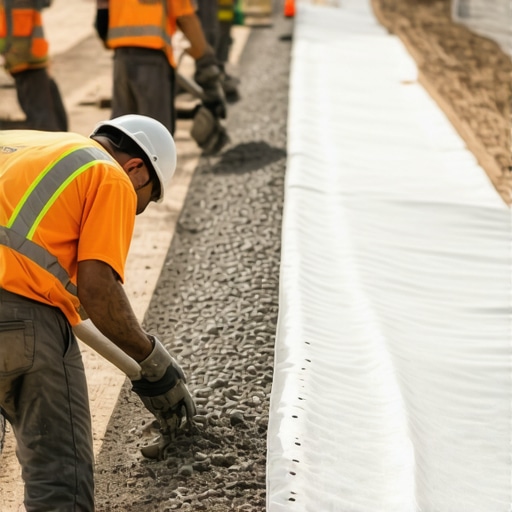
Proper walkway installation begins with excavation depth, typically reaching 6 to 8 inches to accommodate the base material and surface aggregate. You must clear all organic matter—roots, grass, and debris—as these will rot and create structural voids. This is where yard cleanup becomes site preparation. Once the sub-grade is exposed, it must be compacted using a vibratory plate compactor until the soil no longer yields. The geotextile fabric is then rolled out with at least 12 inches of overlap at the seams to prevent soil seepage. Pins should be placed every 3 feet. Next, the base aggregate is added in 2-inch lifts, compacting each layer to achieve maximum density. This is the same logic used in a sod install to prevent uneven settling. Finally, the decorative gravel or chip stone is applied as the top course. This stone should be angular, not round, so the pieces interlock under foot traffic.
Does landscape fabric stop all weeds in gravel paths?
No, landscape fabric primarily prevents sub-soil weeds from emerging, but airborne seeds will still germinate in the organic fines that accumulate in the gravel over time. For a low-maintenance walkway, you must perform regular yard cleanup to remove organic debris like leaves and decomposed mulch that provide a growing medium for new weeds. Fabric is the foundation, not a magic shield.
The Long-Term Integration: Irrigation and Maintenance
In 2026, we are seeing more integrated landscapes where irrigation systems must run beneath or alongside hardscape paths. When installing gravel walkways, always sleeve your irrigation pipes in PVC conduits before laying the geotextile. This allows for future repairs without destroying the compacted base. A 2026 walkway should also account for stormwater runoff. If the grading is off by even 1%, water will pool, leading to hydrostatic pressure that can shift your edging. The settling period for a new gravel path is roughly 3 to 6 months. During this time, you may need to add a small amount of top-dress stone as the aggregate finds its final interlock. Don’t skip the heavy fabric. It’s the difference between a permanent landscape feature and an expensive pile of rocks. It will rot if you use cheap materials. Stick to the engineering specs.