
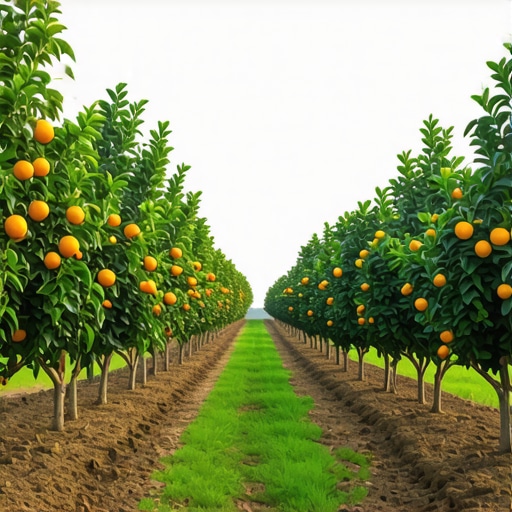
Why the Drip Line Rule Dictates Citrus Health in 2026
The citrus drip line rule is a fundamental horticultural practice where fertilizer and irrigation are applied at the perimeter of the tree canopy rather than the trunk. This method targets the high-density feeder root zone, ensuring maximum nutrient absorption and preventing fungal infections or trunk rot caused by excessive moisture near the root flare.
I always drill into my new crew members: if you don’t fix the soil grading first, every plant you put in the ground is just expensive compost. I remember a job where a rookie tech tried to ‘feed’ a row of premium Meyer lemons by piling high-nitrogen granules right against the bark. Within three weeks, the cambium layer was chemically burned, and the trees started flagging. We had to excavate the top four inches of soil and perform a massive yard cleanup to save the root systems. It was a $5,000 mistake that could have been avoided with a tape measure and a basic understanding of root architecture. Soil prep and physics matter more than the brand of fertilizer you buy.
“Citrus trees require supplemental nitrogen for optimal fruit production, but over-application can lead to excessive vegetative growth at the expense of fruit quality.” – Texas A&M AgriLife Extension
The Engineering of a Root System
To understand the drip line, you must understand the microscopic reality of the soil. Citrus roots are not deep taproots; they are shallow, wide-ranging scavengers. About 80 percent of the tree’s active nutrient-gathering roots reside in the top 12 to 24 inches of the soil profile. These roots extend horizontally well beyond the visible leaves. When we talk about the ‘drip line,’ we are referring to the imaginary circle on the ground where rainwater sheds off the outer foliage. This is where the cation exchange capacity (CEC) of your soil is most critical. If your soil is heavy clay, the nutrients won’t move; if it is sandy, they leach out before the tree can grab them.
How much fertilizer for a 3-year-old lemon tree?
A 3-year-old lemon tree typically requires 0.3 to 0.5 pounds of actual nitrogen per year, divided into three separate applications to prevent nutrient leaching and ensure consistent growth. This should be applied across the drip line and watered in immediately to a depth of 6 inches using a calibrated irrigation system.
| Tree Age (Years) | Nitrogen (N) Requirement (lbs/year) | Application Frequency | Watering Depth (Inches) |
|---|---|---|---|
| 1 | 0.10 | 6 times (Feb – Oct) | 4 |
| 2 | 0.25 | 4 times (Seasonal) | 6 |
| 3 | 0.50 | 3 times (Feb, May, Sept) | 6 |
| 4+ | 0.75 – 1.50 | 3 times (Feb, May, Sept) | 8 |
Mapping the Application Zone
Don’t guess where the roots are. Get on your hands and knees and look at the soil. For a 2026 citrus management plan, we use the radial extension method. You start the application halfway between the trunk and the edge of the leaves, then continue the broadcast of granules to about 2 feet past the actual edge. This forces the roots to ‘chase’ the nutrients outward, creating a more stable and resilient tree. If you are doing a sod install around your citrus, you must leave a 3-foot diameter ring of bare mulch. Grass is a greedy competitor for nitrogen and will starve the tree if it grows right up to the trunk.
“Soil compaction exceeding 300 PSI will physically arrest root elongation, regardless of nutrient availability.” – Agronomy Soil Standards
Where is the drip line on a citrus tree?
The drip line is the ground area directly beneath the outermost circumference of the tree’s branches. In landscaping, this is considered the critical root zone where irrigation emitters should be placed to maintain turgor pressure and deliver nutrients directly to the active root hairs.
The Fertilizer Checklist for 2026 Success
- Soil Test: Check pH levels. Citrus prefers a pH between 6.0 and 7.0. In alkaline soils, iron becomes locked away.
- Macro-Nutrients: Look for an NPK ratio of 2-1-1 or 3-1-1. Citrus are nitrogen hogs.
- Micro-Nutrients: Ensure your mix includes Zinc, Iron, and Manganese. Without these, you get yellowing leaves (chlorosis).
- Grading Check: Ensure water drains away from the trunk. Standing water is a death sentence.
- Irrigation Calibration: Run your irrigation for 45 minutes after fertilizing to move the salts into the root zone.
Precision beats volume every time in landscaping. If you see a contractor tossing ‘weed and feed’ near your citrus, fire them. Those herbicides are designed to kill broadleaf plants, and guess what a citrus tree is? A giant broadleaf. You will kill the tree. Stick to the chemistry and the physics of the drip line. It will not fail you. Keep the mulch back from the root flare. Ensure the soil can breathe. Your 2026 harvest depends on the mechanical precision you apply today.
{“@context”:”https://schema.org”,”@type”:”Article”,”headline”:”Fertilizing 2026 Citrus: Use the Drip Line Rule”,”author”:{“@type”:”Person”,”name”:”Veteran Horticulturist”},”description”:”Expert guide on citrus fertilization using the drip line rule, focusing on root biology, soil chemistry, and irrigation for 2026.”},{“@context”:”https://schema.org”,”@type”:”FAQPage”,”mainEntity”:[{“@type”:”Question”,”name”:”How much fertilizer for a 3-year-old lemon tree?”,”acceptedAnswer”:{“@type”:”Answer”,”text”:”A 3-year-old lemon tree needs 0.3 to 0.5 pounds of nitrogen annually, split into three applications.”}},{“@type”:”Question”,”name”:”Where is the drip line on a citrus tree?”,”acceptedAnswer”:{“@type”:”Answer”,”text”:”The drip line is the area on the ground directly below the outer edge of the tree canopy branches.”}}]}