
The sound of a failing patio isn’t a crack; it is the silent, rhythmic squish of water-logged polymeric sand under your boots. I recently walked onto a job site in late 2025 where a homeowner had spent $35,000 on a multi-tiered travertine patio. Within eight months, the lower tier was a swimming pool, and the foundation of the house was showing signs of efflorescence. The previous contractor had relied on ‘natural pitch’ in a region where we get four-inch rain events in under an hour. They didn’t account for the hydrostatic pressure building up behind the retaining walls or the fact that the soil was heavy, impermeable clay. I had to tell the owner we were tearing it all out. We didn’t just need a slope; we needed a surgical intervention using a slot drain system. This is the reality of modern hardscaping: if you aren’t engineering for the 100-year storm, you are just building expensive compost piles.
Why Patio Drainage Fails in Modern Hardscape Installations
Patio drainage failure occurs primarily when the sub-base saturation exceeds the soil’s load-bearing capacity, typically due to poor grading or the absence of mechanical water diversion. In 2026, managing hydrostatic pressure with slot drains and French drains is mandatory to prevent paver heaving and settling. It is physics, not magic.
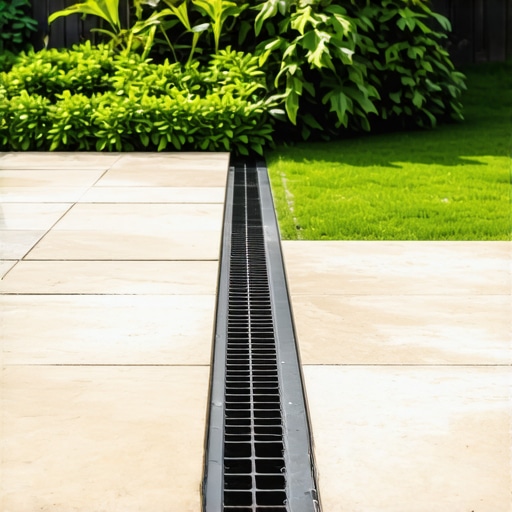
The biggest mistake I see is ‘mow-and-blow’ crews trying to play engineer. They think a 1% slope is enough. It isn’t. You need at least a 2% slope—that is a quarter-inch drop for every foot of run. But even then, if your patio is boxed in by a house foundation and a rising lawn, that water has nowhere to go. It sits. It saturates the modified gravel base. It turns your expensive pavers into a floating raft. This is where the slot drain becomes the hero. Unlike those ugly, wide plastic trench drains you see at big-box stores, a slot drain is a slim, stainless steel or high-density polyethylene profile that disappears into the paver joints while moving massive amounts of water. It is the surgical strike of yard drainage.
“A retaining wall doesn’t fail because of the stone; it fails because of the water trapped behind it.” – Hardscape Engineering Axiom
The Forensic Breakdown of Slot Drain Mechanics
When we install a slot drain, we are creating a low-pressure escape route for surface water. We cut a narrow trench into the sub-base, set the drain in a concrete cradle to ensure it never shifts, and then pitch the pavers directly toward that 1/2-inch opening. The water drops into a hidden 4-inch or 6-inch pipe and is evacuated out to a dry well or the municipal storm line. Don’t skip the concrete cradle. If you just ‘dirt-in’ a drain, the first freeze-thaw cycle will pop it out of the ground like a cork. It will fail. Every time.
How much modified gravel do I need for a patio base?
To calculate the modified gravel needed for a patio base, multiply the total square footage by the desired depth (minimum 6 inches for pedestrian, 10-12 inches for driveways), then divide by 27 to get cubic yards. Always add a 20% compaction factor to your final number, as the plate compactor will significantly reduce the volume of the crushed stone during the 95% Proctor density phase.
| Drainage Method | Flow Capacity | Aesthetic Impact | Maintenance Requirement |
|---|---|---|---|
| Surface Pitching | Low | None | Low |
| French Drain | Medium | Moderate (Gravel visible) | High (Silt buildup) |
| Slot Drain | High | Minimal (Hidden) | Low (Integrated cleanouts) |
The Interplay of Sod Install and Yard Cleanup
Sod installation and yard cleanup are the final stages of a drainage remediation project, ensuring that the surrounding landscape grading directs water into the new slot drain rather than around it. Proper irrigation adjustment is critical here to prevent soil erosion from washing debris into the new drainage channel.
You can’t just throw sod over compacted, dead clay and call it a day. After the heavy machinery leaves, your yard is a parking lot. The soil is crushed. We use a Harley rake to chew up the top six inches, incorporate organic compost to fix the soil microbiology, and then lay the sod. If you don’t de-compact the soil, your new sod install will just sit on top and rot because the roots can’t penetrate the ‘brick’ you’ve created. This is where the irrigation system needs a total audit. If your zones are still spraying the patio, you’re just adding to the drainage problem. Redirect those heads. Keep the water on the grass, not the stone.
“Surface water runoff must be managed at the source to prevent downstream soil degradation and structural hydraulic failure.” – USDA Soil Conservation Service Manual
What is the best slope for a paver patio?
The industry standard for paver patio slope is 1/4 inch of drop per 1 linear foot of distance away from any residential foundation. This 2% grade ensures that surface tension is broken and water moves efficiently toward a drainage exit point like a slot drain or swale. Anything less than 1/8 inch per foot is a recipe for standing water and algae growth.
Post-Installation Checklist: The First 30 Days
- Check slot drain cleanout boxes for construction debris or silt.
- Monitor sod seams for gaps; water deeply (1 inch) twice a week, not daily.
- Inspect irrigation heads for overspray onto the hardscape.
- Look for efflorescence (white powder) on pavers, indicating trapped moisture.
- Ensure downspout extensions are moving water at least 10 feet from the patio edge.
Stop listening to the guy who says ‘it’ll settle and drain eventually.’ It won’t. It will only get worse as the sub-grade softens. Real landscaping isn’t about the flowers; it’s about what is happening three feet under the ground. Fix the dirt, and the rest is easy. Ignore the dirt, and you’re just throwing money into a hole. Do it right the first time. Compact your base. Install the slot drain. Move the water. It’s that simple.