
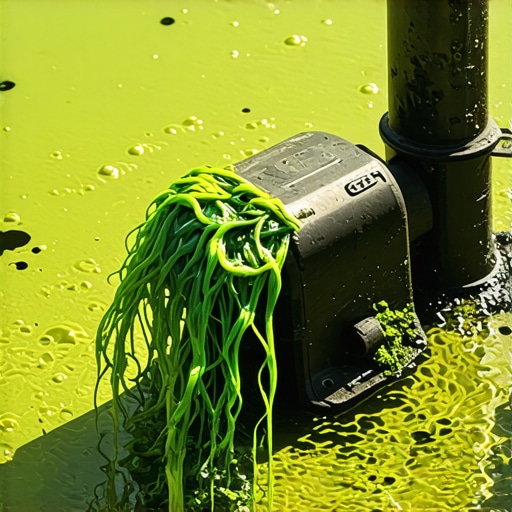
The Viscous Reality of Pond Pump Failure
The smell hits you before the sight does: a swampy, sulfurous stench that signals your $800 pump is struggling for air. You pull the basket and it’s wrapped in a thick, gelatinous shroud of green filaments. This isn’t just a maintenance chore; it is a forensic indicator that your pond’s biological load has collapsed. When your pond pump keeps clogging with green slime, it means your mechanical filtration has been outpaced by a massive nutrient surge, likely fueled by poor yard drainage or improper landscaping nearby. It’s not just a pump issue. It’s a systemic biological failure.
The Apprentice Lesson: Biology Over Mechanics
I always drill into my new crew members: if you don’t fix the soil grading and nutrient input first, every pond pump you install is just an expensive blender for algae. I remember an apprentice, eager to fix a ‘clogged pipe,’ who spent four hours cleaning an impeller only for it to seize again 48 hours later. He didn’t look at the sod install we did uphill. The runoff was dumping high-nitrogen fertilizer directly into the basin. We weren’t fighting a mechanical clog; we were fighting a chemical explosion. You have to treat the cause, not the symptom. The pump is the heart, but the water chemistry is the blood. If the blood is toxic, the heart stops. Period.
What causes the green slime in my pond pump?
The green slime clogging your pump is primarily filamentous algae and biofilm, triggered by an excess of nitrates and phosphates in the water column. When sunlight hits nutrient-rich water, these organisms multiply exponentially, creating a physical mass that exceeds the GPH (gallons per hour) capacity of your intake screen. This is often exacerbated by irrigation runoff or decomposing organic matter from a missed yard cleanup.
“Filamentous algae, often called ‘pond scum’ or ‘moss,’ grows in mats of long, stringy filaments. Its growth is a direct response to high levels of phosphorus and nitrogen, which are common in residential runoff.” – Ohio State University Extension, Pond Management Division
How much debris can a standard pond pump handle?
Most residential pumps are designed to move water, not solids. If you are using a traditional mag-drive pump without a pre-filter or a skimmer box, you are asking for a mechanical seizure. A standard impeller has tolerances measured in millimeters. When a string of algae enters that chamber, it wraps around the shaft, increases friction, and raises the internal temperature of the motor. This leads to thermal shutdown. You need a pump capable of handling solids up to 1/4 inch if you’re dealing with a high-bio-load environment. Check your PSI. If it drops 20% below the factory rating, your intake is already 50% obstructed.
The Nutrient Loading Conflict: Why Your Yard is Killing Your Pond
If you recently did a sod install or applied fertilizer to your lawn, you likely introduced a massive dose of nitrogen into the pond. Rainwater or irrigation overspray carries these chemicals into the lowest point of the property—your pond. This is why landscaping around water features requires a 5% reverse grade or a French drain system to divert nutrient-heavy runoff. Without this, you are effectively ‘power-feeding’ the algae that clogs your equipment. We see this most often in the spring when homeowners are aggressive with their weed-and-feed products.
| Nutrient Source | Primary Chemical | Impact on Pump | Remediation |
|---|---|---|---|
| Lawn Fertilizer | Nitrogen (N) | Rapid Algae Bloom | Divert runoff/French Drain |
| Decomposing Leaves | Phosphorus (P) | Biofilm/Slime buildup | Weekly yard cleanup |
| Fish Waste | Ammonia (NH3) | Bacterial mat growth | Increase Bio-filtration |
| Tap Water Refills | Chlorine/Minerals | Scale and Slime | Use Dechlorinator |
Why does my pond pump stop working after it rains?
Rain events act as a delivery vehicle for organic debris and dissolved nutrients. When it rains, the yard cleanup you skipped comes back to haunt you. Pine needles, grass clippings, and dust are washed into the pond, where they begin to break down instantly. This increases the ‘Total Dissolved Solids’ (TDS). High TDS water is more viscous and harder to pump, and the organic ‘fines’ provide the perfect substrate for green slime to anchor onto your pump’s intake screen. It’s a physical block that happens in hours, not days.
Engineering the Solution: From Pre-Filters to UV Sterilizers
To stop the clogging, you must move from passive filtration to active engineering. A skimmer box is your first line of defense; it pulls water from the surface, capturing floating debris before it can sink and rot. Inside the skimmer, you should have a high-density mat. If you’re still getting slime, you need a UV Clarifier. A UV light at the correct flow rate (usually 30 watts per 1,000 gallons) will mutate the DNA of single-celled algae, preventing them from reproducing. It won’t kill the long stringy stuff, but it stops the ‘green water’ soup that glues the larger debris together.
“Biological filtration relies on the colonization of beneficial bacteria (Nitrosomonas and Nitrobacter) on high-surface-area media to convert toxic ammonia into less harmful nitrates.” – International Pond Technicians Manual
- Inspect the Intake: Check the pump cage for physical obstructions every 48 hours during peak bloom.
- Monitor Flow Rates: A drop in water feature height usually means the impeller is dragging.
- Test Water Chemistry: Keep nitrates below 20 ppm to starve the slime.
- Upgrade Your Bio-media: Use sub-surface rock or K1 media to increase bacterial surface area.
- Clean the Impeller Well: Don’t just spray it; take the housing off and scrub the calcium deposits.
How do I get rid of string algae permanently?
You don’t ‘get rid’ of it; you manage it. Algae is a plant. It needs food and light. By installing irrigation systems that don’t splash into the pond and ensuring a professional yard cleanup removes all leaf litter in the fall, you starve the beast. Use a concentrated dose of beneficial bacteria to out-compete the algae for the remaining nutrients. Also, check your pump’s head pressure. If your pipe diameter is too small, the pump works harder, heats the water, and heat equals more algae. Use 2-inch PVC, not 1-inch flex hose. Don’t skip the basics.
Maintenance Schedule for a Slime-Free System
Your pond is a closed loop. Every action in your landscaping plan affects that loop. If you mulch right up to the edge of the rocks, that mulch will eventually end up in your pump impeller. Use a river-rock buffer zone instead. Ensure your sod install has a clear border of at least three feet from the water’s edge. Professionalism in the yard translates to clarity in the water. Clean the pump housing with a 10% white vinegar solution once a season to dissolve mineral scale that allows slime to grip the plastic. It’s hard work, but it’s the only way to keep the water moving. [image placeholder]