
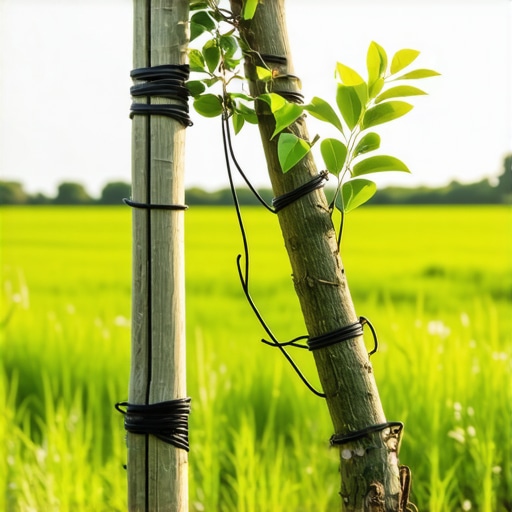
Planning for High Wind Resistance: Why Most Staking Fails
The best way to stake a young tree against high winds is to employ a low-profile, flexible two-stake system that allows the trunk to sway while keeping the root ball stationary in the soil. Rigidly anchoring a tree prevents the development of reaction wood and a healthy trunk taper, which are the biological mechanisms a tree uses to support its own weight as it matures.
I always drill into my new crew members: if you don’t fix the soil grading first, every plant you put in the ground is just expensive compost. I have seen too many rookies spend two hours meticulously staking a 2-inch caliper oak, only to have the tree drown because they ignored the fact that the entire landscape was graded toward the root ball. In high-wind environments, the physics of a tree are simple: the canopy acts as a sail, the trunk acts as a lever, and the roots act as the anchor. If the anchor is sitting in a soup of oversaturated clay, no amount of heavy-duty staking will keep it upright. The soil loses its shear strength, and the whole system tips. You have to understand the soil mechanics before you touch a hammer.
“Trees that are allowed to sway in the wind develop a more pronounced trunk taper and a more extensive root system than those that are rigidly staked.” – ISA Arboriculture Standards Manual
The Biology of Trunk Taper and Reaction Wood
When a tree moves in the wind, it experiences mechanical stress. This stress triggers the production of lignin and cellulose at the base of the trunk. This is called thigmomorphogenesis. If you tie a tree so tight it cannot move, the tree remains weak. It becomes “lazy” in a biological sense. The moment you remove those stakes three years later, the first moderate gust will snap the trunk like a dry twig. We use stakes to protect the root-to-soil interface, not to hold the top of the tree still. The goal is to prevent the root ball from rocking, which shears off the microscopic root hairs that are responsible for 95% of the tree’s nutrient and water uptake.
Materials Breakdown: Why Nursery Stock Beats Big-Box Supplies
I do not allow my crew to use the green plastic tape or the thin wire-in-hose methods you see at the big-box hardware stores. They are junk. They cut into the cambium layer. When we are doing a high-end landscaping project, we use 2×2 cedar or heavy-duty t-posts. For the ties, we use 2-inch wide nylon webbing. This distributes the pressure over a larger surface area, preventing the girdling of the tree. The irrigation setup is also part of this material equation. A tree in high wind loses moisture through its leaves at an accelerated rate. If your irrigation isn’t hitting the root flare and the surrounding 24 inches of soil, the tree will be too stressed to grow the roots it needs for stability. We often install a dedicated bubbler or a 5-gallon-per-hour drip ring to ensure deep penetration.
| Material Type | Pros | Cons | Best Use Case |
|---|---|---|---|
| Wooden 2×2 Stakes | Biodegradable, aesthetic | Can snap in hurricane-force winds | Residential landscapes, protected areas |
| Steel T-Posts | Maximum durability, easy to drive | Ugly, can damage equipment if hit | Commercial sites, high-velocity wind zones |
| Nylon Webbing | Flexible, wide surface area | UV degradation after 24 months | Standard for all professional installs |
| Wire and Hose | Cheap, readily available | Causes trunk girdling, bark death | Never recommended by pros |
How much movement should a staked tree have?
A properly staked young tree should have 2 to 3 inches of lateral movement at the tie point, ensuring the trunk can flex while the roots remain anchored. This specific range of motion allows the tree to sense wind-loading without the risk of the root ball rotating or the trunk snapping under extreme pressure.
The Installation Process: A Step-By-Step Engineering Guide
- Identify the Wind Direction: Look at your site. Which way is the wind coming from? You want your stakes to be perpendicular to the prevailing wind.
- Drive the Stakes Outside the Root Ball: Do not drive the stakes into the root ball. You will destroy the root system you just paid for. Drive them 12 to 18 inches deep into the undisturbed native soil.
- Find the Lowest Point of Support: Hold the trunk with one hand and push it. Find the lowest height where the tree still returns to an upright position. This is where your ties go. Usually, this is about 1/3 the height of the tree.
- Attach the Nylon Webbing: Use a loose figure-eight pattern. This gives the tree room to grow in diameter without being choked.
- Apply Mulch: This is part of the stabilization. A 3-inch layer of wood chips keeps the soil moisture consistent, preventing the soil from cracking and loosening the stakes. Do not build a mulch volcano against the trunk. It will rot.
When should I remove tree stakes and wires?
Tree stakes should be removed after one full growing season, or maximum 18 months, once the tree has established enough lateral roots to support itself. Leaving stakes on longer than two years is a death sentence for the tree, as it will likely result in trunk girdling or a lack of structural integrity.
“A tree should only be staked when absolutely necessary, such as on windy sites, sandy soils, or with top-heavy nursery stock.” – University of Florida IFAS Extension
The Relationship Between Staking and Sod Install
I often see homeowners ruin a perfectly staked tree during a sod install. They want the grass to go right up to the trunk. Don’t do it. You need a 3-foot diameter ring of mulch around that tree. Grass is a heavy feeder and will steal the nitrogen and water that the young tree needs to build structural roots. Furthermore, running a lawnmower or a weed-whacker against the base of a young tree is the fastest way to kill it. One nick to the bark can disrupt the entire flow of nutrients through the phloem. During your yard cleanup, ensure your mulch levels haven’t migrated and that your stakes haven’t started to lean. If the stake is loose, the tree is at risk.
Micro-Climate Logic: Clay vs. Sandy Loam
If you are working in heavy red clay, your biggest enemy is the “bathtub effect.” When you dig a hole in clay and fill it with loose potting soil, you’ve essentially built a pond. In a high wind, that tree will just wallow in the mud. In sandy soils, the stakes won’t hold. You might need to use longer 4-foot stakes to find enough friction to keep the tree upright. Always call 811 before driving stakes. I’ve seen a 30-inch t-post go right through a 24-volt irrigation wire, or worse, a gas line. It is a costly mistake that ruins your profit margin and your reputation. Work smart. Drive the stake with intention. The tamper should literally bounce off the ground once the soil is properly compacted around the stake base.