
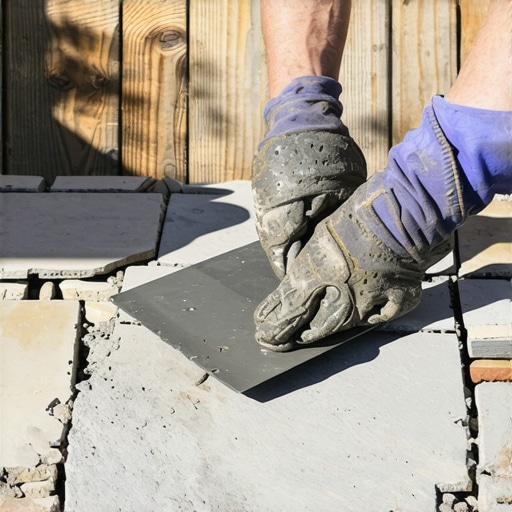
The Forensic Autopsy of a Wobbly Flagstone Step
To fix loose flagstone steps permanently, you must diagnose the bond failure caused by thermal expansion, moisture ingress, or an improper mortar-to-aggregate ratio. Most failures occur because the installer treated natural stone like a ceramic tile, ignoring the specific hydrostatic pressure and freeze-thaw cycles that pull masonry apart at the molecular level.
I recently got called out to tear up a $30,000 patio that was sinking because the previous contractor thought he could skimp on the sub-base compaction and used a cheap, pre-mixed bag of fence-post concrete for the flagstone treads. Within two winters, the water had seeped behind the risers, frozen, and popped every single stone loose. It looked like a landslide in slow motion. The homeowner was furious, and rightly so. You can’t cheat physics. If you don’t provide a stable modified gravel base and a high-strength Type S mortar, the earth will eventually reclaim your hardscaping. It is not a matter of if, but when. This isn’t just about aesthetics; it is about structural integrity and liability. A loose step is a trip hazard that ends in a lawsuit. We do it right, or we don’t do it at all.
“A retaining wall doesn’t fail because of the stone; it fails because of the water trapped behind it.” – Hardscape Engineering Axiom
The Science of Mortar Adhesion and Stone Porosity
Flagstone is a sedimentary or metamorphic rock, which means it is porous. When you apply mortar, the stone actually ‘wicks’ moisture out of the mix. If the stone is bone-dry, it sucks the water out of the mortar too fast, preventing the hydration process from completing. This results in a ‘flash dry’ where the mortar turns to brittle dust instead of a crystalline structure. To prevent this, you must achieve a Saturated Surface Dry (SSD) state on the stone before application. This means the stone is damp but has no standing water on the surface.
| Mortar Type | Compressive Strength (PSI) | Best Use Case | Flexibility |
|---|---|---|---|
| Type N | 750 PSI | General masonry, non-load bearing | High |
| Type S | 1,800 PSI | Flagstone steps, retaining walls, below-grade | Medium |
| Type M | 2,500 PSI | Heavy stone foundations, high loads | Low |
| Polymer-Modified | 3,000+ PSI | Thin-set applications, high-traffic treads | Very High |
How much modified gravel do I need for a patio base?
For a standard flagstone patio or step landing, you need a minimum of 6 inches of compacted 21A or 57 stone modified gravel to ensure proper drainage and load distribution. Calculate your needs by multiplying the square footage by the depth in feet (0.5 ft), then dividing by 27 to get the total cubic yardage required. Don’t skip the plate compactor. Hand-tamping is for amateurs. The base should literally bounce the tamper off the surface when it reaches 98% Proctor density. If the base isn’t solid, the best mortar in the world won’t save your steps.
The Remediation Process: Step-by-Step
First, you have to strip it back. Use a cold chisel and a 3-lb sledge to remove every last bit of the old, failing mortar. If you leave old material, the new bond will fail at the interface. Clean the stone with a stiff wire brush. I often use a muriatic acid solution (1 part acid to 10 parts water) to etch the stone and remove calcium deposits. Rinse it thoroughly. Next, apply a bonding slurry. This is a ‘soup’ made of pure Portland cement and a liquid acrylic fortifier. Paint this onto the back of the flagstone and the concrete substrate immediately before setting. This creates a chemical bridge that ‘bites’ into both surfaces. For the main bed, use a Type S mortar mixed to a ‘peanut butter’ consistency. Butter the back of the stone—don’t just plop it down. You want 100% coverage. No voids. Voids trap water. Water turns to ice. Ice destroys your work.
What is the best mortar for flagstone steps?
The best mortar for flagstone steps is a Type S masonry cement mixed with a 3:1 ratio of sharp sand and fortified with a liquid polymer bonding agent. This combination provides the necessary 1,800 PSI compressive strength while maintaining enough tensile strength to withstand the vibration of foot traffic and the lateral pressure of soil movement. Avoid ‘All-Purpose’ mixes from big-box stores; they contain too much lime and not enough Portland cement for heavy-tread applications.
“Mortar bond strength is significantly improved by the mechanical interlocking achieved through proper surface preparation and moisture management of the masonry units.” – PCA Manual
- Mechanical Bond: Achieved through grinding and cleaning.
- Chemical Bond: Achieved through polymer additives.
- Structural Bond: Achieved through proper joint thickness (ideally 1/2 inch to 1 inch).
Integrating the Landscape: Drainage and Irrigation
Often, steps fail because of irrigation overspray. If your sprinklers are hitting the stone face every morning, you are forcing water into the joints. During a yard cleanup, check your head alignment. If you’re doing a new sod install near the steps, ensure the grade slopes away at a minimum of 2% (1/4 inch per foot). We often install French drains behind the step stringers to relieve hydrostatic pressure. If the soil stays saturated, the mortar will eventually effloresce, leaching white salts and weakening the matrix. A total landscaping plan must account for where that water goes. It’s not just about the steps; it’s about the entire ecosystem of the yard. Don’t let a $50 sprinkler head ruin a $5,000 masonry project. Check your valves. Check your drainage. It matters.
Maintenance and the One-Year Check
In the first year, keep an eye on the polymeric sand or mortar joints. If you see hairline cracks, seal them immediately with a silane-siloxane breathable sealer. This prevents water from entering the ‘pore structure’ of the mortar. Do not use high-pressure washers on new joints; you’ll blow out the fines. Use a garden hose and a soft brush. Landscaping is a long game. You’re building a monument, not a stage set. Treat it with the engineering respect it deserves.