
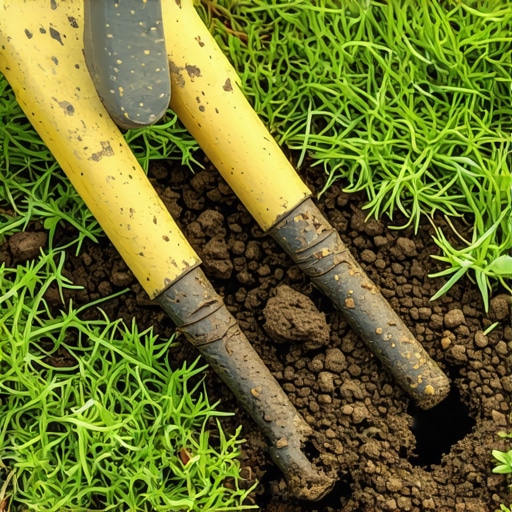
You walk across your lawn and it feels like treading on a wet sponge. The turf looks pale, even after you dumped high-nitrogen fertilizer on it last week. You see water pooling in low spots instead of infiltrating the root zone. This isn’t just a cosmetic issue. It is a structural failure of your soil. Most homeowners think they just need more water or more chemicals. They are wrong. What they need is a forensic mechanical intervention. In my twenty years of managing high-end turf, I have seen thousands of yards gasping for air because the owner fell for the spike aeration gimmick. Core aeration is the only way to remediate compacted soil and prevent a total turf collapse.
What is the difference between core and spike aeration?
Core aeration involves the mechanical removal of cylindrical soil plugs, typically 0.5 to 0.75 inches in diameter and 2 to 4 inches deep, to alleviate soil compaction and improve gas exchange. Unlike spike aeration, which merely displaces soil laterally and increases density, core aeration creates physical voids that allow oxygen, water, and nutrients to reach the rhizosphere directly.
I always drill into my new crew members: if you do not fix the soil grading and compaction first, every plant you put in the ground is just expensive compost. Last year, I had a fresh apprentice try to tell me he could save time by using a tow-behind spike aerator on a two-acre estate. I stopped him right there. I made him take a penetrometer reading of the soil before and after his little spike run. The bulk density actually increased around the holes. He was literally packing the clay tighter while trying to loosen it. We spent the next three days doing it the right way with a hydraulic core machine. Soil is a living organism. If you treat it like a piece of wood you are driving nails into, you will kill the very biology that makes a lawn thrive.
The Physics of Soil Compaction: Why Spikes Fail
Soil compaction is measured by bulk density. In heavy clay soils, once your bulk density hits 1.6 grams per cubic centimeter, root growth stops. Spikes do not remove anything. They are a wedge. As the spike enters the ground, it pushes the soil particles outward. This creates a zone of high-density soil around the perimeter of the hole. It is like a tiny, subterranean concrete wall. Water cannot penetrate it. Roots cannot pierce it. You have essentially created thousands of tiny, dry wells that do nothing for the health of the plant.
“Core aeration is the process of mechanically removing small plugs of thatch and soil from the lawn. This practice is essential for heavy clay soils where bulk density exceeds 1.5 grams per cubic centimeter and gas exchange is limited.” – University of Minnesota Extension
Core aeration, however, relies on hollow tines. When the machine pulls a plug, it removes the mass. This allows the surrounding soil to expand into the new void. The internal pressure of the soil drops. This is where the magic happens. The soil relaxes. Macropores open up. Suddenly, your irrigation system is actually doing its job because the water has a path to the roots rather than running off into the street gutter.
How much modified gravel do I need for a patio base?
While we are talking about soil physics, homeowners often ask about drainage near their patios. For a standard 10×10 patio, you need approximately 4 to 6 tons of modified gravel (2A or 3/4-minus) to create a stable 6-inch base that prevents the hydrostatic pressure from buckling your pavers. Never skip the compaction of this base in 2-inch lifts. If you skip this, your patio will settle within two winters. This same principle of structural integrity applies to your turf. Without a porous base, the surface will fail.
What is the best time for spring aeration in 2026?
The 2026 spring window is narrow. You need to wait until the soil temperature reaches a consistent 50 to 55 degrees Fahrenheit. This usually coincides with the blooming of forsythia. Aerating too early when the soil is saturated can lead to “smearing,” where the tines seal the walls of the hole. Aerating too late during a heatwave can desiccate the root system. Aim for late March to mid-April depending on your local frost line depth.
| Feature | Core Aeration | Spike Aeration |
|---|---|---|
| Action | Removes 3-inch soil plugs | Pushes soil aside with tines |
| Compaction Relief | High (Reduces bulk density) | Negative (Increases density) |
| Thatch Reduction | Direct removal | None |
| Oxygen Exchange | Immediate and deep | Superficial |
| Equipment | Commercial hydraulic aerator | Spiked rollers or shoes |
The Biological Nitrogen Cycle and Gas Exchange
Your lawn is a massive carbon sink. To function, it needs a constant exchange of oxygen and carbon dioxide. When soil is compacted, it becomes anaerobic. This is where the bad bacteria take over. They thrive in low-oxygen environments and produce gasses that are toxic to grass roots. By pulling cores, you are effectively “burping” the lawn. You are reintroducing aerobic conditions that allow beneficial microbes like Azotobacter to fix nitrogen from the atmosphere. This is far more effective than any store-bought fertilizer. You are unlocking the nutrients already present in your soil.
“A retaining wall does not fail because of the stone; it fails because of the water trapped behind it. Similarly, a lawn does not fail because of the seed; it fails because of the lack of pore space in the soil structure.” – Hardscape Engineering Axiom
The 2026 Spring Prep Checklist
- Utility Marking: Always call 811 before aerating. A core tine will shred a shallow fiber-optic line or a landscaping light wire in seconds.
- Irrigation Check: Flag every sprinkler head. The aerator is a 400-pound beast of steel. It will crush a plastic head without slowing down.
- Yard Cleanup: Remove all debris, sticks, and dog toys. A clean surface ensures the tines penetrate to the full 3-inch depth.
- Soil Moisture: The soil should be moist but not muddy. If it is too dry, the tines will only scrape the surface. If it is too wet, you will destroy the soil structure.
- Sod Install Preparation: If you are planning a sod install this season, aerating the transition zones between the old lawn and new sod is critical for root integration.
Remediation After the Core
Once the cores are on the surface, do not rake them up. They contain the very microbes you need. Let them dry and break down. They will act as a top-dressing, filtering back into the holes and the thatch layer. This is the time to overseed. Those holes are perfect nurseries for new grass seed. They provide protection from the sun and birds, and they ensure direct seed-to-soil contact. If you follow this up with a light application of organic compost, you are not just maintaining a yard. You are building an ecosystem. Don’t be a hack. Rent the core machine or hire a pro who uses one. Your soil will thank you in July when everyone else’s lawn is turning brown and yours is still deep green and growing.