
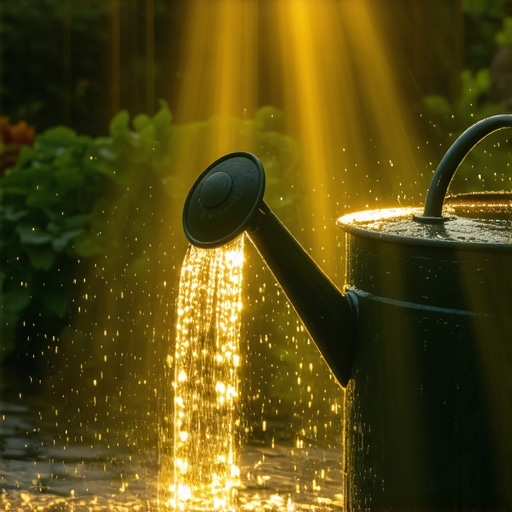
The Forensic Autopsy of a Dying Lawn
I walked onto a job site last July where the turf smelled like a stagnant swamp. It wasn’t the smell of growth; it was the stench of rotting organic matter. The homeowner had spent $12,000 on a high-end sod install only two months prior, but the blades were turning a sickly olive-drab before collapsing into brown slime. They thought they were doing the right thing by watering every night at 10:00 PM. They were actually running a biological weapons lab. By saturating the soil profile right as the sun went down, they ensured the foliar canopy stayed wet for twelve consecutive hours. This created the perfect incubator for Rhizoctonia solani, better known as Brown Patch. The grass wasn’t thirsty. It was drowning and being eaten alive by fungi because nobody told them about evapotranspiration cycles.
The Best Time of Day to Water Your Garden
The best time of day to water your garden is between 4:00 AM and 9:00 AM to maximize water use efficiency. During this window, wind speeds are typically at their lowest and ambient temperatures have not yet spiked, which significantly reduces evaporative loss. Watering in the early morning allows plant tissues to hydrate before the peak solar radiation of the afternoon forces the stomata to close, ensuring that the root zone reaches field capacity without the risk of pathogenic fungal growth that occurs with overnight watering.
Why the 4 AM to 9 AM Window is Non-Negotiable
If you water at noon, you lose up to 40% of that water to the atmosphere before it even touches the soil. That is a waste of money and a strain on municipal resources. More importantly, water droplets on leaves can act as tiny magnifying glasses in some species, though the real danger is physiological stress. The plant is trying to cool itself through transpiration, but the sudden temperature shock of cold well water can disrupt cellular respiration. Early morning watering is the sweet spot. It provides a reservoir of moisture for the plant to draw on as the day heats up. By the time the sun is high, the leaves are dry. Dry leaves don’t grow fungus. It is that simple. I tell my landscaping crews that if they see a client’s irrigation system running at sunset, they should leave a note. You are better off not watering at all than watering at 9 PM.
“A lawn’s water requirement is determined by the rate of evapotranspiration, which is the sum of evaporation from the soil surface and transpiration from the plant. Failure to align irrigation with these cycles leads to systemic root failure.” – Agronomy Manual for Turfgrass Professionals
The Microscopic Reality of Soil Pore Space
Soil is not a solid mass. It is a series of pore spaces. In a healthy landscaping project, those pores are filled with a balance of air and water. When you water incorrectly, you collapse those pores. If you water too frequently but too shallowly, the roots have no reason to dive deep. They stay in the top inch of soil. Then, the first time a heatwave hits, those shallow roots bake. You want deep, infrequent watering. This forces the root system to chase the receding moisture line down into the subsoil. I’m talking six to eight inches deep. This is how you build a drought-resistant landscape. A yard cleanup isn’t just about raking leaves; it’s about inspecting the soil surface for hydrophobic conditions where water beads up instead of soaking in. If your soil is compacted, that water is just running off into the storm drain.
How to Measure Irrigation Efficiency
Most homeowners have no clue how much water they are actually putting down. They talk in minutes. “I run my zones for 20 minutes.” Minutes mean nothing. Flow rates vary by nozzle type, water pressure (PSI), and pipe diameter. You need to talk in inches. You need one inch of water per week, delivered in one or two heavy sessions. This is the gold standard for turfgrass and most ornamental plantings.
| Watering Time | Evaporation Rate | Disease Risk | Efficiency Rating |
|---|---|---|---|
| 4 AM – 9 AM | Very Low | Minimal | 95% |
| 10 AM – 4 PM | Extreme | Low | 50% |
| 5 PM – 9 PM | Low | High | 60% |
| 10 PM – 3 AM | Negligible | Very High | 40% |
“How much water does my lawn need per week?”
To maintain turgor pressure and metabolic function, most lawns require one inch of water per week. This should be applied in deep, infrequent applications rather than daily light mists. Daily watering encourages thatch accumulation and shallow root architecture, making the lawn susceptible to grub infestations and heat dormancy. Use a rain gauge or a straight-sided tuna can to measure how long it takes your system to hit that one-inch mark. In heavy clay soils, you may need to use a cycle-and-soak method to prevent runoff.
Sod Installation: The High-Stakes Exception
When we do a sod install, the rules change for the first fourteen days. New sod is essentially a plant on life support. The roots have been severed, and it cannot access subsoil moisture. For the first week, you need to keep that root-soil interface consistently moist. This might mean watering three times a day for short bursts. However, once those roots knit into the soil—which you can check by gently tugging on a corner of the sod—you must immediately transition back to the deep, morning-only schedule. If you keep the sod soaked for three weeks, it will rot. I have seen landscaping companies lose thousands in material because they didn’t adjust the irrigation clock after the initial establishment phase. Don’t be that contractor. [IMAGE_PLACEHOLDER]
“What is the best way to water after a sod install?”
Immediately following a sod install, you must apply enough water to soak the sod through to the underlying soil. For the first 7 to 10 days, water 2-3 times daily for 10-15 minutes to prevent the seams from shrinking. By day 14, reduce watering to once daily. By day 21, transition to the standard deep watering schedule of 1 inch per week. Never water new sod at night, as the excessive moisture trapped between the sod and the soil will cause damping off and root necrosis.
“Pathogenic fungi like Pythium and Rhizoctonia thrive in saturated conditions where soil oxygen is displaced by water for more than 8 hours.” – Extension Plant Pathology Guide
The Mechanics of Yard Cleanup and Irrigation Audits
Before you even turn your irrigation system on for the season, you need a yard cleanup that goes beyond aesthetics. You are looking for mechanical failures. A single broken sprinkler head can leak hundreds of gallons a day, creating a hydrostatic nightmare that can actually undermine nearby hardscapes or retaining walls. Check for head-to-head coverage. If one head isn’t reaching the next, you have a dry spot. Most people see a brown spot and turn up the whole system. Now they are over-watering 90% of the yard to fix a 10% nozzle blockage. That is lazy landscaping. Clean the filters. Check the backflow preventer. Use 811 to mark lines before you do any aeration or deep grading. If you hit a lateral line with an aerator, you’ve just created an underground geyser.
The Hardscape Connection: Drainage and Grading
Watering isn’t just about the plants; it’s about civil engineering. If your yard is graded toward your house, every time you water, you are pressure-testing your foundation. Proper landscaping requires a 2% slope away from structures. If we are doing a yard cleanup and I see standing water twenty minutes after the irrigation shuts off, we have a compaction or drainage issue. We might need to install a French drain or a dry creek bed to manage that surface runoff. You cannot fix a soil physics problem with a watering schedule. You have to move the dirt.
Checklist for a High-Performance Irrigation System
- Audit Nozzles: Replace any heads that are misting or fogging; this indicates the PSI is too high.
- Clean Filters: Sediment in the lines will reduce flow rates and cause uneven distribution uniformity.
- Adjust Arc and Throw: Ensure you are not watering the sidewalk or the driveway. Concrete doesn’t grow.
- Check Rain Sensors: Make sure your system doesn’t run during a downpour. It makes you look like an amateur.
- Verify Soil Depth: Use a screwdriver to probe the soil. If it doesn’t go in 6 inches easily, you have compaction issues that require core aeration.
Ultimately, your yard is a living, breathing biological system. It follows the laws of thermodynamics and botany. If you ignore the diurnal cycles of the plants, you are fighting a war against nature that you will lose. Water early. Water deep. Shut the system off when it rains. Your grass will thank you by actually staying alive, and your water bill won’t look like a mortgage payment. It is not about how much water you use; it is about how much water the plant actually assimilates. That is the difference between a hack and a professional.