
The Forensic Autopsy of a Moss-Choked Lawn
When you walk onto a property and your boots sink into a spongy, emerald-green carpet where turf should be, you are looking at a systemic failure of the soil environment. Moss is not an invader; it is a squatter that only moves in when the grass has already vacated the premises. I always drill into my new crew members: if you don’t fix the soil grading and chemistry first, every plant you put in the ground is just expensive compost. You cannot simply rake moss away and expect a sod install to take hold. You have to understand hydrostatic pressure, soil compaction, and pH imbalances that created the vacancy in the first place.
“Mosses are opportunistic plants that thrive in conditions where turfgrasses are stressed by low light, poor drainage, or high acidity.” – Penn State Center for Turfgrass Science
Why Moss Invades Your Yard
To remove deep moss from shady lawns, you must address low soil pH, poor drainage, and heavy compaction that inhibits turfgrass respiration. Mechanical removal with a dethatcher followed by calcitic lime applications and core aeration creates the agronomic conditions necessary for shade-tolerant seed to thrive. If you ignore the Cation Exchange Capacity (CEC) of your soil, the moss will return within one season. It is a biological certainty. Most homeowners think they have a “shade problem,” but what they actually have is a “gas exchange problem” caused by surface sealing and thatch accumulation.
The Step-by-Step Forensic Remediation Process
Before we touch a rake, we pull soil cores. If your pH is sitting at a 5.0 or 5.5, your grass is literally starving to death because it cannot uptake nutrients, regardless of how much fertilizer you dump on it. Use a professional-grade soil test to determine exactly how many pounds of calcitic lime are required per 1,000 square feet to hit a target pH of 6.5 to 7.0.
1. Mechanical Excavation and Dethatching
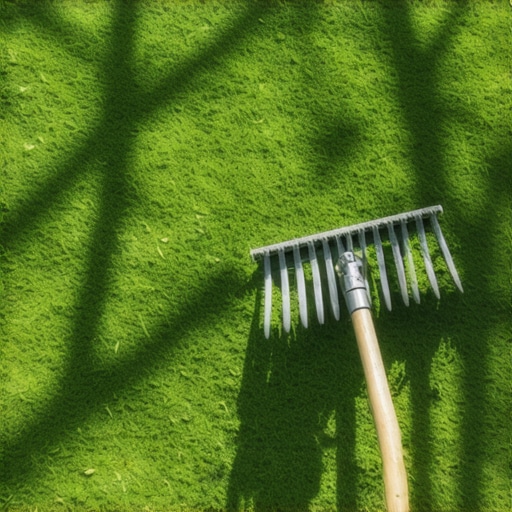
Use a power rake or a heavy-duty vertical mower set deep enough to scarify the soil surface. You aren’t just tickling the moss; you are ripping out the rhizoids. This is a yard cleanup on a microscopic level. Once the moss is bagged and hauled away, you will likely see bare, slick mud. This is the evidence of compaction. It must be broken.
2. High-Density Core Aeration
Don’t use those spike aerators; they just push the dirt sideways and increase compaction. You need a machine that pulls 3-inch soil plugs. This allows oxygen to reach the rhizosphere and improves irrigation efficiency by reducing runoff. In shady areas, the lack of evapotranspiration means the soil stays wet longer. Aeration provides a path for that moisture to move vertically through the soil profile.
3. The Soil Chemistry Correction
Apply your lime and a high-phosphorus starter fertilizer. The phosphorus is critical for root development in new sod install or seed projects. Avoid the cheap bags of 10-10-10 from the big-box stores. They contain too much filler and not enough slow-release nitrogen. We use professional agronomy manuals to calculate the exact N-P-K ratio based on the lab results of the soil test. No guessing.
Material Comparison for Lawn Remediation
| Material | Purpose | Target Measurement | Professional Tip |
|---|---|---|---|
| Calcitic Lime | Raise Soil pH | 50 lbs / 1,000 sq ft | Faster acting than dolomitic lime. |
| Fine Fescue Mix | Shade Tolerance | 7 lbs / 1,000 sq ft | Deep-rooted and drought-resistant. |
| Core Aerator | Gas Exchange | 20-40 holes / sq ft | Ensure soil is moist before starting. |
| Iron Sulfate | Moss Desiccant | 2 lbs / 1,000 sq ft | Turns moss black for easier removal. |
How much modified gravel do I need for a drainage trench?
If the moss is caused by standing water, you need a French drain using 3/4-inch clean crushed stone wrapped in non-woven geotextile fabric to prevent siltation. Calculate the volume of your trench (Length x Width x Depth) and divide by 27 to get cubic yards. Never use rounded pea gravel; it lacks the structural interlock needed to stay stable. Hydrostatic pressure will simply push water around it rather than through it.
Does power raking kill moss for good?
No. Power raking is a physical removal method, not a biological cure. Without changing the soil biology and sunlight penetration, the moss spores will germinate as soon as the next rain hit. You must prune your tree canopy to allow at least 4 hours of filtered sunlight, or Photosynthetically Active Radiation (PAR), to reach the ground. If you don’t, you are wasting your money on seed.
“A retaining wall doesn’t fail because of the stone; it fails because of the water trapped behind it.” – Hardscape Engineering Axiom
The Maintenance Schedule for Moss Prevention
- Mowing Height: Set your deck to 3.5 or 4 inches. Taller grass shades out moss spores and develops deeper roots.
- Irrigation Logic: Water deep and infrequently. Aim for 1 inch of water per week in a single application to force roots to chase the water down.
- Pruning: Thin the lower third of your tree canopy to increase air circulation. Stagnant air breeds moss and fungus.
- Annual pH Testing: Check your levels every fall. Acidic rain and decaying leaves will naturally lower the pH over time.
Stop looking for a “magic spray” to kill moss. Most of those products are just ferrous sulfate which desiccates the plant but does nothing to change the environment. It’s a temporary fix for a permanent problem. Real landscaping is about engineering the soil so the moss cannot survive. It’s hard work. It involves yard cleanup that actually moves dirt. But once you get the nitrogen cycle working in your favor and the drainage corrected, the grass will win the war on its own. It’s science, not luck.