
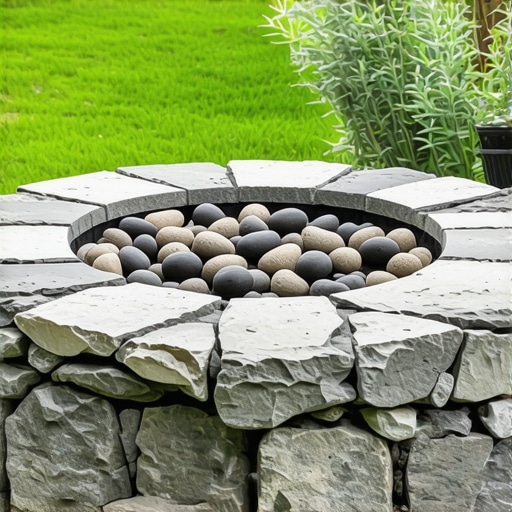
The Engineering Reality of Thermal Shock in Hardscaping
To build a flagstone fire pit that withstands thermal expansion, you must decouple the exterior stone from the heat source using fire-rated kiln bricks and a refractory mortar joint. This prevents direct flame contact with the flagstone, which contains moisture that causes explosive spalling or cracking when heated rapidly. Building a fire pit isn’t just about stacking rocks; it is a thermal management project that requires understanding the expansion coefficients of various materials. If you ignore the physics of heat transfer, your expensive flagstone will be rubble within two seasons. I recently got called out to tear up a $30,000 patio that was sinking because the previous contractor didn’t understand base-layer compaction, but the centerpiece of that disaster was a cracked flagstone fire pit. The homeowner had spent a fortune on Pennsylvania Blue Stone, but the installer had built the fire pit directly on the stone without a heat shield. The first time they lit a high-temperature oak fire, the thermal shock caused the stone to shear horizontally. It was a textbook case of incompetence. You cannot treat stone like it is indestructible. Most sedimentary rocks used in landscaping are porous. They hold water. When you heat that water to 212 degrees Fahrenheit, it turns to steam, expands, and blows the stone apart from the inside out. This is why we use a ‘double-wall’ construction method.
“A retaining wall doesn’t fail because of the stone; it fails because of the water trapped behind it.” – Hardscape Engineering Axiom
The Foundation: More Than Just a Hole in the Dirt
Before you even think about the aesthetic of the flagstone, you must address the subgrade. Most failed fire pits start with a poor sod install or a lack of proper yard cleanup where organic debris is left under the base. You need to excavate at least 12 inches below the finished grade. This isn’t a suggestion. If you are in a heavy clay region, you need to go deeper to account for the freeze-thaw cycle. Fill the first 6 to 8 inches with 2A modified crushed stone. Do not use pea gravel. Pea gravel is round and rolls like ball bearings; it will never compact. You need angular stone that locks together under a vibratory plate compactor. Hit it with the compactor until the machine literally bounces off the surface. That is the only way to ensure you won’t have settling that cracks your mortar joints later. Also, consider your irrigation lines. I have seen too many rookies melt a PVC supply line because they buried it 4 inches away from a fire pit wall. Keep your lines at least 3 feet back or sleeve them in heat-resistant conduit.
| Material Type | Heat Resistance | Durability Level | Primary Failure Mode |
|---|---|---|---|
| Sandstone/Flagstone | Low | Moderate | Spalling/Thermal Cracking |
| Firebrick (Kiln-fired) | Extreme | Very High | None (Standard Use) |
| Granite | Moderate | High | Shattering under high heat |
| Limestone | Low | Low | Calcination and crumbling |
How much modified gravel do I need for a patio base?
To calculate your base material, multiply the square footage by the desired depth in feet (e.g., 0.5 feet for 6 inches) and then divide by 27 to get cubic yards, adding a 20% compaction factor to your final order. Never underestimate how much a stone base will shrink once you put the plate compactor on it. If you order exactly what the volume math says, you will come up short.
Why Firebricks are Non-Negotiable
The interior of your fire pit must be lined with firebrick (refractory brick). These bricks are made from fireclay, a material designed to withstand temperatures exceeding 2,000 degrees Fahrenheit without expanding significantly. When you lay these, use refractory mortar, not standard Type S or Type N mortar. Standard mortar will dehydrate and turn back into dust when exposed to direct flame. Leave a 1-inch air gap between the back of the firebrick and the inside of your decorative flagstone. This is the ‘dead air’ space that acts as an insulator, protecting your expensive exterior stone from the core temperature of the fire.
“Refractory materials must maintain structural integrity at high temperatures while resisting chemical attack from ash and flue gases.” – ASTM C71 Standards Manual
The Step-by-Step Structural Checklist
- Excavate 12 inches deep and 12 inches wider than the pit’s outer diameter.
- Install a non-woven geotextile fabric to prevent soil migration into your gravel.
- Compact 2A modified stone in 2-inch lifts to ensure 98% Proctor density.
- Lay a level ring of concrete pavers or a poured footer as the structural base.
- Build the inner ring with firebricks and refractory mortar.
- Build the outer ring with flagstone, leaving a 1-inch thermal gap.
- Install a steel fire ring insert for added protection and a clean finish.
How do I stop my fire pit from filling with water?
To prevent a fire pit from becoming a swamp, you must install a French drain or a dedicated drainage pipe that exits at a lower point in the yard or into a dry well. This is where landscaping knowledge meets engineering. If you build a pit in a low spot without drainage, the water will saturate the base, and when it freezes, it will heave the entire structure. I always tell my crew: if the water has nowhere to go, it will make its own path, and usually, that path is through your mortar joints. Integrating this with your irrigation system’s drainage is a smart move, but keep the outputs separate to avoid backflow.
The Finish and Maintenance
Once the stone is set, use a high-quality polymeric sand or a breathable mortar for the exterior joints. Do not seal the stone immediately. Flagstone needs to ‘breathe’ and release any trapped moisture. If you seal it too early, you trap water inside, which leads back to our primary enemy: thermal spalling. Wait at least one full season before applying a breathable, penetrating sealer. Maintenance is simple but mandatory. Clean out the ash after every three or four fires. Ash is acidic; when it gets wet, it creates a lye-like substance that can eat away at the refractory mortar. A quick yard cleanup that includes shoveling out the pit will extend its life by a decade. Don’t be the homeowner who lets the pit fill with rain and ash slurry. It’s a recipe for structural rot. Build it right the first time, or don’t build it at all.”, “image”: {“imagePrompt”: “A cross-section diagram of a professionally built flagstone fire pit showing the 2A modified gravel base, firebrick inner lining, the 1-inch thermal air gap, and the decorative flagstone exterior wall on a leveled patio.”, “imageTitle”: “Engineered Fire Pit Cross-Section”, “imageAlt”: “Diagram showing firebrick lining and air gap in a flagstone fire pit”}, “categoryId”: 0, “postTime”: “”}