
Understanding the Biological Filter Load and Biofilm Integrity
To clean a pond filter without killing good bacteria, you must separate mechanical debris removal from biological media maintenance by using dechlorinated pond water for all rinsing procedures. Preserving the Nitrosomonas and Nitrobacter colonies is the only way to prevent ammonia spikes that lead to fish kills and systemic pond failure during the 2026 season. I always drill into my new crew members: if you do not fix the soil grading first, every plant you put in the ground is just expensive compost, and the same logic applies to ponds. If you treat your biological filter like a kitchen sponge, you are essentially nuking a complex ecosystem. I once watched an apprentice scrub $5,000 worth of bio-media with a high-pressure garden hose using city water. Within 48 hours, the ammonia levels hit 4.0 ppm, and every koi in that 3,000-gallon system was gasping at the surface. You cannot treat biological life like inanimate equipment. You are a steward of a nitrogen-processing plant.
The Forensic Anatomy of Pond Filtration
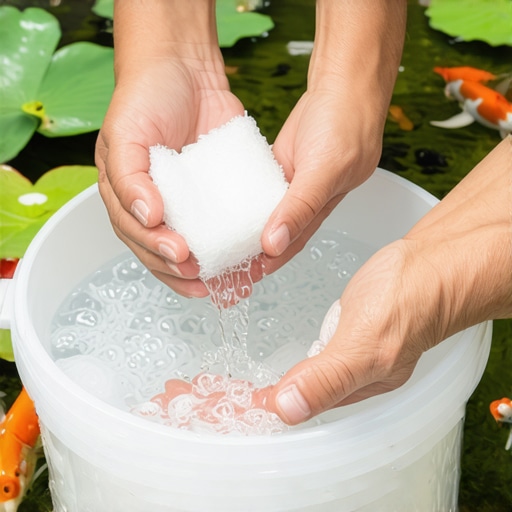
A pond filter is a two-stage reactor. The first stage is mechanical: it catches the large solids like decaying leaves from your last yard cleanup or clippings from a recent sod install. The second stage is biological: it provides the surface area for microscopic bacteria to live. These bacteria are the engine of your water quality. They do not just sit there; they form a biofilm, a sticky matrix of extracellular polymeric substances that anchors them to the filter media. When you see brown ‘gunk’ on your bio-balls or K1 media, that is not dirt. That is a living, breathing colony. Over-cleaning is the most common cause of ‘New Pond Syndrome’ in established systems. [IMAGE_PLACEHOLDER]
“Effective biofiltration requires a surface area where oxygen-rich water can flow over established microbial colonies at a consistent rate to ensure the oxidation of nitrogenous waste.” – Water Quality Manual for Pond Management
How often should I clean my pond filter?
You should clean your mechanical pads weekly, but the biological media should only be rinsed when the flow rate drops by 15% to 20%, usually every 4 to 8 weeks depending on fish load. Over-cleaning the bio-stage prevents the bacteria from reaching a mature, efficient state. Monitoring your GPH (gallons per hour) is more accurate than a visual inspection. If your pump is rated for 3,000 GPH at 5 feet of head pressure and it is only pushing 2,400, your mechanical stage is likely occluded. This is why we integrate irrigation logic into pond builds: consistent flow is the heartbeat of the system.
The 5-Step Clean-Without-Kill Protocol
1. Isolate and Drain: Turn off your pump to prevent debris from washing back into the pond. Use a bottom drain or a submersible pump to pull 20 gallons of pond water into a clean bucket. Never use a garden hose directly on your bio-media unless you have a high-capacity carbon filter inline to remove chlorine. 2. Mechanical Stripping: Remove the coarse sponges or brushes. These can be sprayed with a hose because their primary job is physical straining, not biological housing. 3. The Bio-Rinse: Submerge your bio-media (lava rock, ceramic rings, or plastic media) in the bucket of pond water. Gently agitate it to knock off heavy sludge. You want the media to look ‘dirty-clean’—the biofilm should remain intact. 4. Check the Seals: Inspect the O-rings and gaskets for cracks. Apply a silicone-based lubricant. Avoid petroleum-based products as they will degrade the rubber and leach toxins into the water. 5. System Re-Prime: Reassemble the filter and restart the pump. Observe the discharge for 60 seconds to ensure no air pockets are trapped in the canister.
Technical Comparison: Filter Media Efficiency
| Media Type | Surface Area (Sq Ft per Cu Ft) | Maintenance Frequency | Primary Function |
|---|---|---|---|
| Lava Rock | 30 to 50 | High (Clogs easily) | Biological |
| Bio-Balls | 120 to 160 | Medium | Biological/Gas Exchange |
| K1 Micro Media | 250 to 350 | Low (Self-cleaning) | Active Bio-Filtration |
| Matala Mats | 150 to 200 | Medium | Mechanical/Biological |
Can I use tap water to clean pond filters?
No, you should never use untreated tap water to clean biological media because chlorine and chloramines are designed specifically to kill bacteria. Even a 30-second rinse with chlorinated water can decimate 90% of your beneficial bacteria, forcing your pond to go through a 4-week nitrogen cycle reset. If you must use a hose, ensure you are using a dechlorinator spray or that your yard cleanup team hasn’t left the hose running in the sun, which can spike water temperatures and further stress the microbes.
The Impact of Landscaping Runoff on Filter Life
Your pond does not exist in a vacuum. If you just did a sod install or applied fertilizer to your landscaping, the nitrogen runoff from the next rainstorm will hit your pond like a freight train. This excess nitrogen fuels algae and puts an immense load on your filter. This is why soil grading and proper irrigation management are critical. We design ponds with a raised coping to prevent ‘sheet flow’ runoff from the yard.
“A retaining wall or pond perimeter doesn’t fail because of the stone; it fails because of the water pressure and chemical runoff trapped behind or directed into it.” – Hardscape Engineering Axiom
The Foreman’s Maintenance Checklist
- Check water temperature: Bacteria activity drops significantly below 50 degrees Fahrenheit.
- Monitor pH: Beneficial bacteria consume alkalinity; keep your KH (Carbonate Hardness) above 100 ppm.
- Inspect the pre-filter: Ensure your skimmer basket isn’t starving the pump of water.
- Test Ammonia and Nitrite: Perform these tests 24 hours after cleaning to ensure the colony survived.
Precision is not optional. Every gallon of water you move and every colony of bacteria you preserve contributes to a system that works with nature, not against it. Stop scrubbing. Start rinsing. It is the difference between a stagnant mud hole and a crystal-clear engineering marvel.