
How to Clear Green Algae from 2026 Waterfalls Using Barley Straw Science
A homeowner called me in a panic last July after they completely torched their front lawn and poisoned their custom $15,000 waterfall by applying 10 times the recommended dosage of a copper-based algaecide. They thought more was better. Instead, they had a basin full of dead koi and a water column that was chemically scorched, yet the string algae was still clinging to the rocks like a neon-green carpet. They wanted a magic wand. I told them to stop looking for chemicals and start looking at biology. We had to drain the system, scrub the liner, and implement a long-term biological solution: barley straw. If you want a clear waterfall in 2026, you stop fighting the pond and start managing the nitrogen cycle with technical precision.
What causes excessive algae in backyard waterfalls?
Excessive algae growth in backyard waterfalls is caused by a surplus of nitrogen and phosphorus combined with high sunlight exposure and poor water circulation. This nutrient loading, often from irrigation runoff or decaying organic matter, creates an eutrophic environment where single-celled and filamentous algae thrive rapidly.
The Role of Nitrogen and Phosphate Loading
Algae is not a disease; it is a symptom of a nutrient imbalance. In most 2026 waterfall designs, the flow rate is high, but the biological filtration often lags behind the mechanical pump capacity. When you perform a yard cleanup, if you leave grass clippings or leaf litter near the pond perimeter, those organics break down into ammonia, then nitrites, and finally nitrates. High nitrate levels are the fuel. Furthermore, if you just finished a sod install nearby, the high-phosphorus starter fertilizer used to establish those roots will inevitably leach into the water table. Phosphates are the limit-break for algae. Once they hit a certain ppm (parts per million), you get a bloom that no pump can filter out. You need to understand the hydrostatic pressure of the surrounding soil; if your pond is the low point of the yard, every time your irrigation system runs, it is flushing nutrients into your waterfall basin. This is why site grading is a civil engineering requirement, not an aesthetic choice.
The Barley Straw Mechanism: Nature’s Slow-Release Clarifier
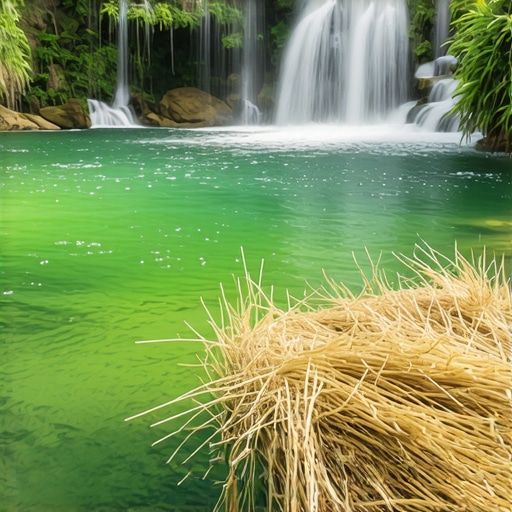
Barley straw is not an algaecide. It does not kill algae on contact. Instead, it acts as a preventative biological inhibitor. When barley straw is submerged in highly oxygenated water (like the splash zone of a waterfall), it begins to rot. But it is a specific kind of rot. As the lignin in the straw breaks down, it releases humic acids. In the presence of sunlight and dissolved oxygen, these humic acids undergo a chemical transformation into low levels of hydrogen peroxide. This micro-dose of peroxide is enough to inhibit the growth of new algae cells by causing oxidative stress, without harming your fish or higher-order aquatic plants.
“The decomposition of barley straw releases compounds that inhibit algae growth without harming aquatic plants.” – North Carolina State University Extension
Why most DIY barley straw attempts fail
People throw a bale of straw into a stagnant corner of a pond and wonder why it smells like a swamp and the algae is still there. For the chemistry to work, the straw needs aerobic conditions. It needs to be in a high-flow area where oxygen is constantly pushed through the fibers. If the straw goes anaerobic, it produces methane and hydrogen sulfide, which is useless for algae control and toxic to your fish. You need about 0.025 pounds of straw per square foot of pond surface area. For a standard 2026-spec waterfall with a 1,000-gallon basin, that is roughly two to three mini-bales tucked into the filter pads or the stream head. Don’t skip the oxygen. It is the catalyst for the entire peroxide reaction.
Material Comparison for Algae Management
| Method | Active Agent | Longevity | Environmental Impact |
|---|---|---|---|
| Barley Straw | Humic Acid / H2O2 | 4-6 Months | Zero (Biodegradable) |
| UV Clarifier | Ultraviolet C Light | 1 Year (Bulb life) | Low (Electrical draw) |
| Liquid Algaecide | Copper or Percarbonate | 72 Hours | High (Risk of toxicity) |
| Ultrasonic Devices | Sound Waves | Continuous | Minimal |
The Integrated Landscaping Approach to Water Clarity
Your waterfall does not exist in a vacuum. It is part of the landscaping ecosystem. If you are struggling with green water, look at your irrigation schedule. Over-watering causes surface runoff that carries soil particles and fertilizers directly into the water. We often see clients who have a sod install performed by a cheap contractor who doesn’t account for the pitch of the land. They lay the sod right up to the pond edge. The first heavy rain or 20-minute irrigation cycle washes the nitrogen-rich sediment into the waterfall. You need a buffer zone. A 12-inch strip of decorative stone or a French drain between the lawn and the pond acts as a literal firewall for nutrients. This is why yard cleanup is critical; removing the muck from the bottom of the pond (the sludge layer) is the only way to lower the base nutrient load. If the sludge is three inches deep, no amount of barley straw will save you. You have to remove the fuel to stop the fire.
How much modified gravel do I need for a pond edge?
To prevent nutrient leaching, you need a minimum 4-inch deep bed of clean, 3/4-inch crushed stone or river rock. This creates a physical barrier that slows down surface water and allows sediment to drop out before it hits the waterfall basin. Do not use limestone, as it will spike your pH and lead to even more algae growth. Stick to inert granite or river jack.
2026 Waterfall Maintenance Checklist
- Inspect water hardness: High GH/KH levels buffer pH swings that stress fish.
- Clean pump intakes: Low flow reduces oxygen, stalling the barley straw reaction.
- Monitor phosphate levels: Use a high-quality test kit; anything over 0.05 ppm is a red flag.
- Replace barley straw: Swap out every 4 to 5 months as the lignin depletion occurs.
- Check irrigation heads: Ensure no spray is hitting the pond surface directly.
“A waterfall is a biological filter, not just a plumbing fixture. If the biology fails, the engineering is irrelevant.” – Hardscape Engineering Axiom
How long does barley straw take to work?
You need to be patient. This is biology, not a light switch. It takes 4 to 6 weeks for the microbial colonies to establish on the straw and for the lignin decomposition to reach a level where hydrogen peroxide production is consistent. If you start in early spring before the water hits 50 degrees Fahrenheit, you will have a clear waterfall all summer. If you wait until the water is already green, you are behind the curve. You cannot outrun a bloom that has already started; you have to prevent it from the ground up.
Ultimately, a clear waterfall in 2026 requires a veteran’s eye for detail. You must manage the sod install runoff, ensure your irrigation isn’t over-saturating the soil, and maintain a rigorous yard cleanup schedule to keep organic debris out of the system. Barley straw is your secret weapon, but it only works if the rest of your landscaping is handled with professional-grade engineering. Don’t be the homeowner who nukes their pond with chemicals. Be the one who understands the biology. Get the straw in early. Keep the water moving. Watch the results speak for themselves.