
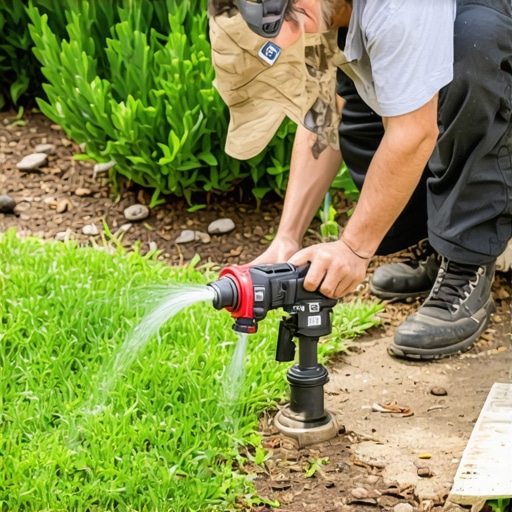
The Anatomy of a Dead Sprinkler Zone
You see the symptom before you hear the cause: a brown, brittle patch of fescue or Kentucky Bluegrass amidst a field of green. This is the visual failure of a hydraulic system. I always drill into my new crew members: if you don’t fix the soil grading and the delivery system first, every plant or sod install you put in the ground is just expensive compost. Irrigation isn’t a luxury; it is the life-support system for your property’s biological assets. When a zone fails to fire, 90% of homeowners assume the controller is fried or a pipe has burst. Usually, it is a $10 plastic-and-copper cylinder known as the solenoid. This component is the bridge between your 24V controller and the physical movement of water. If it fails, the valve stays shut, and your landscaping investment begins its slow descent into dormancy and death.
“Irrigation efficiency is not merely about water delivery; it is about the precise management of soil moisture levels to prevent anaerobic conditions and root rot.” – USDA National Engineering Handbook
How do I test a sprinkler solenoid with a multimeter?
To test a sprinkler solenoid, set your multimeter to the Ohms (Ω) setting and touch the probes to the two lead wires; a functional solenoid should read between 20 and 60 ohms. A reading of zero indicates a short circuit, while an infinite reading (or OL) indicates a break in the internal copper coil. This is the most efficient way to diagnose electrical failure before digging up a valve box. We see this often during a yard cleanup when debris or pests have compromised the wiring. If the resistance is within range but the valve still fails to open, the issue is likely mechanical, such as a torn diaphragm or a blocked port. Don’t guess. Measure.
| Failure Symptom | Likely Root Cause | Required Component | Estimated Cost |
|---|---|---|---|
| Zone won’t turn on | Faulty Solenoid Coil | 24V Replacement Solenoid | $10 – $15 |
| Zone won’t turn off | Debris in Diaphragm | Valve Repair Kit | $20 – $30 |
| Low pressure in zone | Leaking Main Line | PVC Coupling / Primer | $5 – $12 |
| Controller Error (Fuse) | Wiring Short Circuit | Waterproof Wire Connectors | $8 – $12 |
The Solenoid Swap: A Step-by-Step Forensic Repair
Replacing a solenoid is a surgical procedure for your irrigation system. First, shut off the main water supply to the manifold. You will likely find the valve submerged in a box filled with silt and spider webs. Clean it out. A dirty work environment leads to grit entering the valve body, which will ruin the new seal within minutes. Unscrew the old solenoid counter-clockwise. You will see a small plunger and a spring. If the plunger is stuck or the housing is cracked, the magnetic field can no longer lift the metal pin to allow water to bypass the diaphragm. Hand-tighten the new solenoid. Do not use a wrench. Over-tightening will crack the plastic threads, leading to a slow leak that will erode your soil and cause sinkholes near your hardscaping.
“A retaining wall doesn’t fail because of the stone; it fails because of the water trapped behind it, often from a faulty irrigation line or poor drainage.” – Hardscape Engineering Axiom
Why is my sprinkler zone staying on even when the controller is off?
When a sprinkler zone stays on indefinitely, the solenoid plunger is likely stuck in the ‘up’ position or the diaphragm has a microscopic tear that prevents pressure equalization. This results in constant water flow, which can lead to hydrostatic pressure buildup behind walls or under a new sod install. It will rot the roots. You must bleed the air from the system and check for debris like grains of sand or PVC shavings that might be propping the valve open. Irrigation is a game of millimeters. One grain of sand can waste 2,000 gallons of water in a week.
Professional Calibration and Yard Cleanup Checklist
Once the solenoid is replaced, you must recalibrate the entire zone to ensure the health of your landscaping. We often see homeowners fix the solenoid but ignore the pressure-regulated heads. If the pressure is too high, you get misting, which drifts away in the wind; too low, and you get ‘doughnut’ patterns of dead grass. Use a pressure gauge at the furthest head in the run. It should read between 30 and 45 PSI for standard rotors. During your seasonal yard cleanup, always inspect the valve boxes for standing water, which indicates a slow-leaking solenoid seal or a cracked manifold.
- Inspect all 24V wire connections for corrosion.
- Use grease-filled waterproof wire nuts for every connection.
- Check the solenoid plunger for smooth vertical movement.
- Flush the lateral lines before re-installing the solenoid if the system was open.
- Confirm the controller’s transformer is outputting a steady 24-28 volts.
Precision matters. A $10 part can save a $5,000 lawn. Don’t skip the testing phase. If you ignore the ohms reading, you are just throwing parts at a problem. That is what hacks do. We solve problems with physics and engineering. It will save you money. It will save your yard.
Comments are closed.