
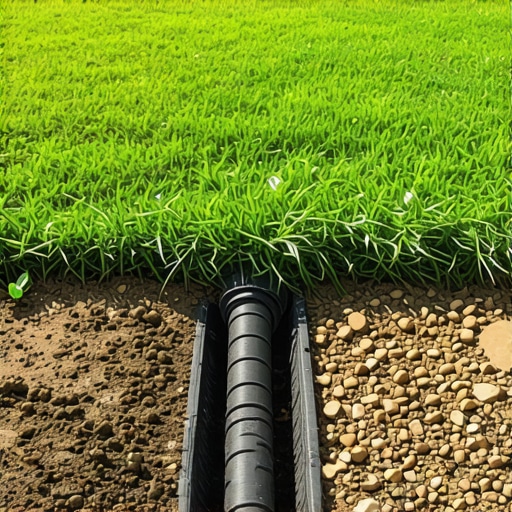
Fixing 2026 Soggy Lawns with a Simple French Drain
You feel it before you see it. That unmistakable, rhythmic squelch beneath your work boots as you walk across the turf. In the landscaping world, we call this the sponge effect, and it is a death knell for a healthy yard. By the time you notice the sulfurous, rotten-egg smell of anaerobic soil, your turf is already suffocating. This is not just a cosmetic issue; it is a structural failure of your land’s ability to process hydraulic load. When water sits in the root zone for more than 48 hours, it displaces oxygen, leading to root rot and the total collapse of the soil’s microbial ecosystem.
I recently got called out to tear up a $30,000 patio that was sinking because the previous contractor failed to account for hydrostatic pressure. The homeowner thought the pavers were the problem, but the autopsy revealed a complete lack of a base-layer drainage system. Water was trapping itself behind the retaining wall, liquefying the bedding sand and turning the structural base into a slurry. We had to excavate the entire site, haul away 40 tons of saturated fill, and rebuild from the dirt up. It was an expensive lesson in why you never ignore subsurface water movement.
The Forensic Signs of Yard Drainage Failure
Identifying drainage failure involves observing surface ponding, soil sponginess, and the presence of water-loving weeds like sedge or moss. When soil remains saturated, it undergoes chemical reduction, stripping roots of oxygen and inviting fungal pathogens that can destroy an entire lawn in a single season.
You need to understand the physics of soil porosity. In a healthy lawn, soil is composed of roughly 50% solid matter and 50% pore space. That pore space should be shared between water and air. In a soggy lawn, water occupies 100% of that space. This creates a state of hypoxia. We measure this through hydraulic conductivity. If your soil has a high clay content, like the heavy smectite clays found in many regions, the particles are so small and tightly packed that gravity cannot pull the water through. This is where engineering must take over for biology. If the earth won’t drain itself, we have to provide a low-resistance path for that water to follow. That path is the French drain.
“A retaining wall doesn’t fail because of the stone; it fails because of the water trapped behind it.” – Hardscape Engineering Axiom
How deep should a French drain be for a backyard?
For standard residential applications, a French drain trench should be excavated to a depth of 18 to 24 inches. This ensures the pipe sits below the root zone of the turf grass and can effectively intercept groundwater before it reaches the surface. The width should be roughly 12 inches to allow for adequate gravel surrounding the pipe.
The Anatomy of a High-Performance French Drain
A high-performance French drain consists of a sloped trench, non-woven geotextile fabric, a perforated Schedule 40 PVC pipe, and clean #57 washed stone. This system utilizes gravity to collect subsurface water and redirect it to a safe discharge point, preventing soil saturation and hydrostatic buildup.
Don’t fall for the cheap, corrugated black plastic tubing sold at big-box stores. It is flimsy, prone to crushing under the weight of a lawnmower, and the ridges catch debris, leading to clogs that are impossible to clear. Professional landscaping demands rigid, perforated PVC. We use Schedule 40 because it handles the PSI of heavy equipment and maintains a perfectly straight line, which is crucial for maintaining a consistent 1% slope. You need a minimum drop of 1 inch for every 8 feet of run. If you don’t have a laser level, you’re just guessing, and guessing leads to standing water inside your pipe.
| Material Property | Corrugated Pipe (DIY Grade) | Schedule 40 PVC (Pro Grade) |
|---|---|---|
| Crush Strength | Low (Approx 30 PSI) | High (Approx 200+ PSI) |
| Flow Efficiency | Poor (Turbulent) | Excellent (Laminar) |
| Cleanability | Impossible (Ridges catch snakes) | Easy (Smooth walls) |
| Lifespan | 5-10 Years | 50+ Years |
What is the best gravel for French drain drainage?
The industry standard is #57 washed stone. This is a crushed limestone or granite roughly 1 inch in diameter. It is critical that the stone is “washed” to remove fines and dust. If you use unwashed gravel, those small particles will migrate to the bottom of the trench and create a concrete-like sludge that seals off your drain pipe within two years.
Engineering the Burrito Wrap and Soil Grading
The burrito wrap technique involves lining the drainage trench with non-woven geotextile fabric before adding stone and pipe. This fabric acts as a mechanical filter, allowing water to pass through while keeping fine soil particles out, effectively preventing the drainage system from silting up over time.
I drill this into my crew: if you don’t use the right fabric, you’re just burying a ticking time bomb. You must use non-woven geotextile, not the woven weed barrier used under mulch. Woven fabric has a low flow rate and will eventually slick over. Non-woven fabric looks like felt and is designed for civil engineering. You line the trench, add a 2-inch bedding of #57 stone, lay your pipe with the holes facing down (yes, down—water rises into the pipe), fill the rest with stone, and then fold the fabric over the top. This is the “burrito.” It keeps the system clean for decades. Only then do you replace your soil and sod.
“Effective drainage systems must account for the peak flow rate of a 25-year storm event to prevent structural soil saturation.” – USDA NRCS Engineering Manual
- Call 811 to mark underground utilities before any excavation begins.
- Conduct a “Perc Test” by digging a hole and filling it with water to see the natural infiltration rate.
- Identify the discharge point—either a dry well, a pop-up emitter, or a municipal storm drain if local code allows.
- Ensure the trench has a consistent 1% to 2% slope toward the discharge area.
- Remove all yard cleanup debris and old sod to prevent organic matter from contaminating the gravel.
Restoring the Turf and Final Yard Cleanup
Restoring the lawn after a French drain installation requires backfilling with a sandy loam soil that promotes drainage and installing high-quality sod. Proper compaction of the backfill is essential to prevent future settling, ensuring the repaired area remains flush with the surrounding landscape.
Once the trench is wrapped, don’t just dump the old heavy clay back on top. You’ve just built a high-tech drainage machine; don’t choke it with bad soil. I recommend a 60/40 mix of coarse sand and screened topsoil. This allows surface water to penetrate quickly into the drain. When performing the sod install, make sure the seams are tight. Use a lawn roller to ensure good soil-to-root contact. If you leave air pockets, the roots will dry out and die before they can knit into the new soil. This is where most yard cleanup projects fail—they focus on the finish and forget the foundation. A month after the install, you shouldn’t even know the drain is there, except for the fact that your yard is finally dry.
How much modified gravel do I need for a patio base?
While French drains use #57 stone, a patio base requires “modified” gravel, often called 2A or CR6. You typically need 4 to 6 inches of compacted modified gravel. For every 100 square feet at a 6-inch depth, you will need approximately 2.5 to 3 tons of material to ensure a stable, non-shifting surface.
Maintenance is the final piece of the puzzle. Even the best French drain needs an annual check. Find your discharge point and make sure no debris or rodent nests are blocking the flow. If you have an integrated irrigation system, ensure the heads aren’t spraying directly into the drain’s surface area, as this can lead to localized saturation. A dry lawn in 2026 isn’t an accident. It is the result of applying engineering principles to the chaos of nature. It takes sweat, it takes specific materials, and it takes a refusal to cut corners. Do it right once, or do it twice and pay double.