
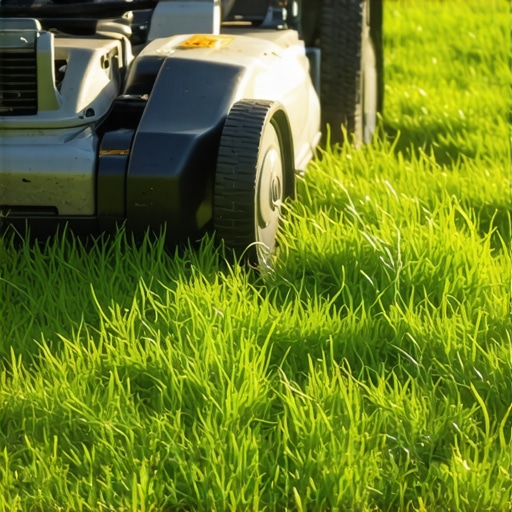
The Microscopic Reality of the Jagged Cut
Dull mower blades tear grass tissue rather than slicing it, leading to a state of mechanical stress known as shredded-tip necrosis. This condition occurs when the mower’s impact exceeds the plant’s structural integrity, causing the vascular bundles to fray. This results in rapid desiccation, increased pathogen susceptibility, and a noticeable white or tan sheen across the turf canopy within 48 hours of maintenance.
The Apprentice Lesson: Why I Fire People Over Dull Steel
I always drill into my new crew members: if you don’t fix the soil grading first, every plant you put in the ground is just expensive compost. But even with perfect grading, a dull blade is the fastest way to lose a client. I remember a job back in 2018 where a rookie took a 60-inch zero-turn out with blades that hadn’t been touched in three weeks. By Tuesday, the client’s $40,000 fescue lawn didn’t look green; it looked like it had been hit by a blowtorch. When you look at a grass blade under a 10x hand lens after a dull cut, you don’t see a clean line. You see a frayed mop head. That frayed tissue can’t heal. It just leaks moisture until the top half-inch of the plant dies. We had to spend three months on a heavy irrigation and fungicide program just to stop the Brown Patch from devouring the weakened turf. If the steel isn’t sharp enough to shave with, it doesn’t touch the grass. Period.
The Forensic Autopsy: Identifying the 2026 Shredding Crisis
The visual symptoms of a dull blade are often misdiagnosed as drought stress or nitrogen deficiency. When a mower blade is blunt, it doesn’t utilize a shearing action. Instead, it relies on raw kinetic energy to smash through the leaf. This shattering of the cell walls leads to immediate turgor pressure loss. Within six hours, the plant begins a localized necrosis. If your landscaping looks ‘dusty’ or ‘gray’ immediately after a cut, you aren’t looking at dust; you’re looking at millions of tiny, dead plant fibers. This is particularly critical during a sod install. New sod is already under extreme transplant shock; hitting it with a dull blade is essentially a death sentence for the root-to-shoot ratio.
“A mower blade must maintain a tip speed of approximately 19,000 feet per minute; however, speed cannot compensate for a rounded leading edge, which increases the required cutting force by 500%.” – Turfgrass Agronomy Manual, Vol 4
The Relationship Between Blade Edge and Fungal Pathogens
Why does the 2026 season seem particularly susceptible? We are seeing a rise in high-humidity microclimates that favor Rhizoctonia solani. A clean cut seals the plant wound in minutes. A torn cut stays open for days, acting as a wide-open door for spores. In my 20 years of yard cleanup and maintenance, I have never seen a well-sharpened lawn succumb to fungus as quickly as a torn one. The plant’s energy is diverted from root growth to wound repair, leaving it defenseless.
| Metric | Sharp Blade (30° Angle) | Dull Blade (Rounded) |
|---|---|---|
| Water Loss Rate | Minimal (Normal Transpiration) | 30-50% Increase |
| Recovery Time | 12-24 Hours | 72-96 Hours |
| Fuel Efficiency | Optimum RPM Stability | 20% Increase in Fuel Consumption |
| Pathogen Entry | Low (Closed Cuticle) | High (Exposed Vascular Tissue) |
How much modified gravel do I need for a patio base?
While often asked during the same site visit, the physics of hardscaping and turf care are both rooted in compaction and drainage. For a standard patio base, you need a minimum of 4 to 6 inches of compacted 2A modified gravel. Just like a dull blade ruins grass, a thin base ruins a patio. If you don’t use a vibratory plate compactor to reach 95% Proctor density, your pavers will heave within two freeze-thaw cycles. Do not trust a contractor who ‘hand tamps’ their gravel base.
What is the ideal sharpening frequency for residential mowers?
For a standard 2026 residential lawn, you should sharpen your blades every 10 to 15 hours of use. If you are performing a heavy yard cleanup that involves hitting pinecones or sticks, that interval drops to 5 hours. Check the ‘nick’ profile of the steel. If you can see light reflecting off the leading edge, the blade is blunt. You want a consistent 30-degree bevel. Don’t go ‘razor sharp’—the edge will roll over too fast. You want a working edge, similar to a butter knife but with a defined, clean bevel.
“Turfgrass quality is directly proportional to the sharpness of the cutting tool; dull blades increase water requirements by up to 1 inch per week due to increased leaf surface area exposure.” – Penn State Extension: Turfgrass Management
The Ground-Up Build: The Master Maintenance Checklist
- Check Balance: A sharpened blade must be balanced on a wall-mounted balancer to prevent spindle bearing failure.
- Metallurgy Matters: Only use high-carbon steel blades. Cheap big-box replacements use soft alloys that dull in three cuts.
- Angle Consistency: Use a specialized grinder jig to maintain a 30-degree angle. Free-handing with a file is for amateurs.
- Debris Management: Always perform a yard cleanup before mowing. A single hidden rock can ruin a $100 high-lift blade in a millisecond.
- The First Cut Rule: On a fresh sod install, wait until roots are established (the ‘tug test’) and use a brand-new blade on the highest setting.
The Science of Surface Area and Evaporation
When you tear a blade of grass, you increase the surface area of the wound by a factor of ten compared to a clean cut. This is basic biology. The stomata cannot close a jagged wound. This leads to a massive spike in irrigation demand. I’ve seen homeowners double their water bill in July because they were trying to ‘green up’ a lawn that was simply being shredded every Saturday. You can’t water your way out of a mechanical injury. It will rot. Fix the blade, or stop mowing.