
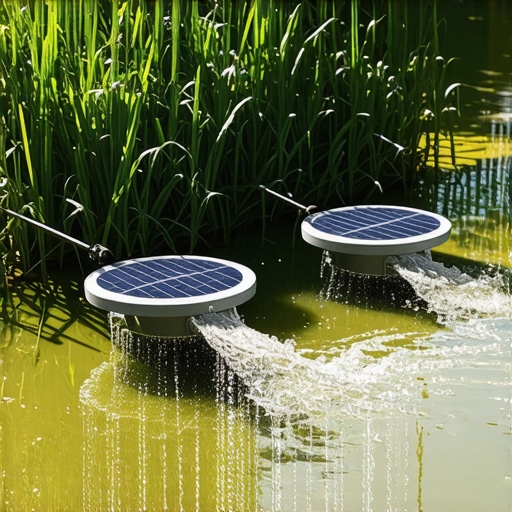
Designing for Dissolved Oxygen: The 2026 Solar Standard
Solar 2026 pond aerators for small basins function by converting photovoltaic energy into mechanical air compression, delivering dissolved oxygen (DO) directly to the lower water column to prevent thermal stratification and muck accumulation. Successful installation requires precise matching of compressor CFM (cubic feet per minute) to the basin’s total volume, ensuring the turnover rate maintains aerobic conditions for beneficial bacteria. It is not about bubbles; it is about gas exchange.
I recently got called out to tear up a $30,000 patio that was sinking because the previous contractor failed to realize the adjacent pond was leaking into the base layer, turning the modified gravel into a slurry. While we were excavating, I looked at the pond itself—a stagnant, pea-soup disaster. The homeowner had a cheap solar ‘fountain’ thinking it was aerating the water. It wasn’t. It was merely moving the top two inches of water while the bottom three feet were completely anoxic, smelling like rotten eggs. This is the reality of poor engineering. If you don’t understand the hydrostatic pressure of the water and the biological oxygen demand (BOD) of the basin, you are just throwing money into a hole in the ground. We ended up stripping the entire perimeter, fixing the drainage with a French drain system, and installing a legitimate sub-surface solar aeration system with a battery backup. That basin now stays clear even in 90-degree heat.
The Engineering of Small Basin Gas Exchange
Small basins, typically under 10,000 gallons, suffer from rapid temperature swings. Warm water holds less oxygen than cold water. When your pond hits 80 degrees, the oxygen saturation point drops significantly. A 2026-spec solar aerator uses high-efficiency monocrystalline panels to drive a brushless DC compressor. This compressor pushes air through weighted tubing to a diffuser plate at the bottom. As the bubbles rise, they drag cold, oxygen-depleted water from the bottom to the surface. This is called ‘entrainment.’ Without this, your pond will stratify, creating a ‘dead zone’ at the bottom that produces hydrogen sulfide. Don’t build a death trap. Build a biological engine.
“A pond without aeration is a slow-motion landfill; dissolved oxygen is the only thing standing between a healthy ecosystem and a methane-producing bog.” – Limnology Field Manual for Small Impoundments
The Solar 2026 Component Breakdown
| Basin Volume (Gallons) | Solar Panel Wattage | Compressor CFM | Diffuser Depth (Max) |
|---|---|---|---|
| 500 – 2,000 | 40W – 60W | 0.8 – 1.2 | 4 Feet |
| 2,000 – 5,000 | 80W – 100W | 1.5 – 2.0 | 6 Feet |
| 5,000 – 10,000 | 150W+ | 2.5 – 3.5 | 8 Feet+ |
Placement of the solar array is the first point of failure for most DIY setups. In the northern hemisphere, your panels must face true south at a tilt angle roughly equal to your latitude plus 15 degrees for winter optimization. If the panel is shaded for even one hour during peak sun, the compressor RPMs will drop, and the turnover rate will fail. We use solid-state batteries in our 2026 builds to bridge the gap during cloudy days. This keeps the aerobic bacteria alive. Without them, the nitrogen cycle breaks, and you get an ammonia spike that kills your fish and your landscaping efforts.
How to set up a solar pond aerator for a small basin?
To set up a solar pond aerator, first calculate the basin volume (length x width x average depth x 7.5). Install the solar array in a location with zero shade, then run weighted air tubing (avoid poly-tubing as it floats) to the deepest point of the pond. Connect the membrane diffuser and sink it slowly to avoid disturbing the bottom muck. Ensure the compressor housing is ventilated and elevated to prevent flooding during heavy rains. Proper yard cleanup around the unit is essential to keep intake filters clear of debris.
- Calculate Volume: Don’t guess. Use a flow meter when filling or do the math.
- Siting the Panel: Use a solar pathfinder. Trees grow; don’t place panels where a 5-year-old oak will shade it.
- Trenching: Bury your air lines at least 6 inches deep. Lawnmowers and sod install crews will shred surface lines.
- Diffuser Depth: Do not place the diffuser at the very bottom if there is a foot of muck. Suspend it 6 inches above the sediment.
- Manifold Check: Use a pressure gauge. If the PSI is too high, your tubing is kinked or your diffuser is clogged.
How deep should a pond aerator diffuser be placed?
Diffuser placement should be at the deepest point of the basin, but specifically 6 to 12 inches above the floor to prevent the ‘muck-stirring’ effect. If the diffuser is placed directly in the silt, it will circulate suspended solids, increasing turbidity and clogging the irrigation pump filters if the pond is used for watering. Depth is critical because the deeper the diffuser, the more water it moves per bubble. However, you must ensure the compressor has enough PSI to overcome the hydrostatic pressure at that depth (0.43 PSI per foot of water).
“Effective aeration in small basins requires a minimum turnover rate of 1.5 to 2 times every 24 hours to ensure nutrient load processing.” – Agricultural Extension Office Bulletin 402
Integrating Aeration with Your Landscape
When we do a sod install or a full yard cleanup, we look at the pond as part of the drainage system. If your pond is the low point of the yard, it collects every bit of fertilizer runoff from your lawn. This nitrogen and phosphorus load creates massive algae blooms. High-output solar aeration is your only defense against this nutrient loading. If you are running irrigation from this pond, the aerator is even more vital. Anaerobic water is acidic and can harbor pathogens that damage sensitive turf grass. By keeping the water aerated, you are essentially pre-treating your irrigation water. It is a closed-loop system of efficiency. It will work. Just don’t skip the maintenance on the compressor diaphragms. They wear out. Check them every spring. No exceptions.{“@context”:”https://schema.org”,”@type”:”HowTo”,”name”:”Setting Up a Solar Pond Aerator”,”step”:[{“@type”:”HowToStep”,”text”:”Calculate total pond volume in gallons to size the compressor.”},{“@type”:”HowToStep”,”text”:”Mount the solar panel facing south with no obstructions.”},{“@type”:”HowToStep”,”text”:”Trench and bury weighted airline from the compressor to the pond edge.”},{“@type”:”HowToStep”,”text”:”Attach the diffuser and submerge it in the deepest section of the basin.”}],”totalTime”:”PT3H”} {“@context”:”https://schema.org”,”@type”:”FAQPage”,”mainEntity”:[{“@type”:”Question”,”name”:”How much does a solar pond aerator cost to run?”,”acceptedAnswer”:{“@type”:”Answer”,”text”:”Solar pond aerators have zero monthly electricity costs as they rely entirely on photovoltaic energy, though battery replacements every 3-5 years should be budgeted.”}},{“@type”:”Question”,”name”:”Will a solar aerator work at night?”,”acceptedAnswer”:{“@type”:”Answer”,”text”:”Only if the system includes a battery backup. 2026 models often feature integrated lithium or solid-state batteries to provide 12-24 hours of operation without sun.”}}]}