
The Hardscape Autopsy: Why Your Yard is a Swamp
To fix wet spots with a French drain, you must excavate a trench at a 1 percent slope, line it with non-woven geotextile fabric, install a perforated 4-inch SDR-35 pipe, and backfill with #57 washed stone. This system redirects hydrostatic pressure away from your foundation and lawn by providing a path of least resistance for subsurface water. Failure to follow these specific engineering steps results in a clogged system that will rot your sod and destabilize your landscaping within two seasons.
I recently got called out to tear up a $30,000 patio that was sinking because the previous contractor ignored the basic laws of physics. The homeowner had a massive wet spot right at the edge of the pavers. Every time it rained, the water stayed. The contractor had just thrown some black corrugated pipe into a shallow hole with no aggregate and called it a day. Within six months, the soil saturated, the base material turned into soup, and the pavers began to dive. When we excavated, the pipe was crushed and completely filled with silt. It was a $30,000 lesson in why you do not cut corners on drainage. You cannot hide bad engineering under a layer of expensive stone. It always comes back to haunt you.
Wet spots are not just an annoyance for your lawn mower; they are a sign of anaerobic soil conditions. When water sits in the pore spaces of your soil for more than 48 hours, it displaces oxygen. This kills the beneficial microbes needed for nitrogen cycling. Your grass roots literally drown. They cannot breathe. You see it as a yellowing patch or a muddy mess, but at the microscopic level, it is a biological dead zone. If you want a successful sod install or a lasting landscape design, you must address the hydrology first.
The Physics of Soil Saturation and Hydrostatic Pressure
Hydrostatic pressure is the force exerted by water at rest against whatever is containing it. In a yard with poor drainage, this pressure builds up against your foundation or under your hardscaping. If you have heavy clay soil, the percolation rate is near zero. Water moves through clay at a rate of less than 0.05 inches per hour. In contrast, a properly engineered French drain using #57 stone allows water to move at several gallons per minute. You are essentially creating an underground highway for water. It is about bypass, not just absorption.
“A retaining wall doesn’t fail because of the stone; it fails because of the water trapped behind it.” – Hardscape Engineering Axiom
We look at the soil structure first. If you are dealing with silt or clay, you cannot just dig a hole. You need to understand the compaction levels. Before we even start a yard cleanup or a new landscaping project, we check the grade. A lot of guys think they can just throw more dirt on top. That is a mistake. All you do is create a new layer of mud. You need a dedicated exit point for the water, whether that is a dry well, a pop-up emitter at the curb, or a connection to a storm sewer where local codes allow.
Material Science: Why Your Choice of Pipe and Stone Matters
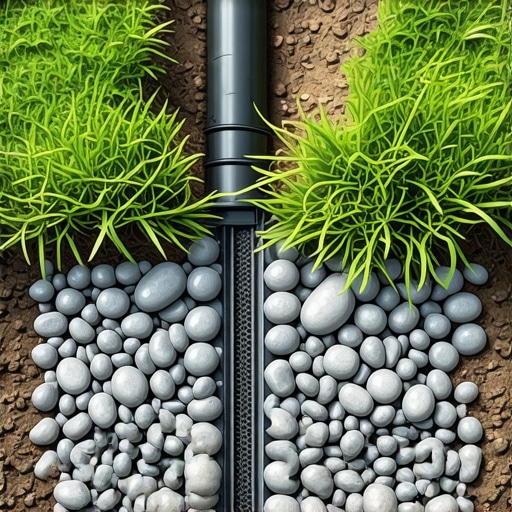
Most big-box stores sell thin, black corrugated pipe. I hate the stuff. It is fragile, difficult to clean, and the ridges catch sediment. If you want a drain that lasts 50 years, you use 4-inch SDR-35 perforated PVC. It is rigid. It has a smooth interior that prevents clogs. More importantly, it can withstand the weight of a skid steer or a heavy sod install without collapsing. [IMAGE_PLACEHOLDER]
| Material Component | Professional Standard | DIY/Big-Box Alternative | Longevity Factor |
|---|---|---|---|
| Drainage Pipe | 4-inch SDR-35 Perforated PVC | Black Corrugated Flex Pipe | 40+ Years vs 5 Years |
| Filter Fabric | 4oz Non-Woven Geotextile | Woven Weed Barrier | Permeable vs Clogging |
| Aggregate | #57 Washed Angular Stone | Round Pea Gravel | Interlocking vs Shifting |
| Slope/Grade | 1% Minimum (1/8″ per foot) | “Eye-balled” Grade | Flow vs Stagnation |
The stone is equally important. Never use pea gravel. You need #57 washed stone, which is usually a crushed limestone or granite about 3/4 inch to 1 inch in size. The angular edges of the stone interlock, providing structural stability for whatever you put on top, like a new sod install. The “washed” part is critical. If there is dust or fines in the stone, that dust will settle at the bottom of your trench and create a waterproof crust. That defeats the entire purpose of the drain.
How deep should a French drain be?
For most residential yards, a French drain should be between 18 and 24 inches deep. This depth ensures you are capturing the subsurface water before it reaches the root zone of your turf grass. If you go too shallow, the water will simply bypass the drain and continue to saturate the surface soil. If you go too deep without a mechanical pump, you may lose the necessary slope required for gravity to move the water. You must verify the location of all underground utilities by calling 811 before you break ground. A trenching machine will snap a gas line or a fiber optic cable in a heartbeat.
Can I put sod over a French drain?
Yes, you can install sod over a French drain, but you must do it correctly using the “burrito wrap” method. This involves lining the entire trench with geotextile fabric, filling it with stone and the pipe, and then folding the fabric over the top of the stone. You then add 2 to 3 inches of a high-permeability sandy loam soil mix before laying your sod. This prevents the silt from the sod’s root ball from washing down into the stone. Without the fabric wrap, your expensive drainage system will be useless within three years due to sedimentation.
Step-by-Step Engineering: The Professional Installation Process
We do not just dig; we calculate. The first step is identifying the lowest point of the wet spot and the final discharge point. You need a minimum drop of 1 inch for every 8 feet of pipe. Use a laser level. Don’t trust your eyes; they lie. Once the path is marked, we use a dedicated trencher or a mini-excavator to cut a 12-inch wide trench. The bottom of the trench must be compacted and smooth.
- Excavation: Dig the trench to the calculated depth, maintaining a consistent 1% slope.
- Fabric Lining: Lay down 4oz non-woven geotextile fabric. Leave enough excess on the sides to wrap over the top later.
- Bedding: Pour a 2-inch base of #57 stone. This protects the pipe from the soil at the bottom.
- Pipe Placement: Install the SDR-35 pipe with the perforations facing DOWN. This seems counter-intuitive to some, but water rises into the pipe from the bottom as the water table increases.
- Backfill: Fill the trench with stone to within 3 inches of the surface.
- The Wrap: Fold the excess fabric over the top of the stone. This is your primary defense against silt.
- Restoration: Top with sandy loam and install new sod. Roll the sod to ensure root-to-soil contact.
“Soil drainage is the most overlooked factor in urban agronomy. Without proper pore space, the nitrogen cycle halts, and pathogens like Pythium thrive.” – Agricultural Extension Field Manual
The final step of any yard cleanup and drainage project is the first rain event. You need to inspect the discharge point. If water isn’t flowing freely, you have a hump in your pipe. Drainage is binary: it either works or it doesn’t. There is no middle ground. If you are doing a full landscaping overhaul, the French drain is the foundation. You do it before the irrigation heads go in, before the trees are planted, and long before the final sod install.
Maintenance and Long-Term Performance
A properly built French drain is low maintenance, but it is not “no maintenance.” Every spring, during your yard cleanup, check the exit point. Clear away any debris, mulch, or overgrown grass that might be blocking the pipe. If you installed a clean-out port (which you should), pop the cap and run a hose through it. You want to see clear water exiting the other end. If the water is muddy, your fabric has failed or you didn’t use washed stone.
Irrigation systems can sometimes hide drainage issues. If you have an irrigation zone that is leaking, it can create a localized wet spot that mimics a natural drainage problem. Always pressure test your irrigation lines if a wet spot appears suddenly in a yard that was previously dry. High-end landscaping requires a balance between adding water and removing it. You are a steward of the hydrology of your property. Treat it with the respect that 8 pounds of weight per gallon of water demands. If you don’t control the water, the water will control your property value. Don’t let a $500 drainage problem turn into a $50,000 foundation repair.