
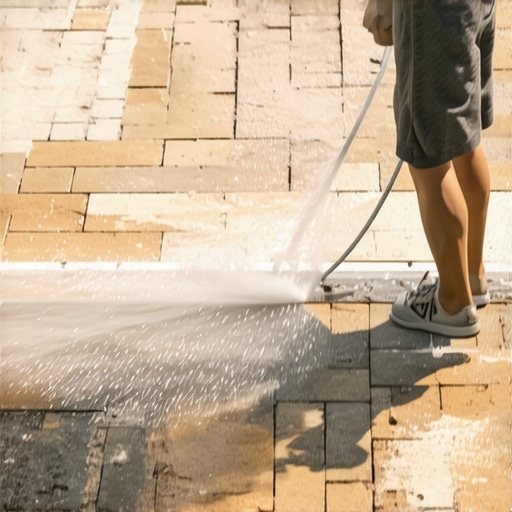
How to Clean Your Pavers Without Power Washing the Sand Out
I recently got called out to tear up a $30,000 patio that was sinking because the previous contractor used a high-pressure wand to clean the surface every spring for five years. By the time I arrived, the interlocking friction that holds a paver system together was non-existent. The homeowner had literally blasted away the structural integrity of their investment, one sand grain at a time. This is what happens when you treat a precision-engineered hardscape like a dirty driveway. If you want to maintain your pavers without ruining them, you have to understand the science of the sand joint and why high PSI is the enemy of longevity.
The Invisible Mechanics of Your Paver Surface
To clean pavers without removing joint sand, you must utilize low-pressure chemical application combined with specialized surfactants and soft-bristle agitation. High-PSI water streams compromise the polymeric bond or interlocking friction provided by sand, leading to structural shifting and weed intrusion. When you blast water into those gaps, you aren’t just removing dirt; you are excavating the very foundation that prevents your pavers from migrating. This loss of material allows water to infiltrate the modified gravel base, which eventually leads to heaving during freeze-thaw cycles.
“A retaining wall doesn’t fail because of the stone; it fails because of the water trapped behind it.” – Hardscape Engineering Axiom
The same logic applies to your patio. If you remove the sand, you open the floodgates for hydrostatic pressure to build up underneath. Most homeowners see a bit of moss or a stain and reach for the pressure washer. That is a amateur mistake. In my 20 years of landscaping, I have seen more damage done by 4000 PSI pumps than by decades of natural weathering. You need to approach this with chemical logic, not brute force. Whether you are dealing with algae from a nearby sod install or mineral deposits from a misaligned irrigation head, the solution is always the same: kill the organic matter at the root and lift the stain without disturbing the ASTM-C144 sand underneath.
The Engineering of the Sand Joint
Joint sand is not just filler. It is a structural component. In an interlocking pavement system, the sand creates rotational interference. This means when a load is placed on one paver, the sand transfers that load to the neighboring units. If the sand is missing, the paver is isolated. It will tip. It will crack. It will fail.
“Joint sand is the crucial element in developing interlock; without it, the units act independently rather than as a unified pavement system.” – ICPI Tech Manual
Proper yard cleanup involves removing debris that can trap moisture against these joints. Decomposing leaves produce humic acid, which can break down the binders in polymeric sand over time. If you do not keep the surface clear, the chemistry of the sand changes, making it more susceptible to washing out even during a heavy rainstorm.
How much modified gravel do I need for a patio base?
A standard residential patio requires four to six inches of 3/4-inch modified gravel (also known as CR-6 or 21A) compacted in 2-inch lifts to 98% Proctory density. Without this compacted base, no amount of sand or cleaning will keep your pavers level. If your patio is already sinking, cleaning it is like painting a burning house. You must address the subgrade compaction first. I tell my crew every day: if you don’t fix the soil grading, every plant and stone you put down is just expensive compost.
The Professional Cleaning Protocol: Step-by-Step
This is the process we use for high-end clients who value their hardscape. We do not use