
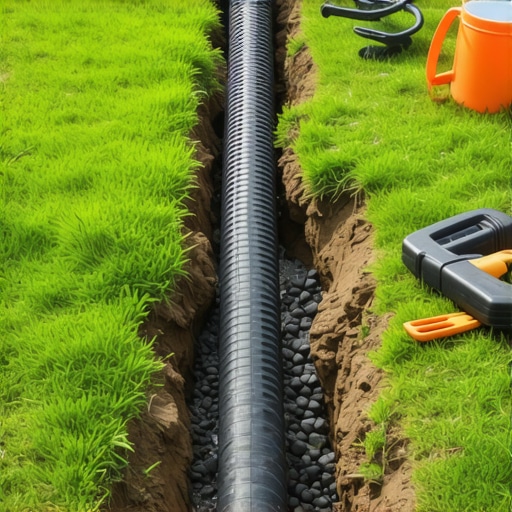
The Anatomy of a Yard Swamp
That squishing sound under your boots is not just an annoyance: it is the sound of your landscape slowly dying. When water stagnates in your yard, it creates an anaerobic environment that suffocates turf roots, encourages fungal pathogens, and can eventually undermine your home foundation through hydrostatic pressure. I recently got called out to tear up a $30,000 paver patio that was sinking and tilting like the Titanic. The previous contractor had ignored the subsurface water flow, and within two years, the base material had washed away, turning a high-end hardscape into a dangerous trip hazard. This is why we don’t just ‘fill holes’ with dirt; we engineer drainage solutions. To fix a soggy spot, you must intercept surface water and groundwater using a French drain system consisting of a perforated pipe buried in a trench of clean, 3/4-inch washed stone wrapped in non-woven geotextile fabric to prevent siltation. It will fail if you skip the fabric. Don’t skip it.
“A retaining wall doesn’t fail because of the stone; it fails because of the water trapped behind it.” – Hardscape Engineering Axiom
Diagnosing the Drainage Failure
Identifying why water is pooling requires a forensic look at your property’s topography and soil composition. Often, a soggy spot is the result of a perched water table or heavy clay layers that prevent infiltration, leading to saturation. If your soil has high clay content, typical in many suburban developments, the water cannot move vertically through the soil profile, forcing it to sit on the surface until it evaporates or moves laterally. This is where landscaping becomes civil engineering. You need to calculate the slope: a minimum of 1 percent or 1/8 inch of drop per foot of run is mandatory to ensure gravity moves the water to the discharge point. Without this slope, your French drain is just a long, expensive underground puddle. Check your utility lines first. Call 811 before you even touch a shovel. Cutting a fiber optic line will ruin your week faster than a flooded basement.
How deep should a French drain be?
A standard residential French drain should be between 12 and 18 inches deep, depending on the volume of water and the frost line in your region. The goal is to reach the subsoil layer while maintaining enough depth for a 12-inch stone column and a 4-inch turf or mulch cap. In areas with heavy irrigation needs, you may need to go deeper to intercept the saturation point before it reaches the root zone of your grass.
The Critical Material Selection
Not all drainage materials are equal. Most homeowners go to a big-box store and buy the cheap, thin corrugated black pipe. This is a mistake. Silt and roots eventually penetrate those thin slits, and the pipe becomes a solid core of mud. I only use SDR-35 PVC or heavy-duty NDS double-wall corrugated pipe. It is rigid, smooth on the inside to prevent debris snagging, and much easier to clean out if needed. The stone choice is equally critical. You want ASTM C33 #57 washed stone. Do not use ‘crusher run’ or stone with ‘fines’ (dust). The dust will clog the geotextile fabric and kill the system’s permeability. You need the voids between the clean stones to allow water to move freely toward the pipe.
| Material Type | Function | Landscaper Recommendation |
|---|---|---|
| Perforated Pipe | Water conveyance | SDR-35 Rigid PVC (Perforated) |
| Drainage Stone | Water filtration/void space | 3/4-inch Clean Washed River Rock or #57 Stone |
| Filter Fabric | Prevents siltation | 4oz Non-woven Geotextile (Avoid woven) |
| Discharge Point | Water exit | Pop-up emitter or daylight to a swale |
The Step-by-Step French Drain Installation
Follow this sod install and drainage protocol to ensure a permanent fix. First, excavate the trench, ensuring you are maintaining that 1 percent slope. Line the entire trench with your non-woven geotextile fabric, leaving enough ‘slack’ on the sides to wrap over the top later. This is called the ‘taco wrap’ method. Place 2 inches of stone at the bottom of the fabric-lined trench to act as a bedding layer. Lay your 4-inch perforated pipe with the holes facing down. This is counter-intuitive to many, but water rises into the pipe from the bottom of the trench. If the holes face up, the water level must rise 4 inches before it even starts to drain. Fill the trench with stone to within 3 inches of the surface. Wrap the excess fabric over the top of the stone. This prevents the soil and yard cleanup debris from migrating into the stone. Top with a thin layer of sand and then your sod. Your sod install will thrive because the roots are no longer drowning.
“Subsurface drainage systems must be designed to accommodate the peak flow rate of a 10-year storm event to prevent system bypass and localized flooding.” – Agricultural Drainage Manual
Does a French drain need an outlet?
Yes, a French drain is not a soak-away pit; it is a transportation system. You must have a designated discharge point, such as a dry well, a pop-up emitter at the curb, or ‘daylighting’ the pipe into a lower-lying ravine or ditch. If the water has nowhere to go, it will simply back up into the trench and exacerbate the soggy spot. Always check municipal codes before directing water toward a neighbor’s property or into the street.
Post-Installation Maintenance
Once the system is in, you aren’t done. A French drain is a mechanical system that requires periodic inspection. Install clean-out ports at the beginning of the run and at any 90-degree turns. Every spring, run a garden hose down the clean-out to ensure the line is clear of debris or rodent nests. Keep your irrigation heads adjusted so they aren’t dumping unnecessary water directly into the drain trench. If you notice the discharge point is dry after a heavy rain, you have a blockage. Address it immediately. A failed drain is worse than no drain at all because it concentrates water in one failure point. Maintain your turf with core aeration to ensure the soil surface remains porous. This allows the water to reach the French drain instead of pooling on top of compacted thatch. A healthy lawn is your first line of defense against erosion and standing water.
- Checklist for Success:
- Verify 1% slope using a laser level or string level.
- Use non-woven geotextile fabric, not weed barrier.
- Ensure pipe perforations face downward.
- Install a pop-up emitter at least 10 feet from the foundation.
- Confirm utility marks are visible before digging.
- Tamp the soil lightly over the trench to prevent settling.