
The Foundation of Winter Survival: Why Most Roses Fail by February
Protecting rose bushes from winter die-back involves insulating the graft union, managing soil moisture levels before the ground freezes, and implementing a dormant-season pruning strategy. Professionals focus on preventing the freeze-thaw cycle from heaving the root ball and protecting the vascular cambium from desiccation during high-wind events.
I always drill into my new crew members: if you don’t fix the soil grading and site sanitation first, every plant you put in the ground is just expensive compost. I’ve seen hundreds of rookies spend three days planting high-end David Austin roses only to watch them turn into black, brittle sticks by March because they didn’t understand the physics of hydrostatic pressure in the soil or the chemistry of late-season nitrogen. You can’t just throw a burlap sack over a plant and call it winterized. True landscaping is about managing the biological clock of the plant and the thermodynamics of the root zone. When the ground freezes, the plant’s ability to pull moisture stops. If the canes are exposed to 20-mph frozen winds, they lose water through a process called desiccation. Without a water source, the cells collapse. That isn’t just ‘cold damage’; it’s cellular dehydration. To prevent this, we look at the yard as an integrated system—from the irrigation timing to the yard cleanup protocols that remove fungal pathogens like Diplocarpon rosae.
“A rose’s ability to survive winter is determined less by the absolute minimum temperature and more by the rate of temperature change and the moisture content of the soil and plant tissues.” – Horticultural Science Research Manual
The Science of Site Sanitation and Yard Cleanup
Effective winter protection begins with a rigorous yard cleanup that goes beyond simply blowing leaves into a pile. Many ‘mow-and-blow’ operators leave debris at the base of the rose, which creates a petri dish for overwintering spores. In my firm, we mandate the removal of all fallen foliage within a 36-inch radius of the main stem. This is critical because fungal spores survive in the duff layer and will re-infect the new growth the moment the mercury hits 50 degrees Fahrenheit in the spring. If you are doing a sod install nearby, ensure the grading doesn’t slope toward the rose beds, as standing water during a mid-winter thaw will lead to root rot. We check the soil pH—ideally 6.5—to ensure the plant has the nutrient bank it needs to build strong cell walls before the first frost. Weak cell walls rupture when water inside them freezes; strong, mineral-rich cell walls can withstand the expansion of ice crystals.
How much mulch do I need for rose winterization?
For standard hybrid tea roses in USDA zones 5 through 7, you need a mound of mulch or high-quality topsoil at least 10 to 12 inches high, covering the graft union completely. This mound acts as a thermal buffer, slowing the rate at which the soil temperature fluctuates during the dangerous freeze-thaw cycles of late January.
The Irrigation Mandate: Hydration Before the Hard Freeze
One of the most common mistakes is shutting off the irrigation system too early. While you want to stop fertilizing in August to prevent tender new growth (which is easily killed by frost), you must continue deep watering until the ground is physically frozen. A hydrated plant is a resilient plant. I tell my clients to aim for 1 to 1.5 inches of water per week through November. This ensures the root zone is saturated. Once the ground freezes, that moisture is ‘locked’ in the soil, providing a tiny amount of latent heat and a reservoir for the roots once the spring thaw begins. If you are installing a new sod install in late fall, your irrigation schedule must be even more precise to balance the needs of the new turf and the established perennials. We use tensiometers to measure soil moisture at the 6-inch and 12-inch depths to ensure we aren’t just wetting the surface.
| Material Type | Insulation Value (R) | Drainage Rating | Best For |
|---|---|---|---|
| Wood Chips | Moderate | High | Established shrub roses |
| Clean Straw | High | Moderate | Extreme cold (Zone 4/5) |
| Mounded Topsoil | Very High | Low | Graft union protection |
| Pine Bark Nuggets | Low | Very High | High-rainfall regions |
Technical Installation: The ‘Hilling’ Process
Hilling is the gold standard for protecting the graft union—the swollen area where the rose variety is joined to the rootstock. If this union dies, your expensive rose is gone, replaced by the wild sucker growth of the rootstock next year. We don’t use ‘rose cones’—those cheap Styrofoam hats you see at big-box stores. They trap heat on sunny days, tricking the plant into breaking dormancy, only to have the sap freeze at night, which shatters the canes. Instead, we use the ground-up build method. We bring in professional-grade compost or screened topsoil. We do not scrape soil from around the rose, as this exposes the shallow feeder roots. We dump the soil directly into the center of the bush, allowing it to naturally slope down. This creates a 12-inch high pyramid. Only after the top inch of this mound has frozen do we add a secondary layer of evergreen boughs or straw to keep the mound frozen. This prevents the ‘heaving’ action that can physically tear roots out of the ground.
“Mulching to a depth of 3 to 4 inches is standard for weed control, but winter protection for sensitive species requires a minimum of 8 to 10 inches of organic material to stabilize soil temperature.” – Penn State Agricultural Extension
Do I need to prune roses before winter?
No. Do not perform heavy pruning in the fall. Pruning stimulates the plant to grow. Instead, only trim exceptionally long canes that might whip in the wind and loosen the root ball. Wait until the forsythia blooms in spring to do your structural pruning. Every cut you make in the fall is an open wound that winter winds will desiccate, leading to more die-back than if you had left it alone.
The Professional Winterization Checklist
- Sanitation: Remove all spotted leaves and old mulch to eliminate fungal spore reservoirs.
- Hydration: Maintain deep irrigation until the ground reaches a hard freeze (typically 32°F at a 4-inch depth).
- Hilling: Apply 10-12 inches of high-quality topsoil over the graft union once the plant is dormant.
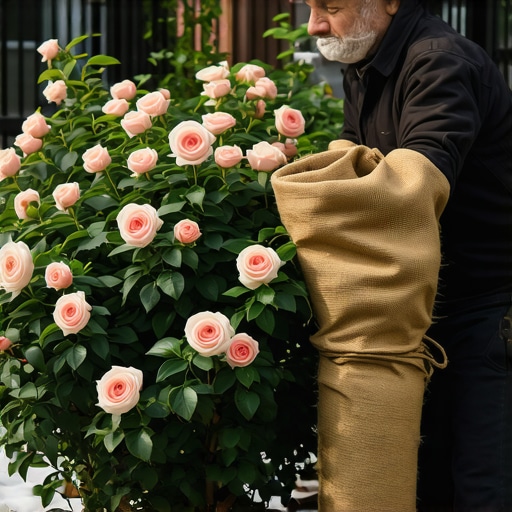
- Wind Protection: Install burlap screens for roses in high-exposure areas to reduce transpiration.
- Pest Control: Apply a dormant spray of lime sulfur or copper fungicide to kill overwintering eggs and spores.
Winter management is a cycle. You aren’t just ‘covering a plant’; you are managing the transition of a complex biological organism into a state of suspended animation. If you follow these engineering standards—proper grading, thermal mounding, and late-season hydration—you won’t be calling me in April to replace a garden full of dead wood. You’ll have roses that hit the ground running the moment the soil warms up.