
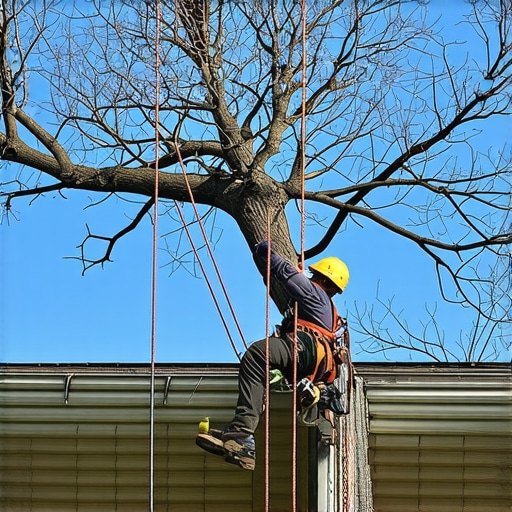
Understanding High-Risk Tree Pruning Over Residential Structures
To safely trim large tree branches over your house, you must employ the three-cut method to prevent bark stripping and utilize static rigging lines to control the descent of the limb. This process requires identifying the branch bark ridge and branch collar to ensure the tree can heal properly through CODIT (Compartmentalization of Decay in Trees). Never attempt to drop a limb freely onto a roof or landscape bed.
I always drill into my new crew members: if you don’t fix the soil grading first, every plant you put in the ground is just expensive compost. When we transition from the ground to the canopy, that technical rigor becomes even more critical. I have seen hundreds of ‘mow-and-blow’ guys try to take down a limb with a hardware store chainsaw and a ladder, only to end up with a punctured roof or a crushed irrigation manifold. This is not just landscaping; it is structural engineering with a biological component. If you do not understand the tension and compression forces within a 500-pound limb, you are a liability, not a contractor.
“A tree’s ability to recover from a pruning cut is entirely dependent on the preservation of the branch collar, where the tree’s natural defense chemicals are concentrated.” – International Society of Arboriculture (ISA) Best Management Practices
The Biology of the Cut: Why the Branch Collar is Sacred
Pruning is essentially creating a managed wound. The tree doesn’t ‘heal’ like human skin; it compartmentalizes. If you flush-cut a branch—meaning you cut it flat against the trunk—you destroy the branch collar. This opens the main trunk to heartwood rot. Conversely, leaving a ‘coat hanger’ stub prevents the wound from sealing, leading to localized dieback. You must find the ‘sweet spot’ just outside the branch bark ridge. It is precise work. It requires a sharp saw. Dull blades tear the cambium layer, leading to opportunistic fungal infections that can eventually kill the entire specimen. This is why professional yard cleanup after a storm often involves more than just hauling brush; it involves surgical remediation of jagged breaks.
The Physics of Rigging: Controlling the Descent
When a branch hangs over a roof, gravity is your primary enemy. You cannot simply cut and hope. We use high-tensile arborist ropes and friction devices like a Port-a-Wrap. By wrapping the rope around the base of the tree, one ground person can control the weight of a massive limb. This prevents the wood from slamming into the shingles or destroying the sod install you just paid thousands for last spring. Heavy impact compacts the soil. Soil compaction kills the fine feeder roots of trees. It is a vicious cycle. Use 1/2-inch or 5/8-inch double-braid polyester ropes. Do not use yellow poly-pro rope from the big-box store. It will snap. It will stretch. It will fail.
| Tool / Material | Specific Application | Critical Specification |
|---|---|---|
| Arborist Rope | Load rigging and lowering | >6,000 lbs break strength |
| Top-Handle Saw | In-canopy precision cuts | 35cc – 40cc engine displacement |
| Port-a-Wrap | Lowering heavy wood safely | Stainless steel friction device |
| Pole Saw | Reaching distal limbs from ground | Manual or gas-powered with 12ft reach |
The Three-Cut Method: The Only Way to Prevent Bark Stripping
The biggest mistake DIYers make is the single top-down cut. As the branch nears the end of the cut, the weight causes it to snap and peel a long strip of bark down the trunk. This is a death sentence for many species. First, make an undercut about 12 inches out from the trunk. Cut about one-third of the way through. Second, make a top cut an inch further out than the undercut. The branch will fall away cleanly between the two. Third, remove the remaining stub by cutting just outside the branch collar. This is the only way to ensure the tree’s structural integrity. It is non-negotiable.
How much does it cost to trim a large branch?
A single large limb removal over a structure typically costs between $300 and $850 depending on access and rigging complexity. This price reflects the insurance and specialized gear required for high-risk work. Expect to pay more if the crew has to navigate power lines or sensitive irrigation systems. Cheap quotes usually mean the contractor lacks workers’ comp insurance. If they fall off your roof, you are the one getting sued. Don’t risk your mortgage to save $200 on a tree trim.
Can I trim a tree myself or do I need an arborist?
If the branch is larger than 4 inches in diameter or higher than 10 feet off the ground, call a certified arborist. Homeowners lack the dynamic load-testing knowledge to predict where a limb will swing once severed. Furthermore, large-scale pruning often necessitates a yard cleanup plan that includes chipping and hauling. If you are also planning a sod install, the heavy equipment used in tree work must be coordinated to prevent destroying your new lawn. Professionals use ground protection mats. You probably don’t.
“Hydrostatic pressure isn’t just for retaining walls; it’s a factor in tree turgor. Pruning during extreme drought can lead to vascular collapse in some hardwood species.” – Agricultural Extension Agronomy Manual
- Inspect for defects: Check the branch for conks, mushrooms, or cracks before climbing.
- Utility Check: Always call 811 if you are using heavy machinery near the street for limb removal.
- Safety Gear: Chainsaw chaps, eye protection, and a hard hat are the minimum requirements.
- Rigging: Never tie a rope to yourself when lowering a limb. Use the tree.
While the internet tells you to water every day after a heavy pruning, turf grass and trees actually need deep, infrequent watering—exactly 1 inch per week—to force roots to chase the water down. Over-watering after the stress of a major trim can lead to root rot. Keep a close eye on the soil moisture levels near the trunk. If you have an irrigation system, adjust the zones accordingly. The tree is in shock. Treat it like a patient in recovery. It will take two years for the tree to fully seal the wound. Patience is the hallmark of a true horticulturist. Don’t rush the process. Don’t skip the safety steps.