
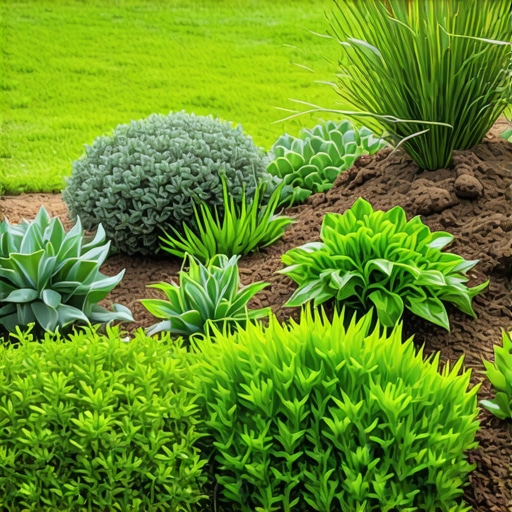
The Fundamentals of Slope Stabilization and Soil Mechanics
Stopping soil erosion is not about aesthetics; it is about managing kinetic energy and hydrostatic pressure. When I train a new apprentice on my crew, I start with a simple lesson: if you do not respect the grade, the dirt will eventually move. I remember a job three years ago where a client spent $15,000 on high-end shrubs for a steep bank. Three months later, a single flash flood washed half of them into their neighbor’s pool. Why? Because they ignored the angle of repose and the soil compaction levels required to hold that mass in place. We had to come in, strip the dead plant material, regrade the entire slope to a 3:1 ratio, and install a multi-layered erosion control system. It was an expensive lesson in physics.
“Slope stabilization is not merely a matter of surface coverage; it is an exercise in soil mechanics and root reinforcement.” – Cornell University Cooperative Extension
The Answer Capsule: How do ground covers stop erosion?
To effectively stop soil erosion with ground covers, you must select species with fibrous root systems that increase soil cohesion. These plants act as a biological anchor, while the foliage provides surface friction to dissipate the energy of rainwater impact and slow surface runoff velocity.
The Anatomy of Erosion: Detachment and Transport
Erosion happens in three stages: detachment, transport, and deposition. To stop it, you must intervene at the detachment phase. When a raindrop hits bare soil, it acts like a miniature bomb, dislodging soil particles. This is where landscaping professionals focus on canopy interception. A dense ground cover layer absorbs this impact energy. If you skip the yard cleanup and leave debris, you might think you are helping, but unmanaged organic matter can actually channel water into small streams called rills. We use a penetrometer to measure the soil resistance before any sod install or planting. If the soil is too loose, it won’t hold roots; if it is too compacted (over 300 PSI), roots cannot penetrate. Both scenarios lead to failure. We aim for a Proctor density of approximately 85% to 90% for planted slopes to ensure stability without suffocating the rhizosphere.
What is the best ground cover for a steep slope?
The best ground cover for a steep slope is a deep-rooted woody perennial or a mat-forming evergreen like Juniperus horizontalis (Creeping Juniper) or Vinca minor. These species provide year-round soil anchorage and are resilient against drought stress once their taproots are established.
| Plant Type | Root Depth (Inches) | Soil Binding Capability | Preferred pH Level |
|---|---|---|---|
| Creeping Juniper | 12-24″ | High (Lateral) | 5.5 – 7.0 |
| Pachysandra | 4-8″ | Medium (Rhizomatous) | 4.5 – 6.5 |
| Creeping Thyme | 3-6″ | Low (Surface) | 6.0 – 8.0 |
| Switchgrass | 36-60″ | Extreme (Fibrous) | 5.0 – 7.5 |
Hydraulic Management and Irrigation Strategy
You cannot talk about erosion control without talking about irrigation. Many homeowners over-water their slopes, thinking more water helps plants grow faster. In reality, saturated soil loses its shear strength. When the pore water pressure exceeds the weight of the soil, the entire bank slides. This is why we install pressure-compensating drip emitters rather than high-flow spray heads. A spray head delivers water at a rate that often exceeds the infiltration rate of the soil, causing immediate surface runoff. We calibrate our systems to deliver exactly 0.5 to 0.75 inches of water per hour, ensuring deep penetration without saturation. If you are doing a sod install on a slope, you must use sod staples—U-shaped metal pins—every 12 inches to prevent the heavy, wet sod from sliding down the hill before the adventitious roots can knit into the subsoil.
“Effective erosion control requires a multi-layered approach that addresses both the velocity of surface runoff and the shear strength of the soil profile.” – USDA Soil Conservation Service
The Engineering Checklist for Erosion Control
- Analyze the soil texture (Sand, Silt, Clay ratios) to determine the percolation rate.
- Check for utility lines by calling 811 before any excavation or deep planting.
- Install a silt fence or straw wattles at the base of the slope during the construction phase.
- Select plants based on USDA Hardiness Zones to ensure long-term survival.
- Apply a 2-inch layer of shredded hardwood mulch; avoid large chips that float away.
- Monitor the nitrogen-phosphorus-potassium (NPK) levels to encourage rapid root expansion.
Ground Cover Installation: Step-by-Step Engineering
Preparation is 80% of the job. First, we remove all invasive weeds and perform a thorough yard cleanup. We then test the soil pH. If the soil is too acidic, the cation exchange capacity is limited, and your expensive ground covers will starve. We amend the soil with organic compost to improve the soil structure and aggregates. When planting, we do not use the “mulch volcano” method. We expose the root flare and ensure the planting hole is twice the width of the root ball. This encourages lateral root growth, which is critical for lateral soil stabilization. After planting, we may use a geotextile fabric—not the cheap plastic stuff from the big-box stores, but a professional-grade woven polypropylene or jute netting. This mesh holds the soil in place for the 24 months it takes for the plants to achieve full canopy closure.
How long does it take for ground cover to stop erosion?
While initial stabilization occurs immediately upon installing geotextiles or sod staples, true biological erosion control takes 12 to 24 months. During this period, the plants develop mycorrhizal networks and secondary root structures that significantly increase the soil’s tensile strength.
The Role of Hardscaping in Erosion Mitigation
Sometimes, plants aren’t enough. If the slope exceeds a 2:1 ratio, you need a retaining wall. This is civil engineering. We focus on hydrostatic pressure. Every wall we build includes a French drain—a perforated pipe surrounded by #57 clean crushed stone—to weep water away from the back of the wall. Without this drainage, the water weight will eventually push the wall over. We use geogrid soil reinforcement for any wall over three feet. This grid ties the wall into the hillside, using the weight of the soil to hold the structure in place. For areas with high-velocity water, we use rip-rap (large angular stones) to create a dissipater. The irregular surfaces of the stones break up the water’s flow, preventing it from carving out a gully at the base of your landscaping project. It is about working with the water, not just trying to block it. Don’t skip the drainage gravel. It’s the most important part of the build.