
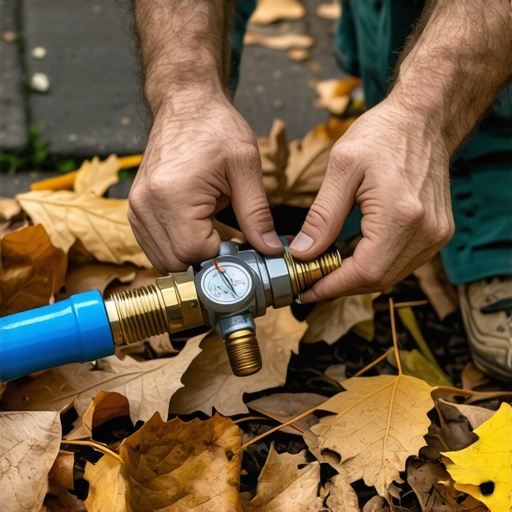
The Forensic Autopsy of a Frozen Irrigation System
I recently got called out to tear up a $30,000 patio that was sinking because the previous contractor failed to winterize the underlying irrigation lines correctly. The client thought they could just shut the water off and walk away. By mid-January, the residual water in the main line froze, expanded, and shattered a three inch PVC manifold directly beneath their expensive pavers. When spring arrived and the system pressurized, it turned the sub-base into a slurry, causing a total structural collapse of the hardscape. This is the reality of poor irrigation management. It is not just about the grass; it is about protecting every engineering asset on your property. If you do not evacuate every drop of liquid from those lines, you are inviting a catastrophic failure that costs thousands to remediate. Landscape maintenance is essentially a battle against physics and thermodynamics.
How to Winterize Your Sprinkler System Without a Pro
To winterize a sprinkler system correctly, you must **manually drain the main valve**, shut off the water supply, and use an **air compressor with high CFM** to blow out all residual moisture from every zone. This process prevents **ice expansion**, which generates over 2,000 PSI of force, easily shattering **PVC pipes** and **polyethylene tubing**. Do not rely on gravity alone.
The Physics of Pipe Failure
Water is a unique substance that expands by roughly 9 percent when it transitions from liquid to solid. In a closed loop system like an irrigation line, that expansion has nowhere to go but out. When the ground freezes, it creates a rigid cage around your pipes. The ice inside then exerts massive outward pressure. Standard Schedule 40 PVC is rated for pressure, but not for the mechanical stress of internal ice expansion. The pipe will develop hairline fractures or total longitudinal splits. This is why we use compressed air. We are not just moving water; we are removing the medium of destruction. Many homeowners make the mistake of using a small pancake compressor. Those units have high PSI but low CFM (Cubic Feet per Minute). You need volume to push the water up and out of the heads. Without enough volume, the air simply bubbles over the water, leaving plenty behind to freeze and crack your valves. It will fail.
| Pipe Material | Burst Pressure (PSI) | Freeze Vulnerability | Expansion Tolerance |
|---|---|---|---|
| Schedule 40 PVC | 280-450 | High | Low |
| Class 200 PVC | 200 | Very High | Minimal |
| Polyethylene (Black) | 80-160 | Medium | Moderate |
| Copper (Backflow) | 2500+ | Low (But Expensive) | Zero |
“A sprinkler system is only as durable as its weakest point, which is almost always the backflow preventer or the manifold valves during a hard freeze.” – Irrigation Association Technical Manual
How much air pressure for sprinkler winterization?
You should never exceed 50 to 80 PSI when blowing out an irrigation system. While your pipes might be rated for 200 PSI, the internal components of your zone valves and the plastic gears inside your rotor heads are delicate. High pressure can melt the plastic through friction or simply pop the seals. It is the volume of air, measured in CFM, that does the heavy lifting, not the pressure itself. If you are working with a large system, you need at least 20 to 50 CFM. Most home compressors only provide 4 to 6 CFM. This is why pros use tow-behind units. If you are doing this yourself, expect to spend much longer on each zone to ensure the air eventually clears the lines.
The Manual Drain and Backflow Protocol
Before you even touch the air compressor, you must isolate the system. Close the main shut-off valve, which should be located in a basement or a heated crawl space. If it is in a sub-grade pit, it must be deep enough to stay below the frost line. Open the manual drain plug and let the water exit the main line. Now, focus on the backflow preventer. This is the most expensive single component in your yard. If it is a Pressure Vacuum Breaker (PVB), you need to open the test cocks to a 45 degree angle. Leaving them fully open or fully closed can trap water inside the ball valve, leading to a cracked brass housing. Repairing a brass PVB is not cheap. It is a precision engineered safety device, not a simple pipe.
- Shut off the main water supply valve and label it clearly.
- Open the drain valve to relieve static pressure.
- Connect the air compressor to the blowout port (usually after the backflow).
- Activate the furthest zone first to prevent a massive pressure spike.
- Continue through each zone until only mist exits the heads.
- Leave all manual valves at a 45 degree angle for the winter.
“Failure to properly drain backflow prevention assemblies is the leading cause of residential irrigation repair calls in the spring.” – Penn State Agricultural Extension
Can I use a small pancake compressor to winterize sprinklers?
Technically, you can use a small compressor, but it is risky and inefficient. A pancake compressor lacks the air volume to keep the heads popped up and the lines clear. You will have to let the tank fill, blow for 10 seconds, and wait again. This cycling can cause the water to settle back into low spots in the piping, creating “traps” that eventually freeze. If you have a large property with significant elevation changes, a small compressor will fail to push water uphill. You are better off renting a 185 CFM industrial compressor for a day. It is cheaper than replacing a manifold. Don’t skip this.
The Soil Connection: Sod and Yard Cleanup
Winterization is also the time for a final yard cleanup. If you just had a sod install, do not neglect the moisture levels. While the pipes need to be dry, the soil should not be desiccated. A final deep soak before the ground freezes helps the new root systems survive the winter dormancy. Once the soil is hydrated, blow the lines. After the blowout, clear all debris and leaves from the lawn. Rotting organic matter left on top of fresh sod will create an anaerobic environment, leading to fungal pathogens like snow mold. A clean yard is a healthy yard. Don’t let your hard work go to waste by being lazy in November.