
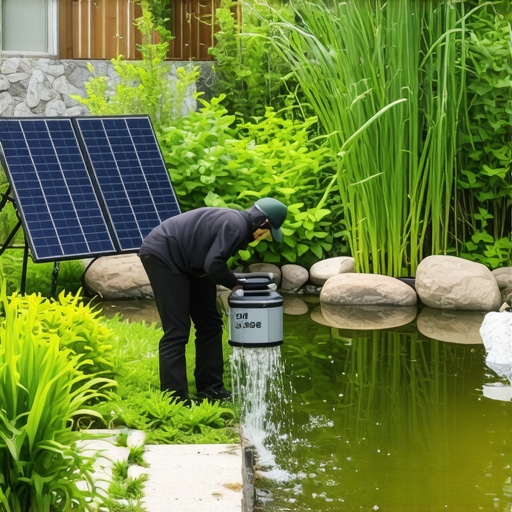
Understanding the Hydrology of Small Pond Aeration
Aeration for small garden ponds involves the mechanical process of increasing dissolved oxygen (DO) levels to support aerobic bacteria and aquatic life while preventing thermal stratification. Using a Solar 2026 Aerator ensures consistent gas exchange without the electrical overhead of traditional AC-powered submersible pumps or complex irrigation tie-ins. It prevents stagnant dead zones that harbor anaerobic pathogens.
I always drill into my new crew members: if you don’t fix the gas exchange first, every plant or fish you put in that pond is just expensive compost. I’ve seen guys spend five figures on landscaping around a water feature only to have the whole thing turn into a sulfurous pit of rot because they ignored the pond’s respiration. Water isn’t just a static liquid; it is a living, breathing biological reactor. When you see a pond covered in pea-soup algae, that’s not a plant problem—it’s a nitrogen and oxygen failure. We don’t just ‘install’ equipment; we engineer a localized biome. The Solar 2026 model is a specific piece of hardware designed for those of us who understand that yard cleanup isn’t just about raking leaves; it’s about managing the organic load that falls into the water and eventually rots, consuming every bit of oxygen in the process.
“Dissolved oxygen is the single most critical water quality parameter for the health of any aquatic ecosystem, influencing everything from nutrient cycling to the survival of macroinvertebrates.” – Texas A&M AgriLife Extension Service
The Physics of Gas Exchange at the Surface
Most hacks think a fountain is an aerator. It isn’t. A fountain is for looks. True aeration happens through the breakdown of the thermocline—the invisible barrier between warm surface water and the cold, hypoxic water at the bottom. The Solar 2026 Aerator uses a high-efficiency diaphragm pump to push air through weighted tubing to a micro-pore diffuser stone. This creates a vertical current known as an air-lift. As the bubbles rise, they drag the nutrient-rich, oxygen-poor water from the floor to the surface. It’s physics, not magic. You need to move the bottom to the top. If you don’t, the bottom becomes an anaerobic zone that produces methane and hydrogen sulfide. It will kill your sod install if you ever use that pond water for backup irrigation. It will kill your fish. It will rot.
Comparing Solar 2026 Technology to Traditional AC Units
The primary advantage of the Solar 2026 Aerator lies in its ability to provide 24/7 gas exchange through integrated lithium-iron-phosphate battery storage without the need for trenching 120V lines. This prevents the ‘nighttime oxygen dip’ where plants stop photosynthesizing and begin consuming oxygen, often leading to dawn fish kills in landscaping projects. Don’t skip the battery specs.
| Feature | Solar 2026 Pro Series | Standard AC Submersible |
|---|---|---|
| Power Source | Monocrystalline Silicon Panel | 120V Hardwired Grid |
| Installation Time | 2-3 Hours | 8-10 Hours (inc. Trenching) |
| Operational Cost | $0.00 / Year | $120 – $350 / Year |
| Aeration Depth | Up to 8 Feet | Up to 15 Feet |
| Biological Impact | High Oxygen Saturation | Medium (Mechanical Only) |
The Mechanical Breakdown: Why 2026 Models Are Different
The 2026 chassis utilizes a brushless DC motor. If you’re buying a brushed motor, you’re buying a disposable toy. Brushless motors in these aerators handle the heat cycles of a full-sun exposure without the windings melting. We’re talking about a 50,000-hour mean time between failures (MTBF). That’s six years of continuous run-time. When we perform a yard cleanup or a full landscaping overhaul, we look for components that won’t require us to come back in six months because a $10 bearing seized up. The diaphragm in the 2026 is EPDM—synthetic rubber that doesn’t crack under high ozone levels. It’s industrial grade.
“A successful aeration system must provide enough oxygen to meet the biological oxygen demand (BOD) of the pond’s sediment layer, or the entire system will suffer from nutrient loading.” – Hardscape and Pond Engineering Standards
How much modified gravel do I need for a solar panel base?
For a standard 40W solar array, you require approximately 2 cubic feet of 21A modified gravel compacted to a 4-inch depth to create a stable, non-settling platform. This prevents the panel from shifting during freeze-thaw cycles which can knock the array out of the optimal 35-degree tilt required for maximum irradiance. Don’t just stick the pole in the dirt. It will lean. Use a level.
The Installation Protocol: Step-by-Step Engineering
A professional aerator installation requires precise placement of the diffuser stone at the deepest point of the pond while ensuring the solar array has an unobstructed southern exposure. Proper irrigation routing for the air lines prevents trip hazards and protects the tubing from UV degradation and weed-whacker damage during routine yard cleanup. Follow the science.
- Site Survey: Locate the deepest pocket using a weighted line; this is your ‘dead zone’ target.
- Line Trenching: Bury the 3/8-inch weighted airline at least 6 inches deep to avoid mower damage.
- Diffuser Prep: Soak the micro-pore stone for 24 hours before startup to prevent ‘dry-firing’ the pump.
- Panel Calibration: Use a compass to find True South and set the tilt angle based on your latitude.
- Pressure Check: Ensure there are no kinks in the line; high back-pressure will burn out the diaphragm.
Can I use a solar aerator in winter?
Yes, the Solar 2026 Aerator is essential in winter to maintain an opening in the ice, allowing toxic gases like CO2 and methane to escape. Without this gas exchange, the pond becomes a sealed chamber where organic decomposition quickly depletes oxygen, leading to total winterkill of all aquatic life. Keep the bubbles moving. Don’t turn it off.
Integrating Aeration with Broader Landscaping Goals
When we do a sod install around a pond, we have to account for the nitrogen runoff. Even the best-managed lawn will leach some nutrients into the water. Aeration is your insurance policy. By keeping DO levels high, you encourage the growth of nitrifying bacteria (Nitrosomonas and Nitrobacter). These microscopic workhorses convert toxic ammonia into nitrites and then into nitrates, which your aquatic plants can actually use. It’s a closed-loop system. If the aerator stops, the cycle breaks. The 2026 model’s ability to run into the evening via its battery bank is what separates the pros from the hobbyists. Most solar pumps die at 5:00 PM. That’s exactly when the pond needs oxygen the most. We don’t build systems that fail when the sun goes down.
Final Site Calibration
The last step is checking the ‘boil.’ You should see a gentle disturbance at the surface, not a geyser. If the boil is too violent, you’re stirring up too much bottom sediment and clouding the water. Adjust the valve. We want laminar flow, not chaos. A pond is a balancing act of biology, chemistry, and mechanical engineering. Respect the process. Do the work. Don’t be a hack. Check the pH after 48 hours of operation; you’ll likely see it stabilize as the CO2 is gassed off. This is how you build a legacy project, not just a job site.