
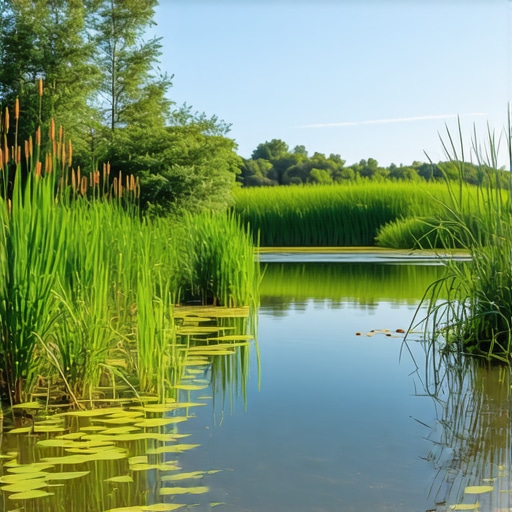
Master Pond Management: Using Native Plants for Biological Filtration in 2026
I always drill into my new crew members: if you don’t fix the soil grading first, every plant you put in the ground is just expensive compost. This is never truer than with pond construction. I’ve seen guys spend sixty grand on a custom backyard pond only to watch it turn into a stagnant, green swamp within three weeks because they didn’t understand the basic biology of nutrient loading. They think a bigger pump is the answer. It isn’t. You can’t out-pump bad biology. If the landscaping surrounding the water doesn’t account for runoff, or if the internal plant density is too low, you’re just circulating dirty water. Clear water in 2026 isn’t about chemicals; it’s about engineering a closed-loop system where native plants do the heavy lifting of nitrogen conversion. Stop looking for a magic bottle of algaecide. Start looking at your littoral shelf.
How do native plants keep pond water clear?
Native aquatic plants maintain water clarity by out-competing algae for essential nutrients like phosphorus and nitrogen, while their root structures provide a massive surface area for beneficial nitrifying bacteria. This biological filtration process, combined with UV shading from floating foliage, prevents the thermal spikes that trigger massive algal blooms. It is the only long-term, sustainable solution for clear water.
The Science of Nutrient Loading and Algae Suppression
Algae is an opportunist. It thrives on excess nitrates and phosphates that enter the water via irrigation runoff, decaying organic matter from a poor yard cleanup, or even fish waste. If you don’t have a higher-order plant species to consume those nutrients, the algae will. We call this nutrient loading. To prevent this, you need a biological density that mimics a natural wetland. Native plants are evolved specifically for your local water chemistry and temperature swings, meaning they hit their peak growth cycle exactly when the algae tries to take hold. They are the frontline soldiers in your pond’s defense. If you skip them, the algae wins. Every time.
“A pond is a living organism, not a static feature. The stability of its water quality is directly proportional to the diversity and health of its macrophyte population.” – Penn State Agricultural Extension
Aquatic Plant Selection for Optimal Bio-filtration
| Plant Category | Role in Ecosystem | Nitrate Uptake | Recommended Species (Generic US) |
|---|---|---|---|
| Emergent | Stabilizes banks, filters runoff | High | Pickerelweed (Pontederia cordata) |
| Submerged | Oxygenates water, hides fry | Extreme | Hornwort (Ceratophyllum demersum) |
| Floating | Blocks UV, cools water | Moderate | Fragrant Water Lily (Nymphaea odorata) |
How deep should I plant aquatic perennials?
Most native aquatic plants require specific depths to survive: marginal plants usually thrive in 2-6 inches of water, while submerged oxygenators need to be 12-24 inches deep. Planting a marginal species too deep will drown the crown, causing the plant to rot and actually increasing the nutrient load you are trying to reduce. Use a tiered shelf system during construction. This isn’t a sod install where everything is on one plane. You need architectural depth. Dig your littoral shelf at exactly 12 inches for optimal versatility. It makes a difference.
The Ground-Up Build: Engineering Your Pond for 2026
Successful pond landscaping begins long before the first shovel hits the dirt. You have to consider the hydrostatic pressure and the surrounding grade. If your yard slopes toward the pond, every rainstorm is going to dump nitrogen-rich lawn fertilizer into your water. That’s a death sentence for clarity. We always grade the perimeter so that irrigation and rainwater are diverted away from the pond basin. We use a 45-mil EPDM liner, but the real secret is the protective underlayment and the rock work. Don’t use limestone; it can jack your pH through the roof and kill your acid-loving natives. Use river rock or granite.
“The most common cause of retaining wall and pond edge failure is not the material itself, but the failure to manage hydrostatic pressure through proper drainage and compaction.” – ICPI Hardscape Standards
Substrate Density and Beneficial Bacteria
Your pond plants shouldn’t be in standard potting soil. That stuff is loaded with peat and fertilizers that will just leach into the water and feed the algae. You want a heavy, mineral-rich clay or specialized aquatic planting media. This holds the plant in place and forces the roots to pull nutrients directly from the water column rather than the soil. This is the definition of bio-filtration. The gravel you use to cover the pots also provides surface area for aerobic bacteria. These bacteria turn toxic ammonia into nitrites, then nitrates. The plants then eat the nitrates. It’s a perfect circle. If you disrupt this with