
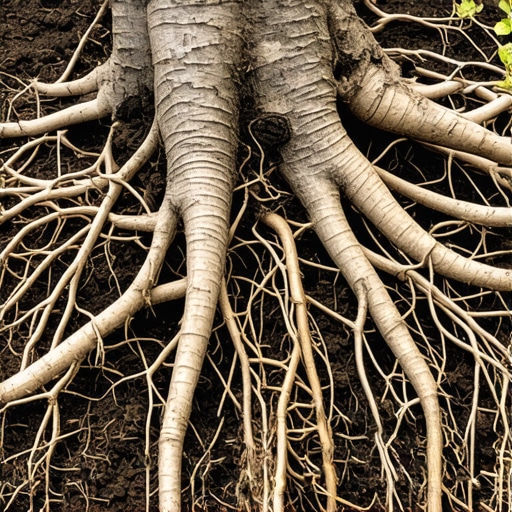
The Anatomy of a Dying Landscape: The Mulch Volcano Autopsy
Walk onto any high-end property where the landscaping looks ‘off’ and you will likely see it: the mulch volcano. It starts with a graying of the leaves in mid-July. Then, the bark at the base of the trunk begins to slough off in wet, smelly chunks. When I peel back that unnecessary pile of dyed hardwood, I find the cambium layer of the tree is literally rotting off. This is a root flare burial. It is a slow, expensive execution of a living asset. Proper mulching requires maintaining a 2 to 3 inch depth while ensuring the root flare remains visible to allow for critical gas exchange. Over-mulching creates anaerobic conditions that trap moisture against the bark, inviting phytophthora and girdling roots that will eventually choke the specimen to death. It is a structural failure of the most basic horticultural principle.
The Apprentice Lesson: Grading and Soil Health
I always drill into my new crew members: if you don’t fix the soil grading first, every plant you put in the ground is just expensive compost. Last season, we took over a site where a sod install had failed three times in two years. The homeowner kept hiring guys who just dumped more mulch and topsoil on top of a compaction layer that was as hard as a highway. I had to sit my lead foreman down and show him the soil probe. We weren’t just looking at dirt; we were looking at a hydrostatic nightmare. If the irrigation system is pumping 1 inch of water a week into a bed that has zero percolation, that mulch isn’t a blanket; it is a sponge for pathogens. We stripped the site to the sub-base, corrected the slope for drainage, and only then talked about mulch. It is about the soil microbiology, not just the aesthetic cover.
The Physics of Soil Respiration and Nitrogen Tie-Up
Effective soil management in 2026 hinges on understanding carbon-to-nitrogen (C:N) ratios and how mulch decomposition impacts the rhizosphere. When you apply high-carbon materials like fresh wood chips, soil microbes draw nitrogen from the surface to break down the wood, temporarily starving your perennials.
“A retaining wall doesn’t fail because of the stone; it fails because of the water trapped behind it.” – Hardscape Engineering Axiom
This same logic applies to mulch. If the layer is too thick, water cannot reach the irrigation sensors, and the soil beneath becomes hydrophobic. You end up with a yard that is bone dry two inches down even after a heavy rain. I have seen yard cleanup crews ignore this and just pile new mulch over the old, creating a thatch layer for the garden beds. It stops air. It stops water. It kills roots.
How much mulch do I actually need for a new planting?
For most USDA hardiness zones, a uniform layer of 2 to 4 inches of organic mulch is the professional standard for moisture retention and weed suppression. Heavy clay soils require a thinner 2-inch layer to prevent saturation, while sandy loams can handle up to 4 inches to combat rapid evaporation and nutrient leaching.
“Excessive mulch depth, especially against the trunk of woody plants, promotes adventitious root growth and trunk decay.” – Penn State Extension
Stop guessing. Use a ruler. If you go deeper than 4 inches, you are creating a habitat for voles and fungal gnats. Don’t do it.
What is the best mulch for weed suppression without chemicals?
To achieve maximum weed suppression without relying on pre-emergent herbicides, professionals use triple-shredded hardwood mulch or long-leaf pine straw applied after a thorough yard cleanup. These materials interlock, creating a physical barrier that prevents sunlight from reaching dormant weed seeds in the soil while allowing gaseous exchange for the root systems of your landscaping plants. Avoid mulch that contains large chunks, as these provide gaps where crabgrass and nutsedge can easily take hold. If you see weeds popping up through 3 inches of mulch, your soil pH or nutrient balance is likely off, favoring the weeds over your ornamentals.
The 2026 Material Standards: A Professional Comparison
Choosing a mulch isn’t about color; it’s about decomposition rates and soil chemistry. In my firm, we categorize materials by their microbial impact. Cedar mulch is excellent for pest resistance due to its natural oils, but it breaks down slowly and can lead to soil acidity over time. Pine bark nuggets are terrible for slopes because they float away during heavy irrigation cycles. Hemlock mulch is a premium choice for acid-loving plants but is often too expensive for large-scale landscaping. We use a Markdown Table to help clients understand the trade-offs before we start the sod install or bed preparation.
| Mulch Type | Decomposition Rate | Best Use Case | C:N Ratio Impact |
|---|---|---|---|
| Triple-Shredded Hardwood | Medium-Fast | Formal Garden Beds | High Nitrogen Draw |
| Pine Straw (Long Leaf) | Slow | Slopes / Acid Plants | Low Impact |
| Cedar Bark | Very Slow | Pest-Prone Areas | Minimal |
| Arborist Wood Chips | Medium | Native Screenings | High Initial Draw |
Remediation: The Step-by-Step Yard Cleanup Protocol
If you have mulch volcanoes or matted mulch, you need a forensic yard cleanup. It is hard work. It is dusty. But it is the only way to save your landscape investment. Follow this checklist before the 2026 growing season begins. Don’t skip the soil testing phase; knowing your NPK levels and pH is the difference between a pro job and a hack job. Use 811 / Dig Safe if you are doing any deep grading or irrigation repairs during this process.
- Excavate the Flare: Use a hand trowel or an Air Spade to find the root flare of every tree.
- De-Matt the Soil: Use a hard rake to break up hydrophobic layers of old, gray mulch.
- Edge the Beds: Cut a 3-inch deep Victorian edge to manage turf encroachment from the sod install.
- Inspect Irrigation: Ensure drip lines are on top of the soil but under the mulch layer.
- Apply Thinly: Spread new material at a depth of no more than 2 inches if old mulch is still present.
The Long-Term Maintenance Schedule
Once you have fixed the structural soil issues, the 2026 schedule is about vigilance. Check your mulch beds every month. If you see slime mold or artillery fungus, your mulch is staying too wet. This is usually a sign of over-irrigation or poor grading. Flip the mulch once in mid-summer to prevent matting. In the fall, do not just pile more on top. If the depth is still 2 inches, leave it alone. Your plants will thank you with vascular health and structural integrity. A healthy yard starts with the dirt. Respect the biology, or you will pay for the removal later. It is that simple. “