
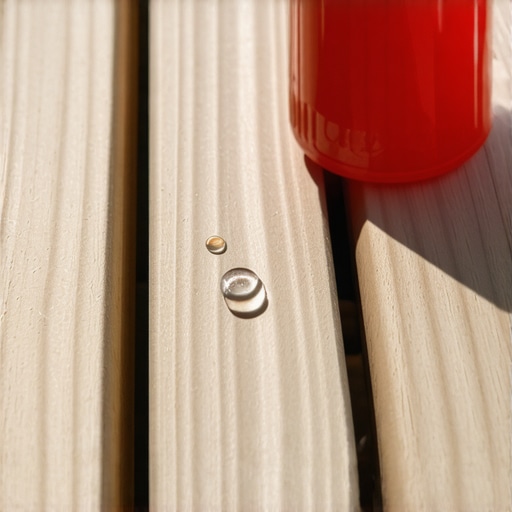
Why the Water-Bead Test is Your Only Defense Against Wood Rot
The water-bead test is a diagnostic protocol used to determine if a wood deck’s cellular structure is protected by a hydrophobic barrier or if it is currently absorbing moisture at a rate that leads to lignin failure. By placing small droplets of water on multiple boards, you are checking the interfacial tension of the wood surface; if the water remains as a distinct sphere, your sealant is functional, but if the water flattens and soaks in, the wood is exposed to fungal decay. It is a binary test. There is no middle ground.
I recently got called out to inspect a project that was less than three years old. The homeowner had spent $35,000 on a custom pressure-treated pine deck with a cedar rail system. The previous contractor, a classic ‘mow-and-blow’ hack who decided he was a carpenter for a weekend, had applied a thick, film-forming acrylic stain before the wood had dropped below 15% moisture content. The result? The wood couldn’t breathe. The moisture was trapped, and when I stepped on the first stair riser, my boot went straight through the stringer. It was a structural autopsy. The wood wasn’t just wet; it was fermented. This is why we don’t guess in this industry. We test.
How to Perform the Water-Bead Test Correcty
Don’t just throw a bucket of water on the deck. That’s amateur hour. You need a systematic approach. Take a dropper or a small spray bottle and test five distinct areas: the high-traffic path from the door, the areas under heavy furniture, the stairs, and the corners where yard cleanup debris often accumulates. Wait exactly sixty seconds. If the water remains beaded, your surface energy is high enough to repel rain. If it disappears into the grain, you are looking at a sod install-level project of stripping and resealing. It is a simple metric of physics. You cannot argue with gravity and surface tension.
“Wood moisture content must be below 19 percent for most coatings to adhere properly, as excessive internal moisture will cause film-forming finishes to blister and peel from the substrate.” – USDA Forest Products Laboratory Manual
The 2026 Structural Timber Reality: Why Old Rules Fail
The lumber we are getting in 2026 isn’t the old-growth heartwood your grandfather used. We are dealing with fast-growth plantation timber that is porous and prone to checking. This wood is thirsty. When you combine this with modern irrigation systems that frequently overspray onto the deck, you create a micro-climate of constant wet-dry cycles. This rapid expansion and contraction of wood fibers—known as hygroexpansion—will shred a cheap sealer in months. You need a professional-grade penetrating oil, not a hardware store wax. We’re looking for molecular bonding, not a plastic coat.
| Sealer Category | Surface Interaction | Typical Lifespan | Failure Mode |
|---|---|---|---|
| Film-Forming Acrylic | Coats the top surface | 1-2 Years | Peeling/Flaking |
| Paraffin Wax Bases | Temporary water barrier | 6 Months | UV Degradation |
| Penetrating Oils | Soaks into wood fibers | 3-5 Years | Fading (No Peeling) |
The Critical Link Between Yard Maintenance and Deck Life
Most homeowners don’t realize their landscaping choices are killing their deck. If your irrigation heads are hitting the rim joist every morning at 4:00 AM, you are essentially pressure-washing your sealer off. Furthermore, if your yard cleanup is non-existent and wet leaves are allowed to sit in the gaps between boards, you are creating a ‘compost sandwich.’ Those leaves hold moisture against the wood, facilitating the growth of Gloeophyllum trabeum, a brown-rot fungus that eats the cellulose and leaves the wood brittle. Keep your gaps clear. It is non-negotiable.
How much modified gravel do I need for a patio base?
While the focus here is decks, if your deck leads to a paver landing, the foundation is the same principle of engineering. For a standard residential application, you need a minimum of 6 inches of modified gravel (CR617 or 21A) compacted in 2-inch lifts. If you skip the compaction, the earth will move. It always moves. Hydrostatic pressure is the enemy of all hardscapes. Without a solid base and proper irrigation drainage, your patio will heave, and your deck footings will shift. Dig deep or don’t dig at all.
“Surface water must be diverted away from structural footings to prevent soil saturation, which significantly reduces the load-bearing capacity of the soil.” – International Code Council (ICC) Guidelines
The Advanced Sealing Checklist
- Check the 10-day forecast: You need 48 hours of dry weather before and 24 hours after application.
- Clean the wood: Use a sodium percarbonate cleaner, not straight bleach. Bleach kills the lignin.
- Test the moisture: Use a digital pin-meter. If it’s over 12%, put the brush down.
- Check the irrigation: Ensure no sprinklers will fire during the curing phase.
- Application: Apply until the wood stops ‘drinking,’ then back-brush the excess.
Common Pitfalls in Wood Preservation
Many ‘pros’ will tell you to power wash the deck at 3000 PSI. That is a crime. High pressure destroys the wood’s soft grain, leaving it ‘fuzzy.’ That fuzz is actually thousands of tiny wood fibers that have been torn loose. When you seal over them, the sealer attaches to the fuzz, not the board. Within a month, the fuzz falls off, and your sealer goes with it. Use a low-pressure wash and a stiff brush. It’s more work. Do it anyway. My crew knows that if I see a pressure washer nozzle closer than 12 inches to a deck board, they’re off the job. We are craftsmen, not vandals. The sod install you did last week won’t matter if your deck looks like a shredded wheat biscuit in six months.
Is a wood deck better than composite in 2026?
The industry is leaning toward composites, but for a purist, nothing beats the thermal properties of real wood. Composite decks get hot enough to cook an egg in the summer. Real wood, properly maintained with a water-bead test schedule, stays cool and looks better with age. The difference is the work. If you aren’t willing to do the yard cleanup and the bi-annual maintenance, buy the plastic boards. If you want a structural masterpiece, stick with timber and learn your chemistry. It will last. But you have to care.