
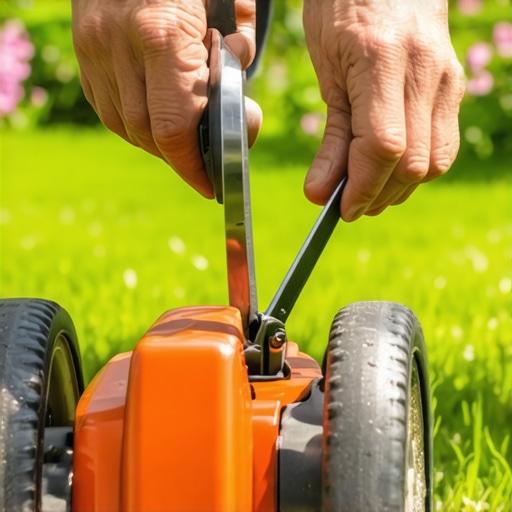
The Science of the Cut: Why Your Dull Blades Are Killing Your Lawn
Mower blade sharpening is the single most neglected aspect of residential turf management, yet it dictates the success of your entire landscaping strategy. A dull blade doesn’t cut grass; it hacks it, leaving behind a jagged, white, shredded tip that increases the surface area of the wound by up to 300%. This mutilation forces the plant to divert energy from root development to wound healing, leaving it vulnerable to pathogens. I always drill into my new crew members: if you don’t fix the soil grading first, every plant you put in the ground is just expensive compost, and if you don’t sharpen your steel, you’re just a glorified weed-wacker technician. I’ve seen $50,000 sod installs decimated in three weeks simply because the homeowner used a blade that hadn’t seen a grinder since the Ford administration. The vascular system of the grass blade is a hydraulic marvel; when you tear it, you effectively cause the plant to bleed out its moisture, requiring your irrigation system to work twice as hard to compensate for the man-made drought. If you want a dark green lawn in 2026, stop looking at fertilizer bags and start looking at your mower’s underside.
“A clean cut is the primary defense against turfgrass disease; ragged edges provide an entry point for fungal spores and increase moisture loss through transpiration.” – Penn State Center for Turfgrass Science
The Physics of Turf Mutilation
Dull mower blades cause necrotic tissue damage that manifests as a tan or whitish haze across the lawn surface approximately 24 hours after mowing. This isn’t a nutrient deficiency; it is a mechanical failure. When a blade is sharp, it shears the leaf blade with minimal impact. When it’s dull, it relies on centrifugal force to bash through the cellulose. This impact shatters the cell walls.
| Feature | Sharp Blade (30° Bevel) | Dull/Nicked Blade |
|---|---|---|
| Recovery Time | 12-24 Hours | 48-92 Hours |
| Water Retention | High (Minimal Leakage) | Low (Rapid Desiccation) |
| Fungal Resistance | Strong (Closed Wound) | Weak (Open Lesion) |
| Fuel Efficiency | 15% Better | Baseline |
How much modified gravel do I need for a patio base?
While often asked during a yard cleanup or hardscape planning, the answer for a standard 4-inch compacted base is roughly 1 ton of modified gravel (2A or CR617) per 50 square feet. This same principle of structural integrity applies to your mower deck. A clogged deck with poor airflow won’t stand the grass up straight, leading to an uneven cut regardless of blade sharpness. You need high-velocity air movement to lift the blades before the steel makes contact. If your deck is caked with old yard cleanup debris, your blade won’t matter.
The 2026 Sharpening Protocol: Beyond the Bench Grinder
For the 2026 season, we are moving away from the ‘razor-sharp’ myth. A razor edge is too thin; it rolls over the first time it hits a stray pebble or a thick clump of fescue. You want a 30-degree bevel with the thickness of a butter knife at the very tip. This provides the mass necessary to maintain momentum through high-density turf without chipping. Use a 60-grit flap disc on an angle grinder rather than a stationary bench grinder to avoid overheating the steel. If the metal turns blue, you’ve lost the temper. It’s now junk. It will stay sharp for about ten minutes before the softened steel folds.
- Check for Balance: Use a wall-mounted balancer, not a nail in the wall. A blade out of balance by even 2 grams will destroy your spindle bearings at 3,000 RPM.
- Inspect the Lift: The ‘sail’ or ‘wing’ of the blade wears down over time. If the wing is thin, your irrigation-fed grass will just get pushed over rather than cut.
- The Nickel Test: The edge should be about the thickness of a nickel before the final hone.
- Safety First: Always pull the spark plug wire. I’ve seen engines kick back and take fingers off. No exceptions.
“Blade balance is critical; an unbalanced blade rotating at high speeds creates harmonic vibrations that lead to premature failure of the crankshaft and deck housing.” – Small Engine Mechanics Standards (ICPI Adjacent)
How soon should I mow a new sod install?
A new sod install should generally be mowed for the first time 10 to 14 days after installation, provided the roots have knitted into the soil. You must use a freshly sharpened blade for this first cut. Because new sod is often highly pushed with nitrogen from the farm, the blades are succulent and heavy with water. A dull blade will snag the entire piece of sod and rip it right off the ground, destroying your $10-per-yard investment in a second. Set your height to the highest setting and ensure your irrigation has been off long enough for the soil to be firm underfoot. Yard cleanup after this first cut is essential; don’t leave heavy clumps of clippings to smother the new crowns.
The Correlation Between Cut Quality and Irrigation Efficiency
Most homeowners believe they have a ‘dry spot’ and turn up their irrigation timers, when in reality, they have a ‘dull blade spot.’ Shredded grass tips lose moisture at an exponential rate. By maintaining a clean cut, you can often reduce your supplemental watering by 15-20%. This is landscaping engineering at its finest—optimizing the biology of the plant to reduce resource inputs. When we perform a professional yard cleanup, we don’t just rake leaves; we inspect the turf for these microscopic signs of mechanical stress. If the tips are white, the blade is dull. It’s a binary reality. Don’t be a ‘mow-and-blow’ hack. Respect the plant, respect the tool, and the lawn will reward you with a density that chokes out weeds naturally, reducing your chemical dependency.