
Stabilizing 2026 Steep Banks with Riprap Stone: A Professional Engineering Guide
I have spent twenty years in the dirt, and if there is one thing I have learned, it is that gravity never sleeps. Most homeowners and ‘mow-and-blow’ outfits look at a steep bank and see a landscaping problem. I look at it and see a structural failure in progress. When you are dealing with a 2026-level gradient, you are not just ‘beautifying’ a yard; you are engaging in civil engineering. I recently stood at the bottom of a 45-degree slope looking at a pile of $15,000 worth of round river stone that had washed into a client’s pool after a single summer storm. The previous contractor had used smooth stones on a steep incline without a toe trench or filter fabric. It was a textbook case of incompetence. The stones had no interlocking friction, acting more like ball bearings than a stabilization layer. We had to haul it all out by hand and start from the subsoil up. That is the cost of doing it wrong.
The Physics of Slope Failure and Hydrostatic Pressure
Stabilizing a steep bank requires managing hydrostatic pressure and soil shear strength through the strategic placement of angular riprap stone. To succeed, a contractor must account for the angle of repose and install a non-woven geotextile filter that allows water to escape while trapping fine soil particles.
[IMAGE_PLACEHOLDER]
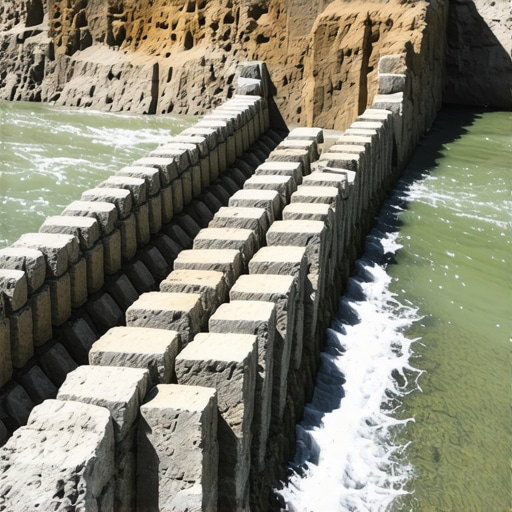
Most people think the stone is there to look heavy. It is actually there to dissipate the energy of moving water and to provide a physical weight that counters the internal pressure of the soil. When soil becomes saturated, the water trapped between the particles pushes them apart, reducing friction and causing a slide. Riprap works by creating a ‘heavy blanket’ that holds the face of the slope in place. But you cannot just throw stone on dirt. You have to address the ‘hydraulic jump’ at the bottom of the slope. If you do not install a proper ‘toe’—a trench at the base of the bank where the first layer of heavy stone is buried—the entire mass will eventually slide down the hill like a carpet on a hardwood floor. We dig our toe trenches at least 24 inches deep and 3 feet wide, depending on the height of the bank. This keys the riprap into the stable earth below the frost line.
Selecting the Correct Riprap Gradation for 2026 Standards
For effective bank stabilization, professionals select stone gradations based on the expected water velocity and slope ratio, typically choosing R-4 or R-5 angular limestone. These stones must have fractured faces to ensure they interlock, creating a cohesive mass that resists movement better than rounded river rock.
| Stone Grade | Median Size (D50) | Typical Application | Weight Range (lbs) |
|---|---|---|---|
| R-3 | 6 inches | Low-flow channels, minor slopes | 10 – 25 |
| R-4 | 12 inches | Moderate slopes, standard banks | 25 – 150 |
| R-5 | 18 inches | High-velocity areas, steep banks | 150 – 500 |
| R-7 | 24+ inches | Riverbanks, heavy engineering | 500 – 2000 |
The table above shows the difference between ‘decorative’ stone and ‘engineering’ stone. If you are stabilizing a bank that drops more than 3 feet over a 6-foot horizontal run, you are at a 2:1 slope. At this grade, R-3 stone is useless. It is too light and will be displaced by the first heavy rain. You need the mass of R-4 or R-5. Furthermore, the shape of the stone is non-negotiable. I have seen guys try to use ‘clean’ round gravel for these jobs. Round stones do not interlock. They roll. You need angular, crushed stone. When these sharp edges press against each other, they create friction that prevents individual stones from being ‘plucked’ out of the matrix by runoff. This is the difference between a permanent fix and a yearly headache.
“Riprap is a permanent, erosion-resistant ground cover of large, loose, angular stone used to protect soil from concentrated runoff.” – Pennsylvania DEP Erosion and Sediment Pollution Control Manual
How much riprap do I need for a steep bank?
Calculating riprap volume is a matter of cubic yardage based on the surface area and the thickness of the stone layer, which should be at least twice the D50 stone diameter. For a standard R-4 installation, you are looking at a minimum depth of 18 to 24 inches to ensure full coverage and structural weight.
The Invisible Foundation: Non-Woven Geotextiles
A critical component of bank stabilization is the geotextile fabric layer, which acts as a separation and filtration barrier between the raw soil and the riprap stones. This fabric prevents the piping of fines, where water flowing behind the stones washes away the soil, eventually causing the riprap to cave in.
Do not use the cheap, woven plastic ‘weed barrier’ you find at big-box stores. That stuff is for flower beds, not engineering. You need a 4-ounce or 6-ounce non-woven needle-punched geotextile. This material looks like felt. It allows water to pass through every square inch of its surface while stopping even the smallest grains of silt. If the water cannot get out from behind the stone, the pressure will build until the entire bank ‘blows out.’ We overlap our fabric seams by at least 18 inches and pin them down with 12-inch steel staples. This ensures that as the stone settles—and it will settle—there are no gaps where soil can escape. It is a one-way valve for water and a permanent wall for soil.
What is the best stone for erosion control on slopes?
The best stone for erosion control is angular, dolomitic limestone or granite because of its high density and fractured edges. Avoid soft stones like sandstone or shale, which will weather and crack over a few seasons, reducing the overall mass and stability of the riprap installation.
The Installation Checklist: Benchcutting and Keying
Installing riprap is a methodical process that requires heavy machinery and a precise sequence of operations. You cannot skip the preparation of the subgrade. If the bank is particularly steep, we use a technique called benchcutting, where we cut small ‘steps’ into the slope before laying the fabric. This gives the stone a flat surface to sit on, further reducing the downward gravitational pull. Use the following checklist for your 2026 project:
- Survey and Utility Mark: Always call 811. Irrigation lines and gas pipes often run near banks.
- Slope Grading: Remove all vegetation and organic debris. Roots rot and leave voids.
- Toe Trench Excavation: Dig a trench at the base of the slope to ‘key’ the first layer of stone.
- Fabric Placement: Lay non-woven geotextile, starting from the bottom and overlapping towards the top.
- Stone Placement: Place stones starting at the toe and working up. Never ‘dump’ stone from the top; it will tear the fabric.
- Vibration and Seating: Use a machine bucket to firmly press the stones into the fabric and each other.
“The stability of a riprap lining depends on the size, shape, and weight of the stones, as well as the filter layer beneath them.” – USDA Natural Resources Conservation Service
Integrating Sod and Irrigation with Riprap Buffers
Once the riprap is in place, the top of the bank must be managed to prevent water from ‘diving’ under the fabric. This is where sod installation and irrigation management come into play. You want a thick, deep-rooted turf like Kentucky Bluegrass or a tall fescue blend right at the edge of the stone. This acts as a natural filter and slows down the water before it hits the riprap. However, you must be careful with irrigation. Over-watering the top of a stabilized bank is a recipe for disaster. We always adjust the irrigation zones to ensure the slope receives 30% less water than the flat lawn. You want the roots to grow deep into the soil to seek moisture, which actually helps knit the bank together. Excess water just adds weight and increases hydrostatic pressure. If you are doing a yard cleanup, ensure you are not blowing leaves and organic matter into the riprap. That material will rot, turn into soil, and allow weeds to grow between your stones, eventually compromising the interlocking friction that keeps the bank stable. It is a system. The stone, the fabric, the soil, and the plants must work together. Anything less is just a pile of rocks.