
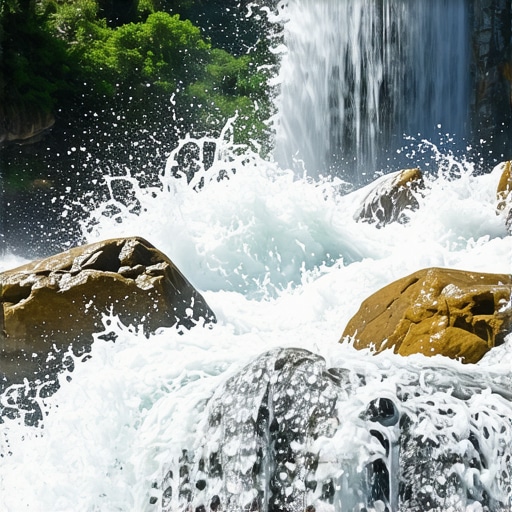
The Hardscape Autopsy: Why Your Waterfall is Bleeding Water
To stop waterfall splashing, you must install graduated cobbles and deflection boulders that break surface tension before water leaves the containment liner. High-velocity GPH pumps require a deeper catch basin and hydrostatic barriers to prevent soil erosion and hardscape settling over time.
I recently got called out to tear up a $30,000 patio that was sinking because the previous contractor installed a 4-foot waterfall without a splash skirt. The water was jumping the liner, saturating the modified gravel base, and turning the subgrade into soup. Within two seasons, the pavers looked like a topographic map of the Rockies. This isn’t just about aesthetics; it is about engineering. Water is a solvent. It is persistent. If you do not control the splash, the water will control your foundation. Most homeowners think they have a leak in the liner when, in reality, they have a kinetic energy problem. The water hits a flat rock at 15 miles per hour and atomizes. Those micro-droplets drift. Over eight hours of pump time, you lose 50 gallons. That is not evaporation; it is structural negligence.
“A retaining wall doesn’t fail because of the stone; it fails because of the water trapped behind it.” – Hardscape Engineering Axiom
Fix 1: The Kinetic Deflector Boulder
The kinetic deflector boulder is a primary igneous stone placed at the impact point to disrupt the laminar flow of falling water. By using a convex surface, you force the water to wrap around the stone rather than bouncing off it, effectively keeping the splash zone within the EPDM liner boundaries.
Stop using flat slate for your splash rocks. Flat rocks are the enemy. When water hits a flat surface, the energy has nowhere to go but out. You need a rounded or angled boulder with a high density. I prefer basalt or granite. These stones have a high specific gravity, meaning they won’t migrate under the constant pressure of a 3,000 GPH flow. Place the deflector rock so it sits exactly where the main ‘tongue’ of the falls hits the basin. The goal is to turn the vertical drop into a horizontal slide. This reduces the PSI hitting the water surface in the basin, which stops the ‘burping’ effect that sends water over the edges.
How much modified gravel do I need for a patio base?
If you are fixing a waterfall that has already damaged your hardscape, you need a minimum of 6 inches of compacted 21A or 3/4-inch modified gravel. For every 100 square feet, you are looking at approximately 2.5 tons of material. Don’t skip the plate compactor. A hand tamper is a toy. If the base isn’t at 98% Proctor density, your waterfall fixes won’t matter because the ground will move again.
Fix 2: The Graduated Cobble Armoring System
Graduated cobble armoring utilizes varied stone diameters (from 2-inch pebbles to 8-inch river rocks) to create a porous matrix that traps splash-back. This system mimics natural stream beds and uses void spaces to swallow water droplets before they can migrate toward the perimeter landscaping.
Think of this as a silencer for your water. If you have a single layer of rocks, the water hits the hard surface and bounces. If you have three layers of varying sizes, the water falls into the gaps. It gets trapped in the ‘interstitial spaces.’ This is where biology meets engineering. Those spaces also provide surface area for nitrifying bacteria, which helps your water quality. You want a mix. Start with 6-to-9-inch cobbles at the bottom, fill the gaps with 2-to-3-inch river stones, and top it off with a handful of 1-inch gravel. This creates a jagged, uneven surface that kills the water’s momentum. It will not splash. It cannot splash.
| Stone Material | Density (lbs/ft3) | Porosity | Splash Mitigation Rating |
|---|---|---|---|
| Basalt Cobble | 180 | Very Low | 9/10 |
| Limestone Slate | 150 | Medium | 3/10 |
| River Rounded Granite | 165 | Low | 8/10 |
| Lava Rock | 85 | High | 1/10 (Too light, will float) |
Fix 3: The Liner Overhang and Shingle Method
The shingle method involves overlapping liner segments and flat capstones so that any capillary action or wicking is directed back into the reservoir. This gravity-fed design ensures that even if water splashes, it hits a non-porous barrier and returns to the recirculation system.
I see guys trying to ‘glue’ their way out of splash problems with pond foam. Foam is a temporary fix; gravity is permanent. You need to shingle your rocks like a roof. The rock above must always overhang the rock below. This creates a ‘drip edge.’ If your waterfall rock is flush with the liner edge, water will find its way behind the liner through capillary action. It will suck the pond dry. I always tell my crew: if you can’t see the liner tucked behind the rock, you’ve built a leak. You need at least 2 inches of overhang. This forces the water to drop vertically rather than crawling backward. It is basic physics. Ignore it, and you will be doing a yard cleanup every month to fix the mud holes you’ve created.
“Effective water feature design requires a minimum 2:1 ratio of basin width to waterfall height to contain 98% of splash-off during high-velocity flow rates.” – Pond Contractors Association Standard
How do I stop sod from dying near a waterfall?
The most common cause of death for sod install projects near water features is hydrostatic saturation. If your waterfall splashes, the soil stays anaerobic, and the roots rot. You must fix the splash first, then ensure the soil grading slopes 2% away from the pond. Use a fescue blend for durability, but keep it out of the splash zone. Standing water on sod is a death sentence.
The 2026 Maintenance Checklist
Landscaping isn’t a ‘set it and forget it’ deal. It’s a living system. Every spring, you need to get in there and check your rock positions. Ice heaves stones. Animals move them. The 2026 standard for water features requires a proactive approach to irrigation and drainage. If your irrigation heads are hitting your waterfall, you’re overfilling the basin and causing more splash. Sync your systems.
- Inspect the ‘tongue’ of the waterfall for stone shifting after the first thaw.
- Check the GPH output; if the pump is too strong for the basin, install a ball valve to throttle flow.
- Remove any ‘mulch volcanoes’ near the liner that might be wicking water out.
- Verify that the 811 markers from your original install are still clear before any yard cleanup digging.
- Clean the bio-falls filter mats to prevent back-pressure overflows.
It will rot. That is what happens when you let water sit against your foundation or under your pavers because of a ‘pretty’ waterfall. Do the engineering now. Fix the stones. Control the velocity. A waterfall should be a closed-loop system, not a slow-motion flood of your backyard. Don’t be the homeowner who calls me in three years to tear it all out. Compaction, density, and geometry—those are the tools of a master landscaper, not a garden hose and a dream. Get the rock sizes right, and your 2026 season will be about enjoying the sound of water, not the sound of a shop vac sucking out your flooded basement.